
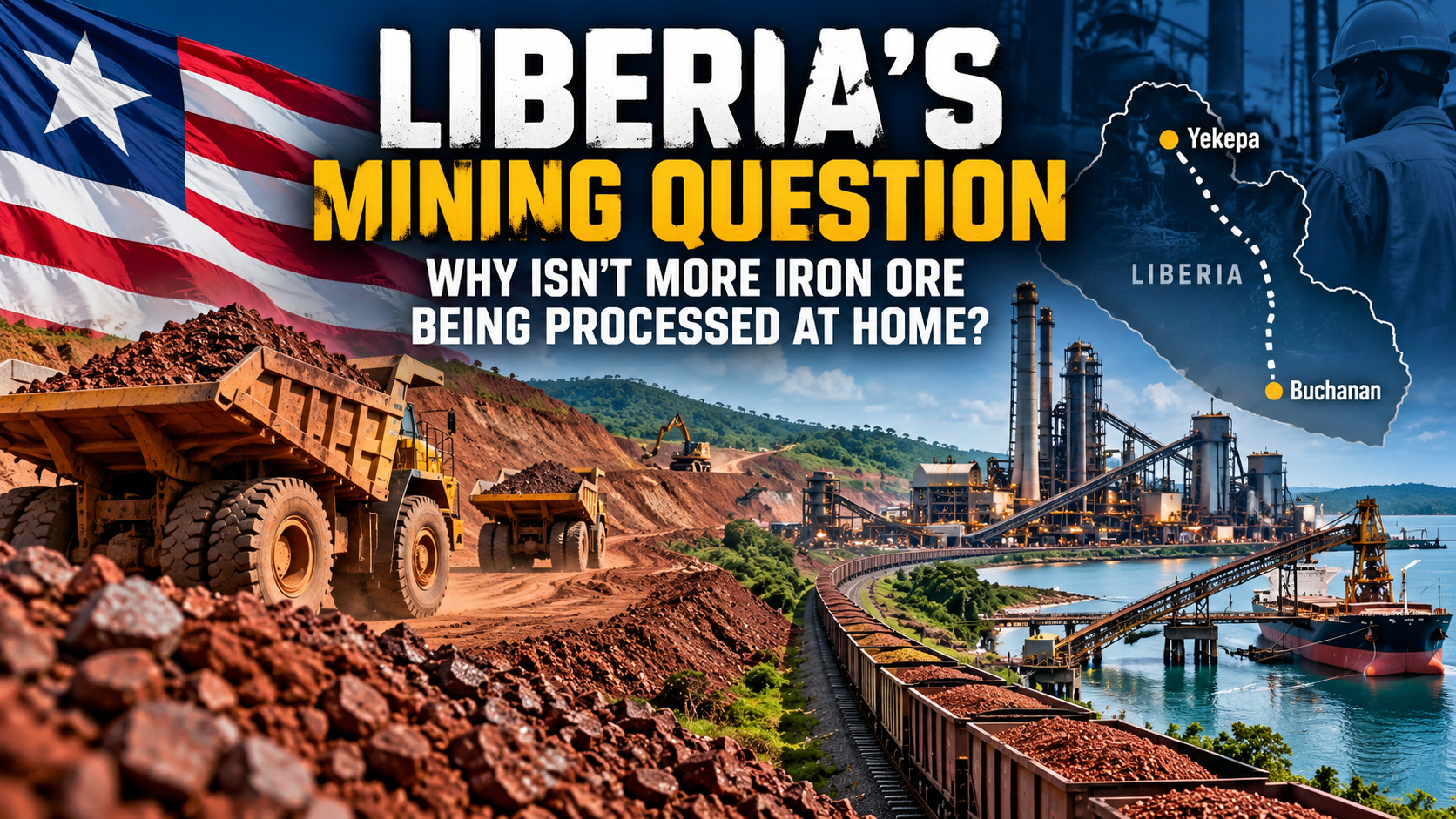
Liberia has some of West Africa’s most significant iron-ore resources, yet a fundamental question continues to shape the country’s mining debate: Why is Liberia still exporting so much of its mineral wealth in relatively unprocessed form?
The question has become increasingly relevant as large concession companies continue to play a central role in Liberia’s mining sector. Among the most prominent is ArcelorMittal, the global steel and mining company whose operations in Liberia have focused primarily on the extraction, processing and export of iron ore.
From Mineral Extraction to Industrial Development
Liberia’s mining industry has historically been structured around the export of raw materials. Iron ore is extracted, processed to the extent necessary for export, transported through the country’s infrastructure and shipped to international markets.
Critics argue that this model leaves Liberia capturing only a portion of the potential economic value of its mineral resources.
The greater opportunity, they contend, would be to move further along the industrial value chain—developing facilities capable of producing higher-value iron and steel products inside Liberia.
Such a transformation could potentially create new manufacturing jobs, expand technical skills, increase government revenues and stimulate supporting industries ranging from transportation and engineering to construction and energy.
ArcelorMittal’s Role
ArcelorMittal has operated in Liberia for more than two decades and remains one of the country’s most important mining investors.
Its Liberian operations have centered on the extraction and processing of iron ore for export rather than the manufacture of finished steel products.
That distinction is at the heart of the debate.
ArcelorMittal is itself one of the world’s largest steel producers, but Liberia has not yet developed an integrated steel-manufacturing industry comparable to the scale of the country’s mineral resources.
The issue therefore goes beyond one company. It raises a broader question about the structure of Liberia’s concession economy and whether future agreements should require greater domestic processing and industrial development.
Who Captures the Value?
Mining creates economic activity even when minerals are exported in processed or semi-processed form. Companies invest in infrastructure, employ workers, pay taxes and royalties, purchase local services and contribute to government revenues.
But the economic value of a mineral can increase substantially as it moves through additional stages of processing and manufacturing.
For Liberia, that creates a strategic policy question:
Should the country remain primarily an exporter of minerals, or should it use those resources as the foundation for a domestic industrial economy?

A stronger value-addition strategy could include mineral processing, steel production, fabrication, engineering services and manufacturing.
Such an approach would require more than simply asking mining companies to build factories. Liberia would need reliable electricity, transportation infrastructure, skilled labor, industrial financing, appropriate regulation and access to regional and international markets.
The Buchanan–Yekepa Corridor
The debate is also connected to Liberia’s railway infrastructure.
The historic railway linking the mineral-producing areas of northern Liberia with Buchanan provides an important potential industrial corridor. Rather than serving exclusively as a route for exporting iron ore, policymakers and investors could view the corridor as part of a broader economic-development strategy connecting mines, processing facilities, manufacturing operations and the port.
This is why discussions surrounding the future of the Buchanan railway have significance beyond transportation.
A modern, multi-user rail system could potentially support mining, agriculture, manufacturing and other commercial activity while helping connect inland production to Liberia’s coastline.
Liberia’s Industrial Choice
The central issue is not whether foreign mining companies should operate in Liberia. Foreign investment has played an important role in developing the country’s mining sector.
The more fundamental question is how Liberia structures those investments to maximize long-term national benefits.
Mining concessions can generate immediate revenues and employment. Industrialization, however, can create deeper economic linkages that continue to generate value after a mineral leaves the ground.
Liberia therefore faces a strategic choice: continue relying heavily on the export of mineral commodities, or use its natural resources as the foundation for a broader industrial transformation.
The country’s iron ore wealth gives Liberia an opportunity.
The challenge is turning that geological wealth into lasting domestic economic value.
For policymakers, the conversation should move beyond how much ore Liberia can export and toward a more consequential question:
How much of the value created from Liberia’s minerals can actually remain in Liberia?
Leave a Reply