
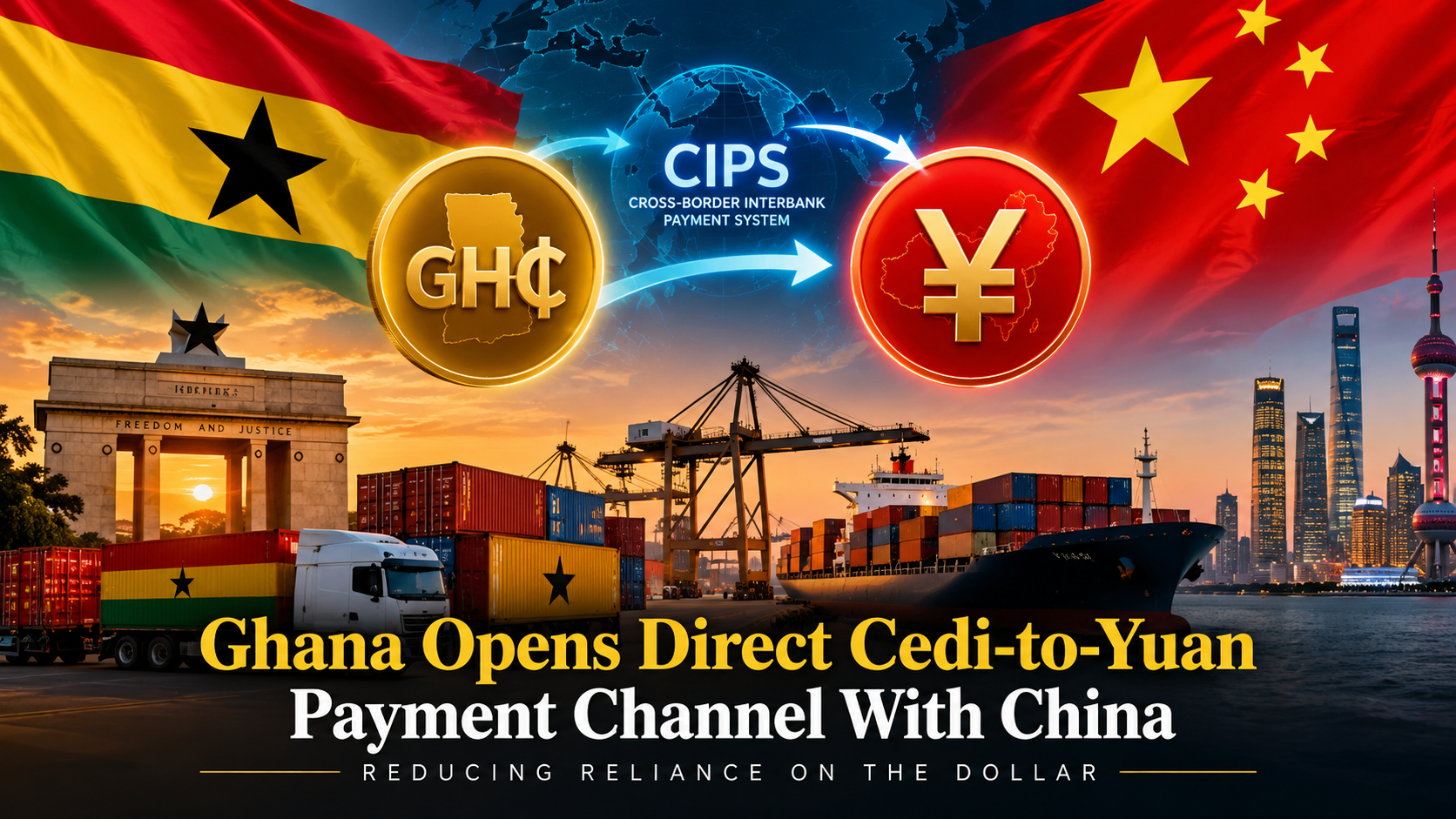
ACCRA, GHANA — Ghana has introduced a new direct payment mechanism allowing local businesses to settle trade transactions with Chinese companies using the Ghanaian cedi and Chinese yuan, creating an alternative to the traditional dollar-based pathway for Ghana-China commerce.
The initiative, announced by Bank of Ghana Governor Dr. Johnson Pandit Asiama, connects Ghanaian payments to China’s Cross-Border Interbank Payment System (CIPS), China’s infrastructure for international yuan transactions.
Under the arrangement, Ghanaian importers can initiate payments from their domestic cedi accounts while Chinese exporters receive settlement in yuan. The system is designed to reduce the need for businesses to first convert cedis into US dollars before completing a transaction with a Chinese supplier.
A New Route for Ghana-China Trade
For years, much of Africa’s international trade has relied heavily on the US dollar as an intermediary currency. Even when neither the buyer nor seller is based in the United States, dollar clearing has frequently been part of the transaction chain.
The Ghana-China arrangement introduces another route.
The change could be particularly relevant for Ghanaian companies importing machinery, electronics, vehicles, industrial equipment, textiles and other goods from China.
Stanbic Bank Ghana Leads the Pilot
The mechanism is currently being piloted by Stanbic Bank Ghana, while Ghana Commercial Bank is preparing to introduce a similar service.
According to the announcement, the new payment channel can reduce settlement times to approximately the next business day while also lowering some of the foreign-exchange conversion costs associated with conventional transactions.
For smaller businesses, faster settlement and reduced transaction costs could make a meaningful difference, particularly for companies operating on tight margins or managing frequent imports.
The Dollar Is Not Being Replaced
The development should not be interpreted as Ghana abandoning the US dollar or the international banking system.
Traditional payment channels, including SWIFT and US-dollar clearing, remain available.
Rather, Ghana is adding another option to its international payments infrastructure.
That distinction is important. Businesses will still be able to select payment arrangements according to their suppliers, banks, currencies, pricing agreements and risk-management requirements.
The yuan channel simply gives Ghanaian companies another tool.
Why China Matters to Ghanaian Trade
China is one of Ghana's most important commercial partners, making the ability to settle transactions directly in yuan strategically significant.
A direct local-currency-to-yuan mechanism could help Ghanaian businesses manage currency exposure while potentially reducing the number of conversions required during a transaction.
It also strengthens the financial infrastructure supporting bilateral trade.
For Beijing, expanding yuan-based settlement across African markets supports the international use of China's currency. For African economies, establishing alternative payment corridors can provide greater flexibility in international commerce.
Beyond Imports: Building a Two-Way Trade Corridor
The significance of the arrangement extends beyond Ghanaian imports from China.
A functioning payment corridor could also facilitate Ghanaian exports to the Chinese market.
That creates the possibility of a more balanced commercial relationship in which the same financial infrastructure supports both directions of trade.
Ghana's exporters could potentially benefit from easier yuan settlement when selling commodities, agricultural products, processed goods and other products to Chinese buyers.
The broader objective is therefore not simply to make it easier to buy Chinese goods. It is to develop financial infrastructure capable of supporting a larger two-way Ghana-China trading relationship.
Africa's Search for More Flexible Financial Infrastructure
Ghana's move comes amid a broader push across Africa to diversify trade relationships, payment systems and currency arrangements.
China's expansion of yuan settlement infrastructure is part of that transformation.
Beijing has also announced zero-tariff treatment for eligible products from 53 African countries, further strengthening the potential commercial relationship between China and African exporters.
Payment infrastructure and trade policy can reinforce each other: preferential market access becomes more useful when businesses have efficient mechanisms for getting paid.
For African economies, the larger question is whether these developments can translate into increased exports, stronger domestic production and better terms for African businesses.
What Ghana's New System Could Mean
The direct cedi-to-yuan mechanism could provide Ghanaian businesses with several potential advantages:
- Fewer currency conversions for eligible China-related transactions
- Potentially lower foreign-exchange costs
- Faster payment settlement
- Greater choice beyond dollar-based settlement
- Improved infrastructure for Ghana-China trade
- Potential support for Ghanaian exporters to China
However, the system does not eliminate foreign-exchange risk. Businesses will still be exposed to movements between the cedi and yuan, and the practical cost of transactions will depend on bank pricing, exchange rates and the structure of individual trade agreements.
A Strategic Financial Shift
Ghana's new payment corridor represents more than a banking-product upgrade.
It is part of a larger evolution in how African economies interact with global markets.
The continent has traditionally operated within financial systems heavily influenced by the dollar, European banking networks and international correspondent banks. The emergence of additional payment corridors — including yuan-based systems — gives African businesses more options.
For Ghana, the immediate test will be whether the new mechanism moves beyond a pilot and becomes a widely used commercial channel.
If adoption expands, the cedi-to-yuan corridor could become an important component of Ghana's trade infrastructure with China — while providing a model for other African economies seeking more diversified international payment options.
Panafrican.email will continue tracking how Ghana's new payment system develops and what it means for African trade, banking and economic sovereignty.
Leave a Reply