

The Woman Who Held Malcolm X
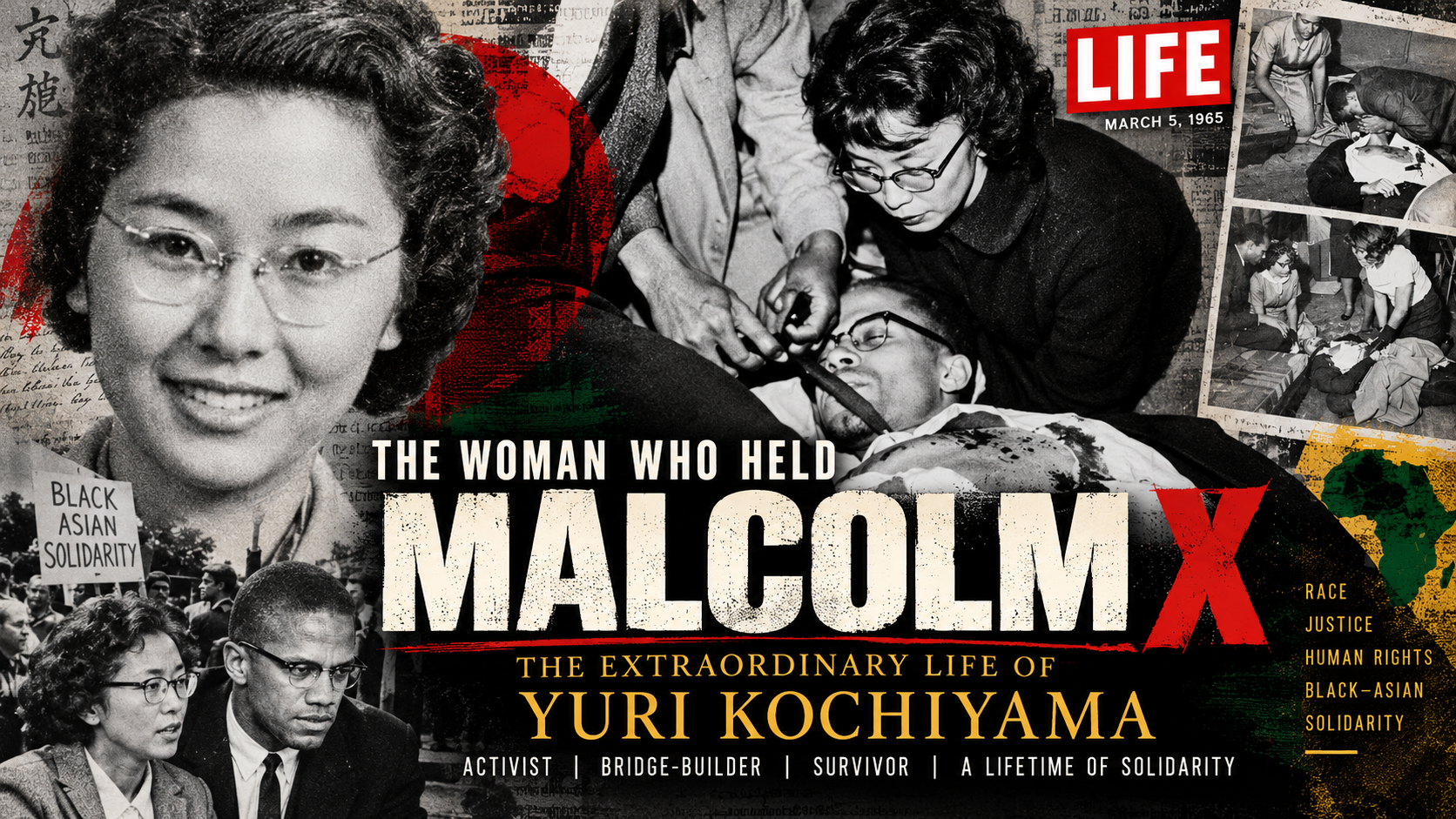
The photograph became one of the enduring images associated with the death of Malcolm X: a Japanese American woman kneeling beside the wounded leader at Harlem’s Audubon Ballroom, cradling his head in her lap. Her name was Mary Yuriko Nakahara — known to the world as Yuri Kochiyama.
She was not a stranger who happened to wander onto the stage. Kochiyama had already become part of Malcolm X’s political circle. She had met him in 1963, joined the educational work of his Organization of Afro-American Unity, hosted him at her Harlem home in 1964, and continued organizing after his assassination.
The photograph
The archival record maintained by CORE NYC identifies the photograph’s source as LIFE magazine, March 5, 1965, and lists LIFE Magazine as the rights holder. TIME likewise identifies the photographer as Earl Grant, a close associate of Malcolm X.
Before Malcolm X: a life shaped by incarceration
Born May 19, 1921, in San Pedro, California, Kochiyama grew up in a Japanese American family. Her political consciousness changed dramatically during World War II, when the U.S. government forcibly removed and incarcerated Japanese Americans, including her family.
That experience became part of the foundation of her later activism. She came to understand racism and state power not as abstract ideas, but as forces that could enter an ordinary family’s life and alter its future.
Meeting Malcolm X
In 1963, Kochiyama met Malcolm X after she was arrested during a protest demanding construction jobs for Black and Puerto Rican workers. She initially challenged him on his views about integration. Instead of dismissing her, Malcolm invited her to attend the Liberation School associated with the Organization of Afro-American Unity.
Malcolm X came to the Kochiyama home
On June 6, 1964, Kochiyama hosted Malcolm X at her Harlem home to meet Japanese journalists and Hiroshima-Nagasaki atomic-bomb survivors traveling with a world peace study mission. The meeting brought Black liberation and Japanese anti-war activism into the same room.
It was a glimpse of the increasingly international framework of Malcolm X’s politics — and of Kochiyama’s own growing commitment to solidarity across communities.
February 21, 1965
Kochiyama and her oldest son were in the audience when Malcolm X was assassinated at the Audubon Ballroom. In the chaos that followed the gunfire, she moved toward Malcolm and placed his head in her lap.
The resulting photograph appeared in LIFE. For decades, however, the woman in the picture was frequently presented without her name. UCLA’s Asian American Studies Center notes that the photograph is the only known image of Yuri and Malcolm together and that the original LIFE publication did not identify her or acknowledge the Asian American presence at Malcolm’s talk.
Her life after Malcolm
The photograph could have become the final chapter of Kochiyama’s story. Instead, it became one chapter in a life of organizing.
She worked on political-prisoner campaigns, Japanese American redress and reparations, anti-war activism, ethnic studies and Black–Asian solidarity. Her own wartime incarceration experience remained a powerful reference point in her political thinking.
A timeline of solidarity
San Pedro, California.
The experience becomes a defining part of her later political consciousness.
After a protest arrest, she encounters Malcolm and begins attending OAAU educational sessions.
He meets Japanese journalists and Hiroshima-Nagasaki peace activists.
The historic photograph of Kochiyama cradling Malcolm’s head is taken.
Her legacy continues through Black, Asian American and human-rights movements.
Listen to Yuri in her own voice
Historical photographs tell us what happened visually. Oral history lets us hear how the people involved remembered it. Densho’s archive preserves Kochiyama’s recorded recollections, including her memories of meeting Malcolm X.
Why the story matters
Kochiyama’s life complicates the way American history is often divided into separate movements. Black liberation, Asian American activism, anti-war organizing, Japanese American redress and political-prisoner campaigns were not isolated worlds. People moved between them, learned from one another and built alliances.
For African and diasporic readers, the story offers another example of solidarity that crossed ethnic and national boundaries. Kochiyama did not become Black to support Black liberation. She brought her own experience of racial injustice into a broader struggle for human freedom.
That is why the photograph matters — but it is also why the photograph is not enough.
Primary sources & further reading
Leave a Reply