
By Panafrican.email News Desk
October 3, 2026
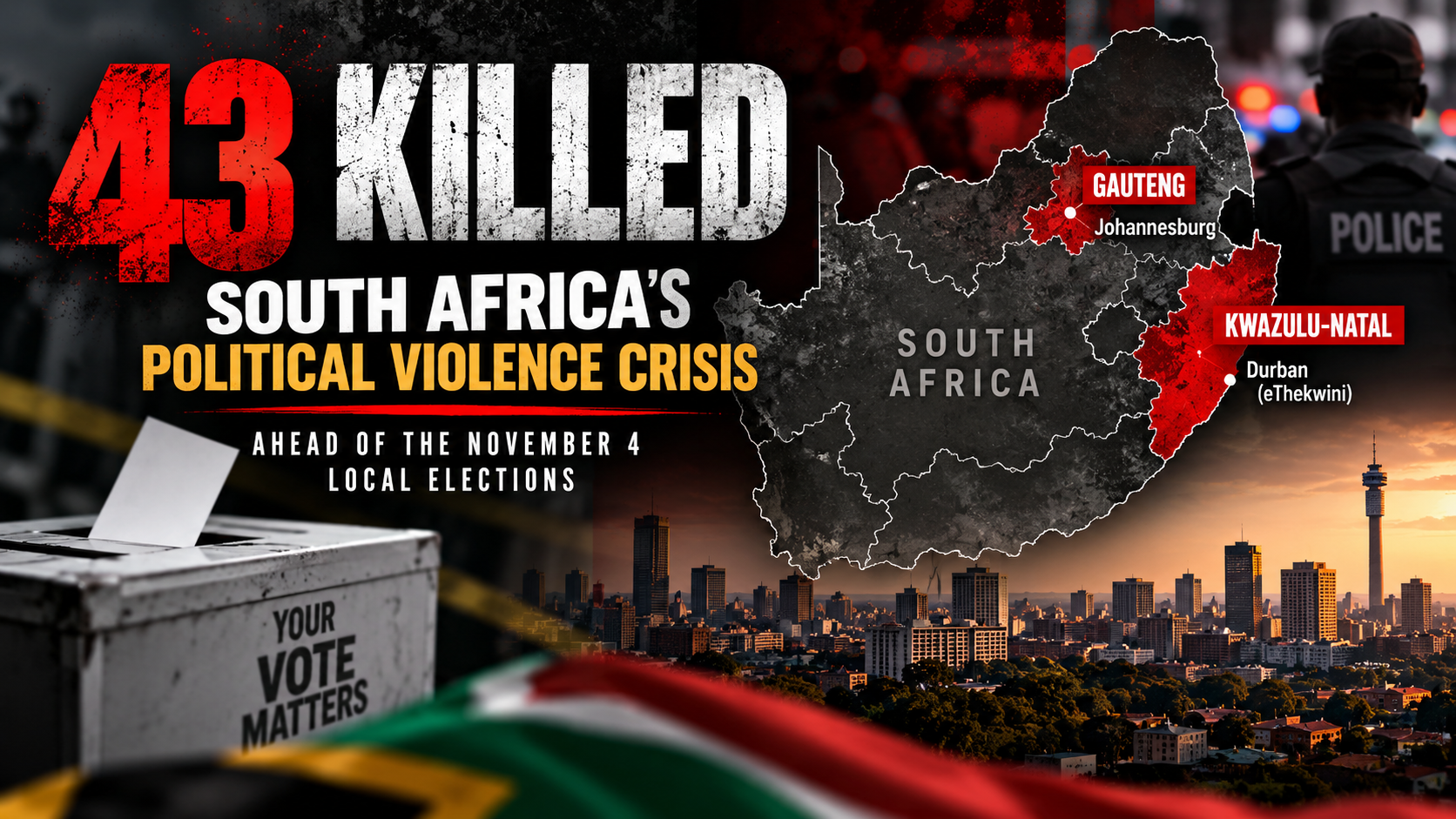
South Africa is entering a tense period ahead of its November 4 local government elections, with a new report documenting 45 politically linked attacks and at least 43 deaths between January and September 2026.
The figures, reported by Africanews with AFP and drawn from the Global Initiative Against Transnational Organized Crime (GI-TOC), highlight the continuing threat posed by political violence at the local level. The attacks have primarily involved political party officials, ward councillors, civic organisations and movements, and traditional leadership. (Africanews)
A Rising Toll Ahead of the Vote
According to the GI-TOC database, the number of people killed in suspected political attacks during the first nine months of 2026 has already exceeded the organisation’s previous full-year totals since it began systematically monitoring politically linked violence in 2015.
GI-TOC’s report, “Bullets and Ballots,” warns that the period ahead could carry additional risks as political competition intensifies before the November municipal elections.
The organisation recorded 45 politically linked attacks through September 30. The available figures describe the killings as suspected political hits; they do not establish that every individual death was conclusively motivated by politics. (Africanews)
KwaZulu-Natal at the Centre of the Violence
The violence has been concentrated particularly heavily in KwaZulu-Natal, followed by Gauteng.
KwaZulu-Natal is an important political battleground and a strong base for the uMkhonto weSizwe Party (MKP), while Gauteng contains Johannesburg and represents South Africa’s largest economic centre.

The GI-TOC data indicates that political party members have been among the principal victims. Of the 43 people recorded as killed, 13 were affiliated with the African National Congress (ANC) and eight with the MK Party, according to the report. (Africanews)
The attacks have not been limited to national political figures. Local political structures, ward councillors, civic organisations, movements and traditional authorities have also been identified among the targets.
That local dimension is significant because municipal politics directly intersects with questions of infrastructure, housing, public services, development and control of local resources.
Why Local Elections Matter
South Africa’s local government elections are scheduled for November 4, 2026.
The vote comes at an important moment for the country’s political system. The ANC, which governed South Africa nationally for decades following the end of apartheid, lost its parliamentary majority in the 2024 national election.
Local elections therefore provide an opportunity to measure political support at the municipal level while parties compete for control of councils across the country. Africanews reported that opposition parties are seeking to benefit from public dissatisfaction associated with infrastructure failures, crime and corruption. (Africanews)
The results will also be closely watched ahead of the next national election cycle in 2029.
Political Violence and Democratic Participation
Political killings can have consequences beyond the victims and their families.
When councillors, candidates, party officials, community organisers or traditional leaders become targets of violence, the effect can extend into the broader political environment. Communities may become reluctant to participate in campaigns, organise politically or openly support particular candidates.
The concentration of violence at the local level also illustrates why electoral security cannot be viewed solely as a matter of protecting polling stations.
Campaign events, political meetings, candidate-selection processes and community organising can all become potential points of conflict during periods of intense competition.

GI-TOC warned that the most dangerous period could still lie ahead as political contests accelerate. (Africanews)
The Role of KwaZulu-Natal and Gauteng
The geographical concentration of reported attacks is particularly notable.
KwaZulu-Natal recorded the largest share of the politically linked attacks identified by GI-TOC. The province is home to a large population and has become an important centre of competition between established and newer political forces.
Gauteng, which recorded 10 attacks in the database, presents a different but equally important environment. The province includes Johannesburg and is South Africa’s economic hub.
Together, the two provinces demonstrate how political violence can intersect with both community-level political competition and broader struggles for influence over major economic and administrative centres. (Africanews)
Protecting the Electoral Process
The figures reported by GI-TOC do not by themselves establish the motive behind every killing. Investigations, prosecutions and judicial findings remain important for determining whether individual cases were politically motivated and who was responsible.
Nevertheless, the scale of the reported attacks has raised concerns about the security environment surrounding the approaching elections.
For South Africa’s electoral institutions, political parties, civil society organisations and law-enforcement agencies, preventing intimidation and violence will be an important part of maintaining public confidence in the electoral process.
The November vote will take place against a backdrop of heightened political competition and an unusually high number of suspected politically linked killings recorded before election day.
As campaigning intensifies, the challenge will be to ensure that political competition remains a contest of ideas, programmes and votes rather than one shaped by fear and violence.
Leave a Reply