
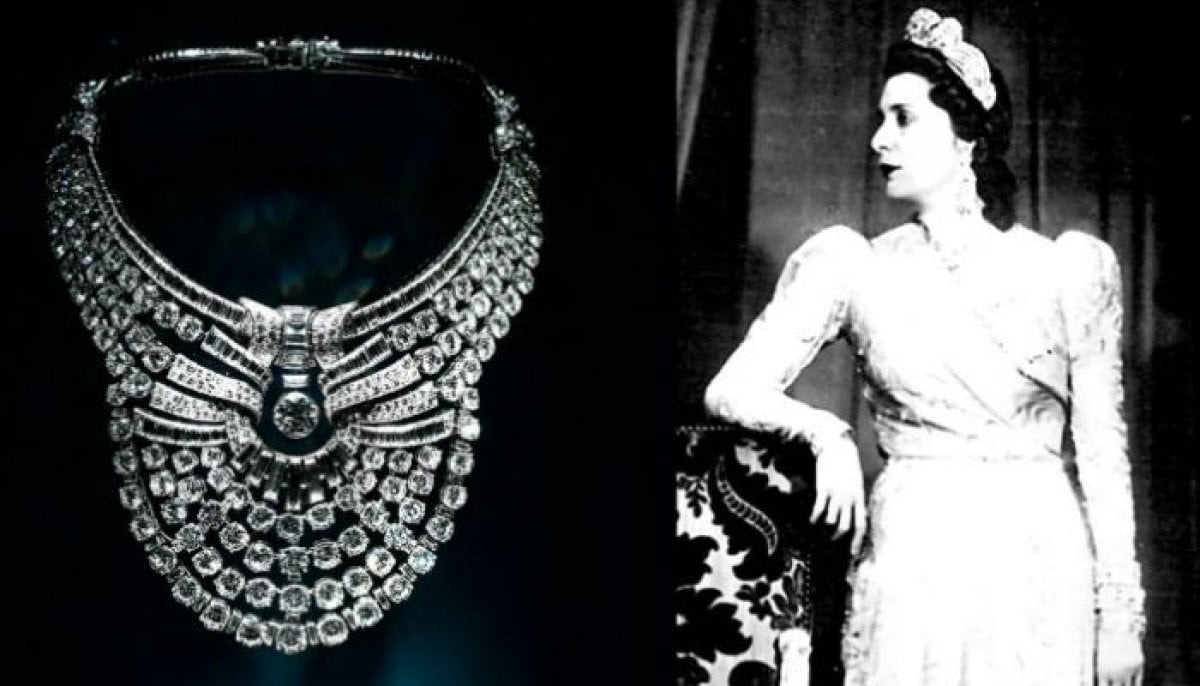
A historic diamond necklace once worn by Egypt’s Queen Nazli has been stolen from Vienna’s Museum of Applied Arts (MAK), triggering an international manhunt and renewed concerns about security at major European museums.
The theft occurred on Thursday, August 27, 2026, when two men entered the museum as ordinary visitors, purchased tickets and made their way to an exhibition featuring the work of French luxury jeweller Van Cleef & Arpels. Once inside, the suspects reportedly smashed a glass display case with a hammer and escaped with the necklace.
A necklace containing 673 diamonds
Although early reports described the piece as a “600-diamond necklace,” police and exhibition information identify the stolen jewellery as containing 673 diamonds and other precious stones, with the diamonds weighing more than 200 carats in total.
The platinum necklace was created for Egypt’s former royal family and is believed to be worth more than $4 million. Its historical significance, however, extends well beyond its monetary value.
The necklace was associated with Queen Nazli of Egypt, the wife of King Fuad I and mother of King Farouk. In 1939, Nazli reportedly wore the spectacular piece during the wedding of her daughter, Princess Fawzia, to Mohammad Reza Pahlavi, the future Shah of Iran.
The jewel was part of a major Van Cleef & Arpels exhibition at MAK, which featured hundreds of objects and was scheduled to continue through September 27.
Thieves caught on surveillance cameras
The robbery has attracted particular attention because the suspects apparently did little to conceal their identities.
According to Austrian authorities, the two men entered the museum without masks and were clearly captured by surveillance cameras. Police described them as slim men with dark hair and short beards. Images of the suspects have subsequently been released as investigators attempt to identify them.
Police said the men smashed the display case and fled with the necklace. Reports also indicate that at least one of the suspects may have been carrying a firearm, although no museum visitors or staff were injured during the robbery.
Tracking dogs and other investigative resources were deployed following the theft, while Austrian authorities appealed for information from the public.
From Egyptian royalty to the international art market
The necklace’s history reflects the dramatic trajectory of Egypt’s former royal family.
Queen Nazli belonged to the final generation of Egypt’s monarchy. Following the political transformation that eventually brought the Egyptian monarchy to an end, royal possessions entered the international art and jewellery market.
The necklace resurfaced decades later and was eventually sold at auction. It reportedly achieved $4.3 million at Sotheby’s in New York in 2015, demonstrating how dramatically the value of historically significant royal jewellery can rise over time.
Its connection to both Egyptian and Iranian royal history makes the theft particularly significant from a cultural-heritage perspective.
Another museum heist raises security questions
The Vienna robbery comes amid a series of high-profile thefts targeting European museums and cultural institutions.
The incident has drawn comparisons with the 2025 Louvre jewellery robbery in Paris, as well as recent thefts involving historic gold objects in Spain and artworks in Italy. The frequency of such crimes has intensified scrutiny of museum security, particularly the protection of small, extremely valuable objects that can potentially be removed quickly.
For museums, the challenge is especially complicated when exhibitions involve jewellery and other portable valuables. Security systems must balance protecting priceless objects with maintaining an environment that remains accessible and welcoming to the public.
Investigation continues
The stolen necklace has not been recovered, and authorities have not publicly identified the two suspects.
Austrian police are continuing their investigation and have appealed to anyone who may have witnessed the robbery, seen the suspects or encountered the distinctive necklace since the theft.
For now, one of the most remarkable pieces of jewellery associated with Egypt’s former royal court remains missing.
The Vienna theft is more than the loss of an expensive necklace. It represents the disappearance of an object carrying nearly a century of royal, diplomatic and artistic history—from Egypt’s monarchy and the 1939 wedding of Princess Fawzia to the international luxury jewellery market and, most recently, a museum exhibition in Vienna.
As investigators search for the thieves and the missing necklace, the case is likely to remain under international attention, particularly because the piece’s historical provenance could make it extremely difficult to sell openly.
This necklace, stolen from an exhibit at Vienna’s Museum of Applied Arts, has been added to INTERPOL's Stolen Works of Art database by Austrian authorities.
— INTERPOL (@INTERPOL_HQ) August 28, 2026
The piece, adorned with 673 diamonds, once belonged to Queen Nazli of Egypt.https://t.co/Vu7vWW0AkC pic.twitter.com/hgZYl2MLkG
Leave a Reply