
By Panafrican.email Intelligence Desk
The future of gaming may not be a faster PlayStation, a more powerful Xbox or an increasingly expensive gaming PC.
It may be a network.
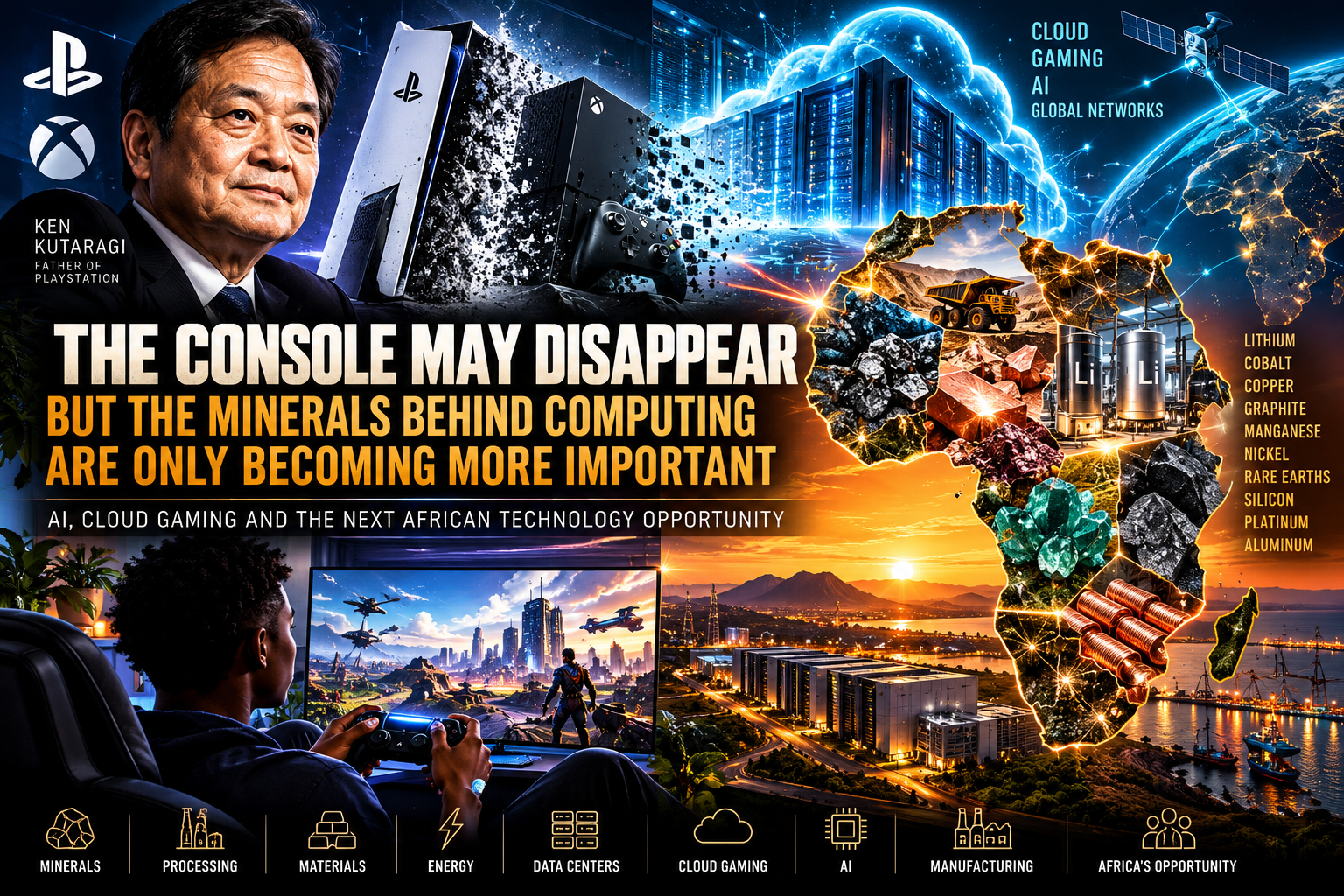
Ken Kutaragi, widely known as the “Father of PlayStation,” has issued a striking warning about the future of dedicated gaming hardware. In a recent discussion, Kutaragi argued that rapidly rising hardware costs, artificial intelligence and cloud computing could eventually make dedicated game consoles unnecessary. He described the possibility of a future in which powerful computing happens on servers rather than inside machines sitting beneath a television. (Insider Gaming)
At first glance, this sounds like a story about Sony, Microsoft, gamers and the console industry.
It is actually a much bigger story.
It is a story about minerals.
The console could disappear. The hardware doesn’t.
If gaming moves from the console to the cloud, the physical hardware does not disappear.
It changes location.
Instead of every household requiring a powerful processor, graphics chip, storage system and cooling architecture, much of that computing could be concentrated inside enormous data centers.
The television becomes a terminal.
The smartphone becomes a terminal.
A lightweight computer becomes a terminal.
The intelligence sits somewhere else.
That means the future computing economy will require extraordinary quantities of:
- Copper for electrical systems and data infrastructure
- Graphite and lithium for batteries and energy storage
- Cobalt and nickel for some battery technologies
- Rare-earth elements for advanced electronics and motors
- Silicon and other semiconductor materials
- Aluminum and steel for infrastructure
- Manganese for batteries and industrial applications
- Platinum-group metals for specialized technologies
- Fiber-optic infrastructure and telecommunications equipment
The machine may become smaller in the consumer’s hands while becoming larger somewhere else.
Welcome to the mineral technology age
This is where Africa enters the conversation.
Africa is not merely a continent with deposits that happen to be useful to Silicon Valley, Asian manufacturers or European automobile companies.
Africa possesses many of the materials required to build the physical infrastructure of the next computing economy.
The OECD’s October 2026 review of African critical minerals identifies cobalt, copper, graphite, lithium, manganese and nickel as strategically important resources, while emphasizing that Africa still captures too little value beyond extraction. (OECD)
The African Union has made a similar argument through its Africa Green Minerals Strategy: the objective should not simply be extracting minerals and shipping them abroad, but developing value addition, industrialization and manufacturing at source. (African Union)
That distinction is enormous.
There is a difference between:
Africa exporting lithium ore
and
Africa producing battery-grade materials, battery components, energy-storage systems and eventually complete technologies.
There is a difference between:
Africa exporting copper
and
Africa manufacturing electrical equipment, data-center infrastructure, cables and other high-value products using African copper.
There is a difference between:
Africa exporting graphite
and
Africa participating in the battery-material supply chain.
That is the mineral technology question.
Cloud gaming could actually increase mineral demand
The popular interpretation of cloud gaming is that fewer consoles should mean less hardware.
That is only partly true.
The hardware simply migrates.
A traditional gaming model distributes computing power across millions of households.
A cloud model concentrates computing power into massive server farms.
Those facilities require electricity, cooling, networking, storage, processors, backup power and physical infrastructure.
And all of that infrastructure requires materials.
The International Energy Agency has already highlighted Africa’s major role in critical mineral supply, while noting that much of the continent’s mineral production remains focused on raw exports rather than higher-value processing. (IEA Blob Storage)
So the question for Africa should not be:
“Will Africans manufacture the next PlayStation?”
The more important question is:
“Will Africa manufacture the infrastructure that makes the next PlayStation unnecessary?”
That is a much bigger opportunity.

From gaming consoles to African computing infrastructure
Imagine a different industrial strategy.
Liberia produces and processes strategic minerals.
Guinea develops mineral-processing and industrial corridors.
Ghana expands its technology, energy and mineral-processing ecosystem.
The Democratic Republic of Congo moves further into cobalt and copper value chains.
Zimbabwe and other lithium-producing economies develop downstream processing.
Mozambique and Tanzania participate in graphite supply chains.
South Africa expands its sophisticated mineral-processing and advanced manufacturing capabilities.
Then connect those industries through African power, telecommunications, ports, railways, universities and technology companies.
The result is no longer simply a mining industry.
It becomes a mineral technology ecosystem.
The missing layer is intelligence
There is another transformation taking place.
Artificial intelligence increasingly depends on enormous amounts of physical infrastructure.
AI models may appear intangible.
They are not.
They require chips.
Chips require factories.
Factories require electricity.
Data centers require cooling.
Networks require cables.
Batteries require minerals.
Power systems require metals.
Transportation requires infrastructure.
The “cloud” is therefore not floating above Africa.
It is built from physical materials extracted from the Earth.
That creates a profound strategic opportunity.
Africa could develop systems that connect geological intelligence to industrial intelligence.
Instead of merely asking:
Where is the mineral?
A modern African mineral intelligence platform should ask:
Where is it?
How much is available?
Who owns the concession?
What infrastructure is nearby?
What is the grade?
What processing technology is required?
Where is the nearest power source?
Where is the nearest port?
Who are the potential buyers?
What products could be manufactured locally?
What is the economic value of processing it inside Africa rather than exporting it raw?
That is where mineral technology becomes business intelligence.
Africa’s opportunity is downstream
Africa’s strategic weakness has never simply been a lack of minerals.
It has been the gap between having the resource and controlling the technology chain surrounding the resource.
A 2025 UK Growth Gateway analysis found that Africa has substantial reserves of critical minerals but remains underdeveloped in midstream and downstream processing. (GOV.UK)
That is the opportunity.
The continent needs more refineries, processing plants, laboratories, geological databases, mineral-testing facilities, engineering companies, battery-material producers, recycling operations and advanced manufacturing.
And those industries need African engineers, programmers, geologists, researchers, entrepreneurs and investors.
The new African technology stack
The next African technology stack should therefore look something like this:
MINERALS → PROCESSING → MATERIALS → ENERGY → COMPUTING → AI → MANUFACTURING → PRODUCTS
Not:
MINERALS → RAW EXPORT → IMPORT FINISHED TECHNOLOGY
That distinction could determine whether the next technological revolution creates African industrial wealth or simply creates another commodity boom.
The Afrotropical opportunity
This is why the emerging concept of Afrotropical mineral intelligence deserves serious attention.
Africa should build its own intelligence layer around the resources beneath the continent.
Maps should connect geological deposits to:
- mines
- concessions
- roads
- railways
- ports
- electricity
- industrial parks
- refineries
- processing facilities
- telecommunications
- data centers
- manufacturers
- financial institutions
- export markets
The result would be more than a mining map.
It would be an economic operating system for African mineral technology.
And this is where artificial intelligence becomes particularly powerful.
AI can help analyze geological information, satellite imagery, production data, commodity prices, infrastructure constraints, logistics and industrial demand.
The objective is not to replace the geologist or engineer.
It is to give them a much larger intelligence system.
The console question is therefore the wrong question
Will the PlayStation disappear?
Maybe.
Kutaragi’s argument is ultimately a prediction, not a guaranteed outcome. But the direction is clear: computing is becoming increasingly networked, AI-assisted and cloud-based. (Insider Gaming)
The more important question for Africa is what happens underneath that transformation.
Because whether the computer sits in your living room or inside a data center, it still requires physical infrastructure.
And that infrastructure requires minerals.
The African continent has an opportunity to move from being the quarry for the digital economy to becoming one of its factories.
The age of the console may eventually end.
The age of mineral technology is only beginning.
Panafrican.email will continue tracking the intersection of African minerals, artificial intelligence, computing infrastructure, industrialization and strategic technology.
Leave a Reply