
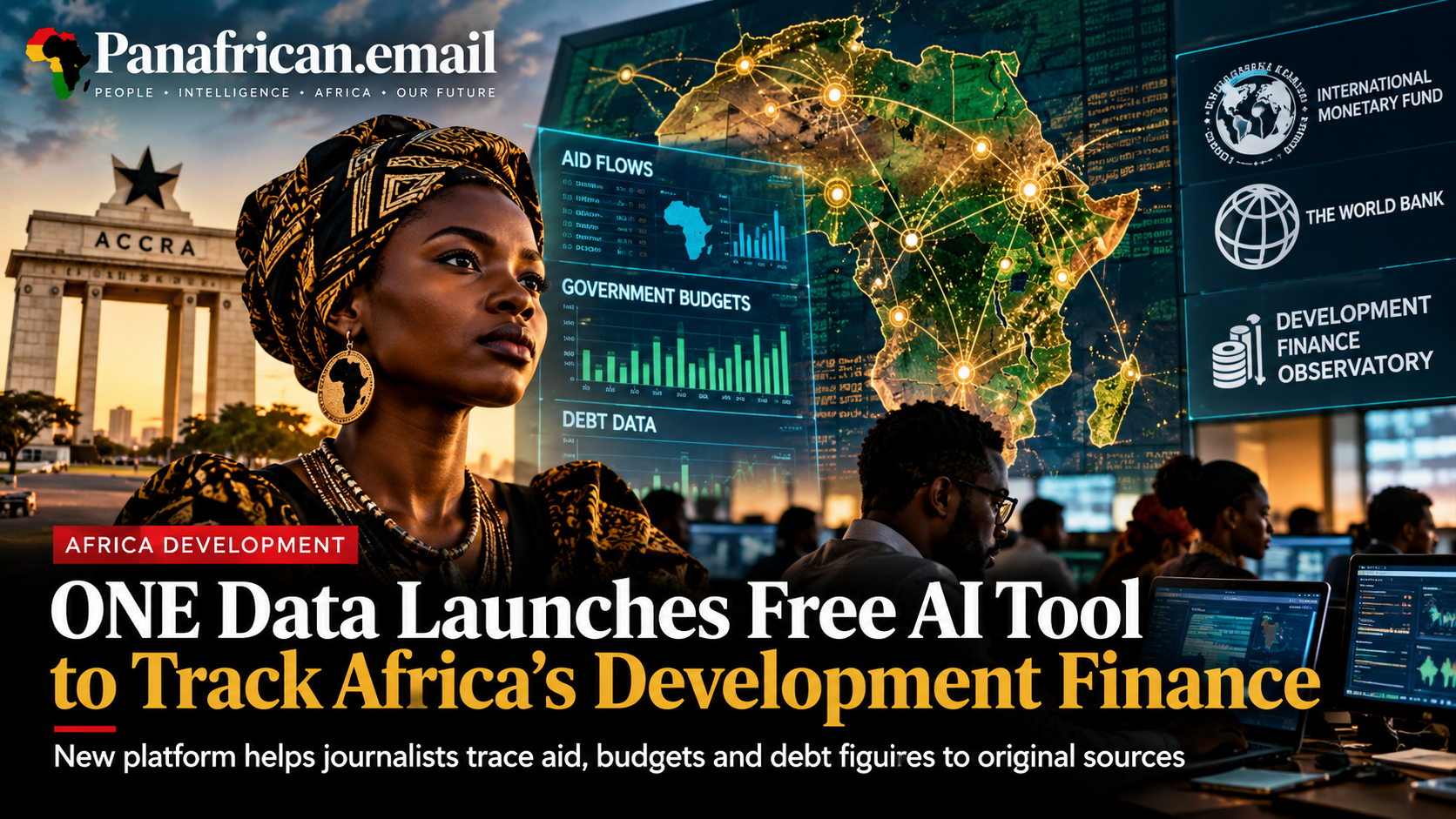
Washington, D.C.— October 16, 2026 — A new free artificial intelligence-powered research tool is giving journalists, researchers and the public a faster way to trace how development finance moves through governments and institutions.
ONE Data, the data arm of the ONE Campaign, launched the Development Finance Observatory on October 14, 2026. The platform brings together information on development assistance, domestic government budgets and public debt that has traditionally been dispersed across databases maintained by institutions including the International Monetary Fund (IMF) and World Bank.
The objective is straightforward: make complex development-finance data easier to locate, verify and understand.
For African journalists and researchers, that could prove particularly useful. Tracking the relationship between foreign assistance, government budgets and debt often requires moving between multiple institutional databases, reports and statistical releases. The new platform is designed to bring those sources into a more accessible research environment.
From scattered numbers to traceable intelligence
Development-finance figures can tell a much larger story than the headline number attached to an aid package or loan.
Questions about who provided the financing, where the money was allocated, how it was recorded in national budgets and how debt obligations changed over time require researchers to connect information from several sources.
The Development Finance Observatory is intended to simplify that process by allowing users to trace figures back to their original sources.
That source-tracing capability is especially important in an era when AI-generated information is increasingly entering public discourse. Rather than treating an AI system as the final authority, journalists can use the tool to locate the underlying data and independently verify the numbers.
Why this matters for Africa
African governments remain major participants in international development-finance systems, while questions surrounding debt sustainability, aid effectiveness and domestic resource mobilization continue to shape economic policy across the continent.
A tool that makes these datasets easier to interrogate could therefore become useful not only to journalists, but also to civil-society organizations, researchers, policymakers and citizens seeking greater transparency around public finance.
For Panafrican.email’s intelligence ecosystem, the development is significant because financial data is infrastructure for understanding political and economic power. Aid flows, sovereign debt, government spending and external financing can reveal relationships that are not immediately visible in conventional news reporting.
The platform does not eliminate the need for verification. Its greatest value may instead be its ability to shorten the distance between a reported figure and the primary source behind it.
An emerging layer of African data intelligence
The launch comes as AI increasingly becomes part of the investigative and research toolkit available to African media organizations.
The important question is no longer simply whether AI can summarize financial information. It is whether AI can help researchers find the source, follow the money and reproduce the evidence.
The Development Finance Observatory points toward that second model: AI-assisted research grounded in traceable public data.
For journalists covering Ghana and the wider African continent, that could provide another instrument for investigating how development finance is raised, allocated and ultimately reflected in national economies.
Development Finance Data. Simplified.
Explore aid, debt, climate and health finance, domestic budgets, remittances and other development-finance indicators from a single traceable data platform.
Source: News Ghana / ONE Data
Intelligence status: Unverified
Region: Ghana / Africa
Category: Development Finance, Data Intelligence
Leave a Reply