
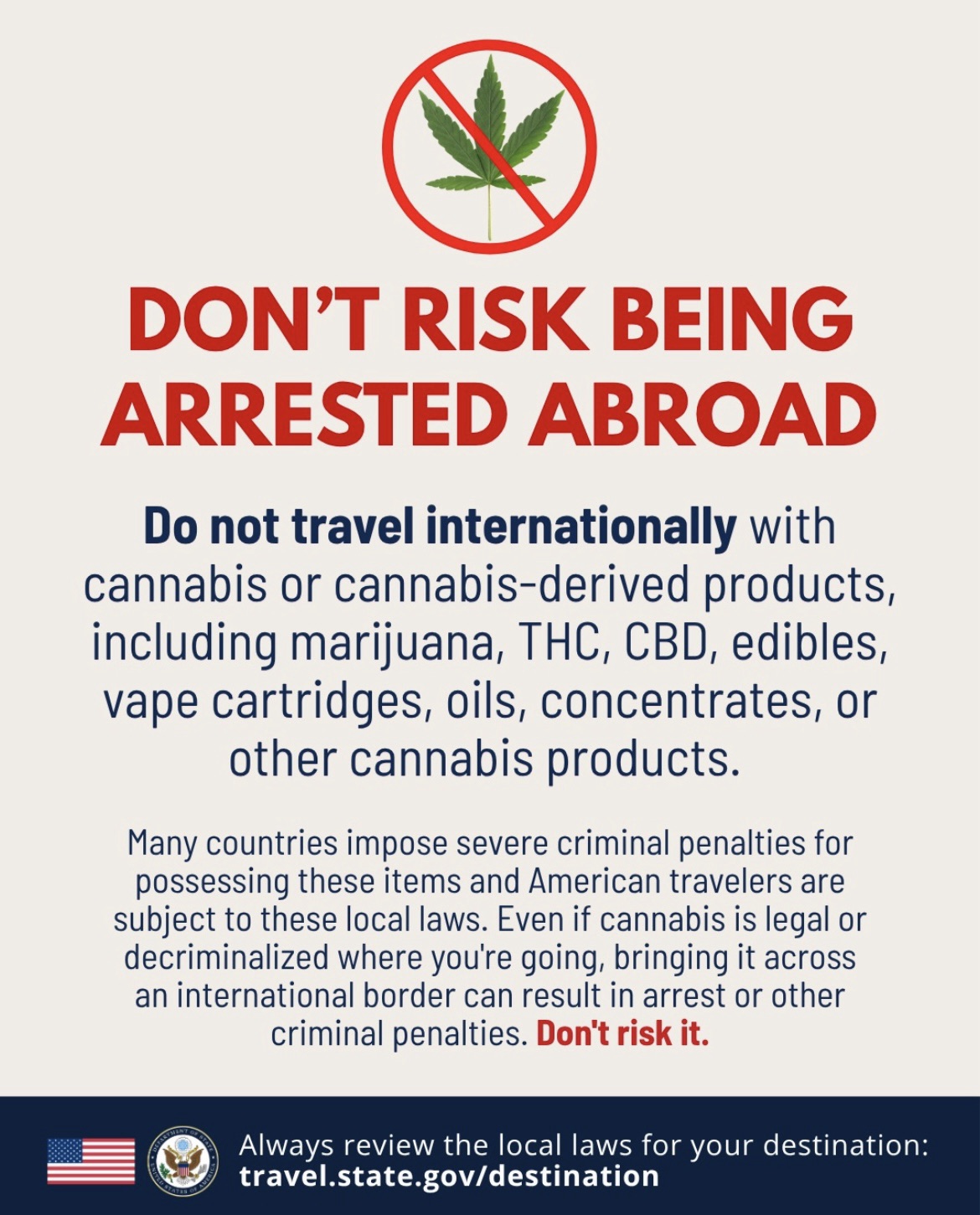
WASHINGTON — U.S. authorities are reminding Americans traveling abroad that taking cannabis or cannabis-derived products across an international border can result in arrest, prosecution and severe criminal penalties—even when those products are legal in the United States or at the traveler’s destination.
The warning applies to a broad range of cannabis-related products, including marijuana, THC and CBD products, edibles, vape cartridges, oils, concentrates and products marketed for medical use.
Legal at Home Does Not Mean Legal Abroad
One of the most important points in the advisory is that travelers should not assume that laws governing cannabis in their home state will protect them once they leave the United States.
Cannabis laws vary considerably from country to country. Some nations have legalized or decriminalized certain forms of cannabis, while others maintain strict prohibitions and impose severe penalties for possession, importation or trafficking.
The warning also applies to medical marijuana. Having a prescription or authorization to use cannabis in the United States does not necessarily provide permission to bring the product into another country.
Even if cannabis is legal or tolerated at a traveler’s destination, crossing an international border with cannabis can create a separate criminal offense.
Travelers Can Be Arrested for Cannabis They Didn’t Realize They Had
U.S. officials are also cautioning travelers about accidental possession.
Americans have reportedly encountered legal problems after discovering cannabis products in their luggage that they did not realize they were carrying. Items can include forgotten edibles, vape cartridges, oils and concentrates left in bags or clothing.
For this reason, travelers are being encouraged to begin international trips with a completely empty bag.
Passengers should carefully inspect every compartment, pocket and pouch before leaving the country, particularly if the luggage has previously been used for domestic travel.
A small forgotten cannabis product can potentially create a major legal problem once an international border is crossed.
Check the Rules Before Leaving
Travelers should research the laws of their destination before departure and review official information regarding prohibited items.

The U.S. State Department’s destination information is available through travel.state.gov.
Travelers should also check the requirements of their airline, transit countries and destination country. This is particularly important for passengers whose itinerary includes a connection in another country, because they may become subject to that country’s laws even if it is not their final destination.
Cannabis Laws Can Carry Serious Consequences
The warning highlights a broader issue facing international travelers: national borders can change the legal status of products that are permitted domestically.
A cannabis product purchased legally in one jurisdiction may be treated as a prohibited controlled substance elsewhere. Penalties can include detention, arrest, criminal prosecution, fines and imprisonment, depending on the country and circumstances.
Travelers should therefore avoid relying on assumptions based on U.S. state laws, social attitudes toward cannabis or the legality of a product at home.
A Simple Rule for International Travelers
For Americans traveling internationally, the safest approach is straightforward:
Do not bring cannabis or cannabis-derived products across an international border.
Before packing, completely empty the luggage and inspect all compartments and pockets. Travelers should also verify the prohibited-item rules and drug laws applicable to every country on their itinerary.
The advisory serves as a reminder that international travel involves complying with the laws of the country being entered—not simply the laws of the country where a product was purchased.
For Panafrican.email readers traveling between Africa, the United States and other international destinations, checking destination-country regulations before departure is especially important. When in doubt about a controlled substance or prohibited item, leave it behind and seek official guidance before traveling.
Leave a Reply