
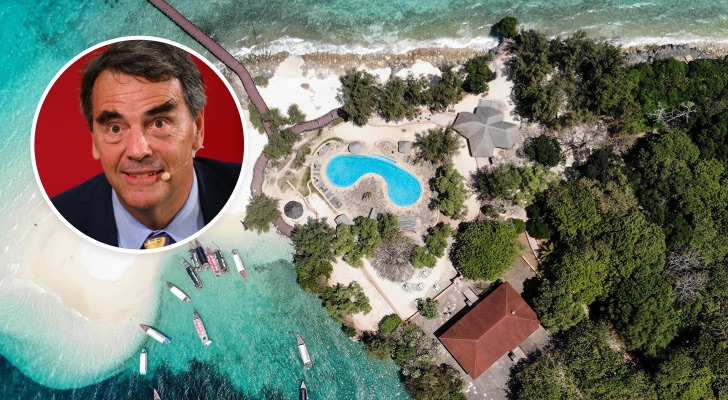
An unusual property dispute has emerged in Tanzania after American billionaire venture capitalist Tim Draper announced that he was selling his private island in Lake Tanganyika for $7.9 million—only for Tanzanian authorities to clarify that he does not actually own the land.
Draper announced on August 28 that he was putting his Tanzanian island on the market because he and his family no longer used it enough. He described the property as a “gorgeous place” and offered it for $7.9 million or the best offer, inviting potential buyers to contact him directly. According to Forbes, Draper said he had already received several offers and expected the property to sell quickly.
The island has since been identified as Lupita Island, located in Nkasi District in Tanzania’s Rukwa Region on Lake Tanganyika. The property has been developed into a luxury tourism destination featuring cottages, a spa, gym, swimming pool, bars, games facilities and access to the lake. Draper became involved with the property in 2004 and spent several years developing it into an exclusive resort.
Tanzania draws a line over land ownership
The controversy began when Tanzania’s Ministry of Lands, Housing and Human Settlements Development issued a clarification on August 31.
According to the ministry, Lupita Island itself is not owned by Draper or his company. The underlying land remains under the ownership of the Tanzania Investment and Special Economic Zones Authority (TISEZA).
Draper is a shareholder in Firelight Safaris Ltd, the company that holds a Derivative Right granted by TISEZA to develop and operate a tourist hotel on the island. In other words, the billionaire has an investment interest in the resort and associated rights—but that is different from owning the Tanzanian land itself.
The distinction is important because Tanzania’s land system does not treat land ownership in the same way as a conventional private-property market. Foreign investors generally participate through legally recognized investment and derivative rights rather than acquiring outright ownership of Tanzanian land.
So what is actually being sold?
The Tanzanian government’s clarification does not necessarily mean that Draper cannot exit his investment.
Instead, it means the transaction would have to be structured around the investment and resort rights held by Firelight Safaris, rather than a straightforward transfer of ownership of the island itself.
The ministry indicated that Firelight Safaris is a legitimate investor and may transfer its investment to another investor, provided the transaction complies with Tanzanian law and established procedures.
That makes the $7.9 million asking price considerably more complicated than the headline “billionaire sells private island” suggests. The price appears to represent Draper’s investment interest and the resort operation rather than the purchase of sovereign Tanzanian territory.
A luxury resort in one of Africa’s Great Lakes
Lupita Island sits in Lake Tanganyika, one of Africa’s Great Lakes and one of the world’s largest freshwater lakes. The resort was designed as an ultra-private destination, with visitors able to enjoy swimming, fishing, kayaking, snorkeling and boating.
Guests can also access safari destinations on mainland Tanzania, including areas around Katavi National Park and the Mahale Mountains.
For more than two decades, the island has therefore represented not simply a piece of real estate, but a combination of tourism infrastructure, investment rights, hospitality operations and an internationally marketed luxury destination.
The bigger lesson
The dispute highlights an important distinction between owning an African business or investment and owning African land.
Draper may be able to sell his stake and the associated investment rights, subject to Tanzanian approval and procedures. But Tanzania’s government has made clear that the underlying land remains under the country’s legal land framework.
For now, the $7.9 million “island sale” is therefore better understood as a proposed transfer of a luxury resort investment, rather than the sale of a privately owned piece of Tanzanian territory.
The episode also raises broader questions about foreign investment, land rights and the balance between attracting international capital and maintaining national control over land and natural resources—issues that continue to shape investment debates across Africa.
Leave a Reply