
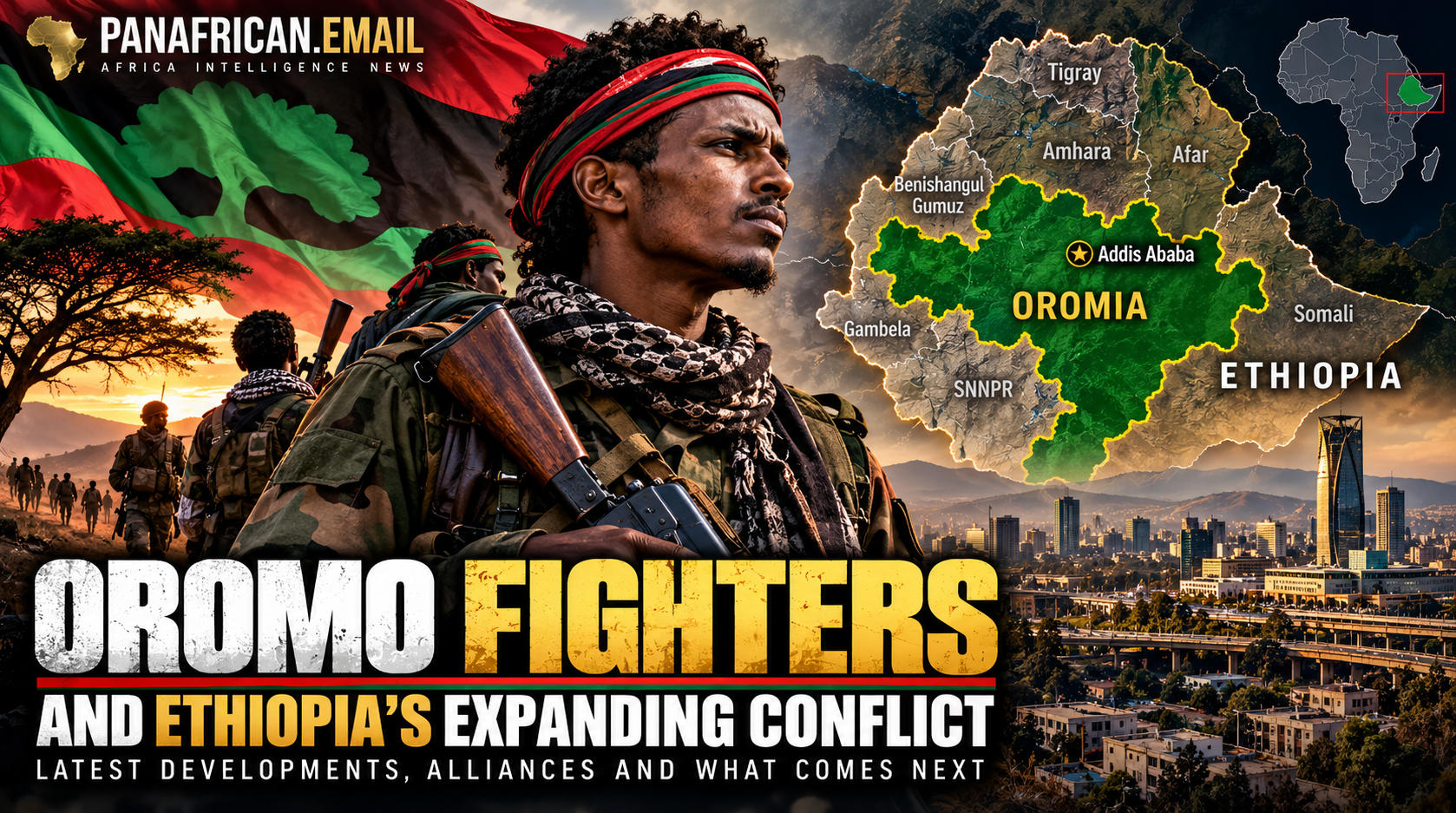
ADDIS ABABA, Ethiopia — October 1, 2026 — Ethiopia’s security crisis has entered a new and more complicated phase, with the Oromo Liberation Army (OLA) becoming part of a broader alliance of armed organizations opposing the federal government as fighting intensifies in Tigray, Afar and other parts of the country.
The developments mark a significant expansion of Ethiopia’s conflict landscape. The OLA has fought federal and regional security forces in Oromia since 2019, while renewed fighting in northern Ethiopia has brought together several groups that were previously adversaries.
On September 21, seven Ethiopian armed groups announced the formation of the Ethiopian Peoples’ Forces Alliance for Survival, an alliance that includes the Tigray People’s Liberation Front (TPLF), Amhara Fano forces and the OLA, among others. The groups said they intended to remove Prime Minister Abiy Ahmed’s government and establish a transitional political arrangement. (Reuters)
The alliance does not mean that the participating organizations have identical political objectives. Ethiopia’s armed movements have different ethnic, territorial and political agendas, and analysts have pointed to geographical distance and disagreements among the groups as obstacles to effective coordination. (Reuters)
The Oromo Liberation Army
The OLA emerged from the former armed wing of the Oromo Liberation Front after the political changes that followed Abiy Ahmed’s rise to power in 2018. The OLA did not accept the disarmament process and continued an armed struggle in Oromia.
The United Kingdom’s March 2026 country information assessment says the OLA operates principally in rural Oromia and that its territorial control remains fluid and limited. The Ethiopian government designated the OLA a terrorist organization in 2021. (GOV.UK)
Oromia is Ethiopia’s largest regional state and surrounds Addis Ababa. The conflict there has continued despite repeated government military operations and previous attempts to establish a political settlement.
The OLA’s leadership has presented its struggle primarily in terms of Oromo political rights and self-determination. The Ethiopian government, meanwhile, has accused the organization of attacks against civilians and security forces.
A new alliance changes the political picture
The September alliance represents an important development because it places the OLA alongside organizations from several other Ethiopian regions.
The coalition includes the TPLF, Fano and armed groups representing Oromia, Afar and Benishangul-Gumuz interests. The participating organizations have historically had competing political objectives and, in some cases, have fought one another.
Reuters reported that the groups accuse the federal government of centralizing power and marginalizing regional interests. The government has promoted a national dialogue intended to address Ethiopia’s political divisions. (Reuters)
The alliance therefore represents cooperation around a common opposition to the federal government rather than evidence that Ethiopia’s various armed movements have resolved their underlying disagreements.
Jaal Marroo, the OLA’s military leader, had said before the alliance announcement that discussions among the organizations had taken place several times. (Al Jazeera)
Violence continues inside Oromia

The new national alliance comes while the separate conflict in Oromia remains active.
In March, the Ethiopian Human Rights Commission reported renewed attacks in parts of Arsi Zone. The commission said attacks attributed to the OLA since October 2025 had resulted in deaths, injuries, abductions, property destruction and displacement. It also reported killings and other abuses following attacks in Shirka and Robe districts in February 2026. (Ethiopian Human Rights Commission – EHRC)
In June, the commission reported on attacks in Aseko Woreda in which it said an armed group identifying itself as the OLA killed members of security forces and civilians, displaced residents and destroyed or burned property. The commission called for investigations and accountability. (Ethiopian Human Rights Commission – EHRC)
These allegations are contested within Ethiopia’s polarized information environment, but the humanitarian consequences of the conflict are independently documented.
Amnesty International reported in March that it had interviewed survivors of sexual violence in Kellem Wallaga and documented allegations of rape, gang rape, sexual slavery, killings, torture and destruction of civilian property attributed to OLA fighters. Amnesty called for investigations and accountability. (Amnesty International USA)
The OLA has rejected accusations that its fighters deliberately target civilians.
The conflict is no longer confined to Oromia
The OLA’s participation in the new alliance comes as Ethiopia faces renewed large-scale fighting in the north.
Fighting between federal forces and Tigrayan forces intensified in September, threatening the November 2022 Pretoria peace agreement that ended the previous Tigray war.
Federal forces and their allies have reported capturing strategic locations, including Alamata, while Tigrayan forces have conducted operations in Tigray and neighbouring Afar. Reuters reported on September 28 that government-aligned forces had captured Alamata, although the rapidly changing battlefield has made independent verification of some claims difficult. (Reuters)
The fighting has also produced a growing humanitarian emergency.
Médecins Sans Frontières reported hundreds of war-wounded patients arriving at hospitals in Tigray during the latest escalation, while telecommunications disruptions have complicated communication and humanitarian operations. (ACLED)
Drone attacks and the widening battlefield
The latest conflict has also introduced a growing drone dimension.
ACLED reported that suspected suicide-drone attacks targeted Ethiopian National Defence Force facilities at Bishoftu in Oromia and locations around Kombolcha and Bahir Dar in late September. (ACLED)
On October 1, Reuters reported that explosions had been heard in Addis Ababa and that an individual linked to the opposition alliance claimed responsibility for drone strikes targeting military positions. Reuters said the claim could not independently be verified. (Reuters)
Ethiopian authorities subsequently banned drone flights over Addis Ababa.
If opposition forces are able to conduct attacks far from the established northern front lines, it would demonstrate that Ethiopia’s security crisis is becoming geographically broader. However, the precise capabilities and command relationships behind the reported attacks remain uncertain.
Ethiopia’s relations with Eritrea deteriorate
The widening conflict is also affecting Ethiopia’s relations with neighbouring Eritrea.
On October 1, Ethiopia announced that it would close its embassy in Asmara and ordered 10 Eritrean diplomats to leave the country within 48 hours.
Addis Ababa has accused Eritrea of supporting opposition forces. Eritrea has repeatedly denied such allegations. Sudan and Egypt have also rejected Ethiopian accusations of involvement. (Reuters)
The deterioration is particularly significant because Ethiopia and Eritrea fought alongside one another during the 2020–2022 Tigray war before relations subsequently deteriorated.
The current confrontation therefore has the potential to extend beyond Ethiopia’s internal political struggle and affect the wider Horn of Africa.
What does the OLA alliance mean?
The OLA’s participation in the Alliance for Survival places the Oromo armed movement inside a much larger national political and military equation.
There are several important questions.
First, can the alliance coordinate militarily?
The participating groups are geographically dispersed. The OLA’s principal area of operations is Oromia, while the TPLF is concentrated in Tigray and Fano groups operate principally in Amhara. Reuters reported that analysts have questioned whether the organizations can overcome geographic and political differences sufficiently to operate as a coherent force. (Reuters)
Second, what is the alliance’s political program?
The organizations have called for a transitional political arrangement, but their individual visions for Ethiopia’s constitutional structure, regional autonomy, territorial administration and national government are not identical.
Third, will the alliance affect the conflict in Oromia?
The OLA has continued to operate independently in Oromia, where government forces and armed fighters remain engaged in a long-running conflict. Whether the new national alliance produces additional coordination, resources or political leverage for the OLA remains uncertain.
Civilians remain at the centre of the crisis
For ordinary Ethiopians, the significance of the latest developments is measured less by the alliances announced by armed organizations than by security, displacement, access to food and medicine, communications and the ability to travel safely.
Ethiopia’s previous major war produced enormous civilian suffering. The renewed fighting in the north, combined with continuing conflicts in Oromia and Amhara, creates the possibility of multiple crises reinforcing one another.
Human-rights organizations have documented abuses attributed to government forces and armed groups, while authorities and armed organizations routinely dispute allegations made against them.
Independent investigation remains particularly difficult when communications are disrupted and access to conflict areas is restricted.
A country facing multiple conflicts
Ethiopia’s current crisis cannot be reduced to a single confrontation between the government and one opposition group.
The OLA’s long-running conflict in Oromia, the renewed Tigray war, the Fano insurgency in Amhara, tensions involving Afar and other regional groups, and deteriorating relations with Eritrea are increasingly interconnected.
The September formation of the Alliance for Survival has created a new political framework linking several of these conflicts.
But the alliance’s durability, military coordination and political objectives remain uncertain.
For Ethiopia, the immediate challenge is preventing the country’s separate conflicts from becoming a single, interconnected national war. For civilians in Oromia, Tigray, Amhara, Afar and other affected areas, the priority remains protection from violence and restoration of basic services.
As fighting continues into October, the direction of Ethiopia’s political crisis will depend not only on battlefield developments but also on whether credible channels for political negotiation and civilian protection can be restored.
Leave a Reply