
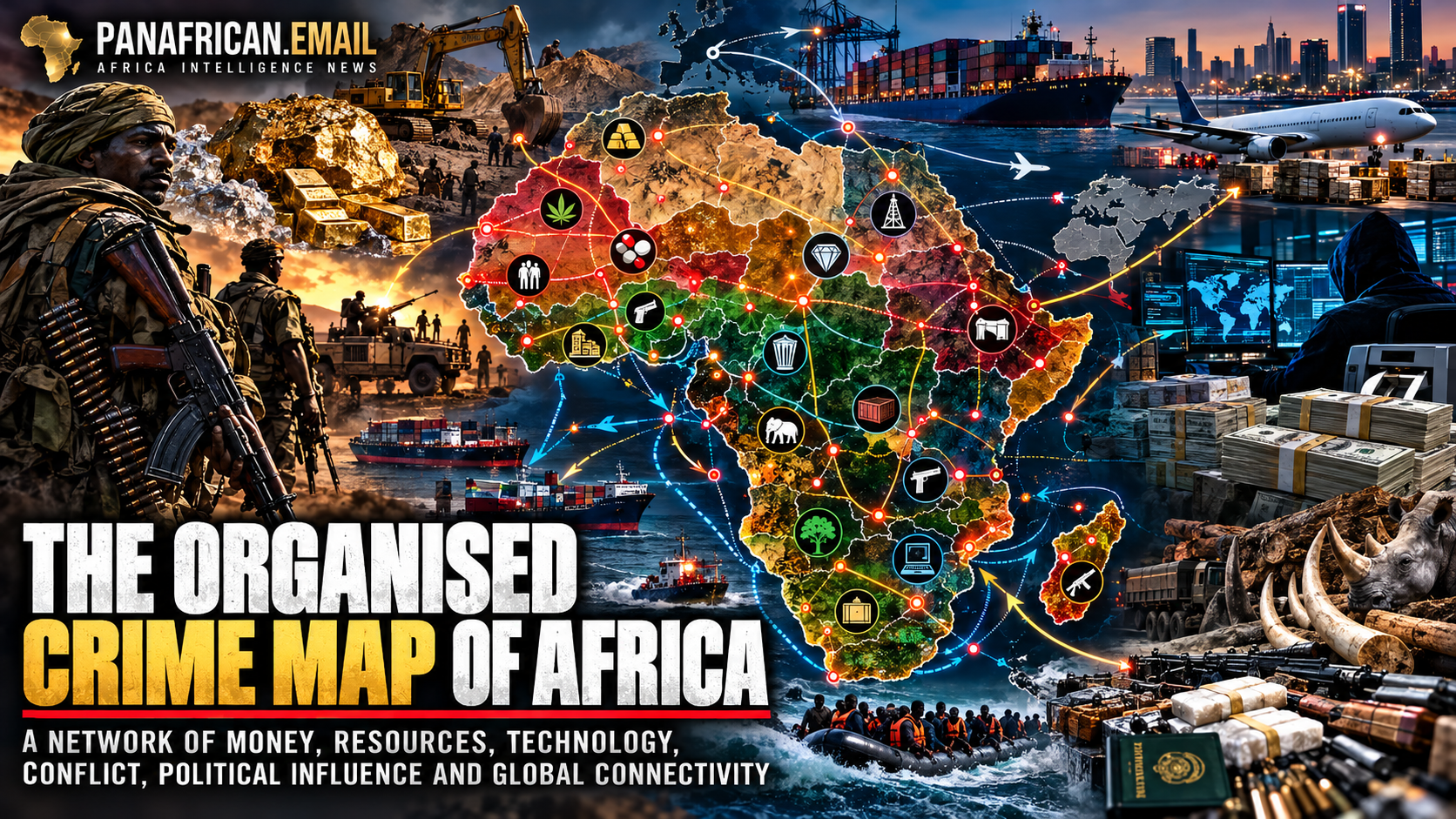
The latest Africa Organised Crime Index presents a broad picture of organised crime across the continent, showing that criminal markets have expanded since 2019 while the capacity of many states and societies to respond has weakened.
The 2025 edition, produced through the ENACT programme in partnership with the Institute for Security Studies (ISS), INTERPOL and the Global Initiative Against Transnational Organized Crime (GI-TOC), assesses all 54 African countries, examining criminal markets, criminal actors and resilience.
The report says 92.5% of African countries have low resilience to organised crime, while 23 countries face the combination of high criminality and low resilience—a combination the report describes as particularly vulnerable.
The countries most exposed
The 2025 country criminality rankings place the following countries at the top of the African index:
Country
Criminality score
Democratic Republic of the Congo
7.47
South Africa
7.43
Nigeria
7.32
Kenya
7.18
Libya
7.05
Central African Republic
7.03
Uganda
6.65
Mozambique
6.63
Sudan
6.63
Somalia
6.55
South Sudan
6.42
Mali
6.33
Cameroon
6.18
Burkina Faso
6.03
Ethiopia
6.03
Chad
6.00
Niger
5.93
Tanzania
5.93
Madagascar
5.83
Côte d’Ivoire
5.78
Ghana
5.77
Liberia
5.65
Angola
5.62
The index separately measures criminality and resilience, so a high criminality score does not by itself mean that a country has weak institutions. For example, South Africa, Nigeria and Kenya have high criminality scores but comparatively stronger resilience scores than many other highly affected countries.
What is driving organised crime?

The 2025 research identifies several major criminal markets operating across Africa. The most pervasive include financial crimes, human trafficking, non-renewable-resource crimes, counterfeit goods and arms trafficking.
But the nature of organised crime differs considerably from one region to another.
East Africa has particularly significant problems involving human trafficking, arms trafficking and human smuggling.
North Africa is a major centre for cannabis trafficking and also has extensive financial crime.
Central Africa is heavily affected by crimes surrounding non-renewable natural resources, including minerals.
West Africa has become an important cocaine-trafficking corridor.
Southern Africa has particularly significant wildlife-trafficking markets.
This regional variation is important because organised crime is not a single industry. Criminal networks frequently combine several markets, using ports, airports, roads, financial systems, border crossings and digital infrastructure.
Natural resources and conflict
The connection between conflict and organised crime is particularly pronounced in Central and parts of East and West Africa.
The 2025 index identifies the Democratic Republic of the Congo and Central African Republic as particularly exposed to foreign criminal actors. The Central African Republic receives the maximum score of 10 for non-renewable-resource crimes, while the DRC and CAR both score 9.0 for foreign actors.
The report argues that geopolitical competition can intensify these dynamics. Natural resources, weapons networks and foreign actors can become intertwined with existing conflicts, creating illicit economies that are difficult to dismantle.
The rise of cybercrime
Organised crime is also moving increasingly into the digital economy.
The Africa index identifies growing online financial fraud and ransomware, with cybercrime increasing in four of Africa’s five regions.
That means organised crime is no longer primarily about physical trafficking routes.
Criminal networks can now operate simultaneously through:
- online fraud;
- cryptocurrency and financial transfers;
- identity theft;
- ransomware;
- illicit online marketplaces;
- trafficking networks;
- counterfeit goods;
- money laundering;
- traditional smuggling routes.
Africa’s rapidly expanding digital economy therefore presents both an economic opportunity and a new security challenge.
The role of state-linked actors
One of the report’s more significant findings concerns the relationship between organised crime and political power.
The 2025 index says state-linked actors drive organised crime in nearly half of African countries, with their influence assessed as severe in 48% of countries.
The report also identifies foreign actors as an increasingly important factor, particularly in West Africa, where transnational cocaine trafficking has expanded.
This does not mean that governments as institutions are necessarily criminal organisations. Rather, the index measures the extent to which individuals or networks connected to state structures are involved in or facilitate criminal markets.
West Africa under pressure
West Africa remains particularly important to the continent’s organised-crime landscape because of its position between Latin American cocaine-producing regions and European consumer markets.
The 2025 index identifies the cocaine trade as the dominant criminal market in the region. It also points to growing involvement by foreign criminal groups.
Countries such as Ghana, Côte d’Ivoire, Liberia, Sierra Leone, Guinea and Guinea-Bissau therefore sit within a wider network of maritime, aviation, financial and overland trafficking routes.
This does not mean that these countries are equivalent in their exposure or institutional capacity. Their individual scores differ considerably.
Ghana and Liberia
Ghana receives a 5.77 criminality score, placing it 21st among African countries in the 2025 index, while Liberia scores 5.65, placing it 22nd.
For Ghana, the index records a criminal markets score of 6.03, compared with 5.50 for criminal actors and 5.33 for resilience.
Liberia records 5.30 for criminal markets, 6.00 for criminal actors and 3.38 for resilience.
The distinction matters: the index is not simply measuring how much crime exists. It attempts to assess the interaction between criminal markets, the actors operating them and the ability of institutions and society to resist them.
Africa’s resilience problem
Perhaps the most important finding is not the criminality ranking itself but the continent’s limited resilience.
According to ENACT, only a small minority of African countries demonstrate comparatively strong resilience against organised crime, while 92.5% are classified as having low resilience.
The report also identifies a decline in the non-state actors resilience indicator since 2021. Civil society organisations, journalists, community organisations and other non-state institutions can play an important role in exposing criminal networks and supporting vulnerable communities.
A continental security map
The data reveals several overlapping crime corridors rather than one continent-wide criminal system.
The Sahel: arms trafficking, human trafficking, smuggling, illicit-resource economies and conflict-related criminal markets.
West Africa: cocaine trafficking, financial crime, human trafficking and maritime trafficking.
Central Africa: natural-resource crime, armed groups and foreign criminal actors.
East Africa: human trafficking, arms trafficking, human smuggling and cyber-enabled crime.
North Africa: cannabis trafficking, financial crime and trafficking networks.
Southern Africa: wildlife trafficking, financial crime and increasingly sophisticated transnational networks.
These markets frequently overlap. A single network can participate in several forms of illicit activity and move money, people, commodities and information across multiple jurisdictions.
What the 2025 index tells us
The Africa Organised Crime Index does not describe every country as equally affected, nor does a country’s ranking constitute a judgement on its government or population.
Instead, it provides a comparative measurement of criminality and resilience.
The central finding is that organised crime has become increasingly embedded in Africa’s economies and security environment since 2019, while many countries have not strengthened their ability to respond at the same pace.
For policymakers, the challenge therefore extends beyond arresting individual criminals. Effective responses require stronger financial investigations, border controls, anti-corruption mechanisms, judicial capacity, cybercrime capabilities, protection of civil society and greater international cooperation.
For Africa’s ports, mineral-producing regions, financial centres and rapidly expanding digital economies, the index provides a warning that organised crime increasingly operates across traditional boundaries.
The organised crime map of Africa is no longer simply a map of trafficking routes. It is a map of money, resources, technology, conflict, political influence and global connectivity.

Africa Organised Crime Index 2025 — ENACT
Global Initiative — Africa Organised Crime Index 2025
ENACT Africa — 2025 Index findings
Leave a Reply