
ASMARA, Eritrea — Eritrea, one of Africa’s most politically isolated countries, is finding itself at the center of a rapidly changing strategic landscape as the war involving Iran reshapes shipping, security and diplomatic calculations around the Red Sea.
A new Reuters report from inside Eritrea describes a country that has long kept outsiders at arm’s length but now says it is prepared to engage more openly with the outside world. The shift comes as the Red Sea assumes even greater importance for global commerce and regional security.
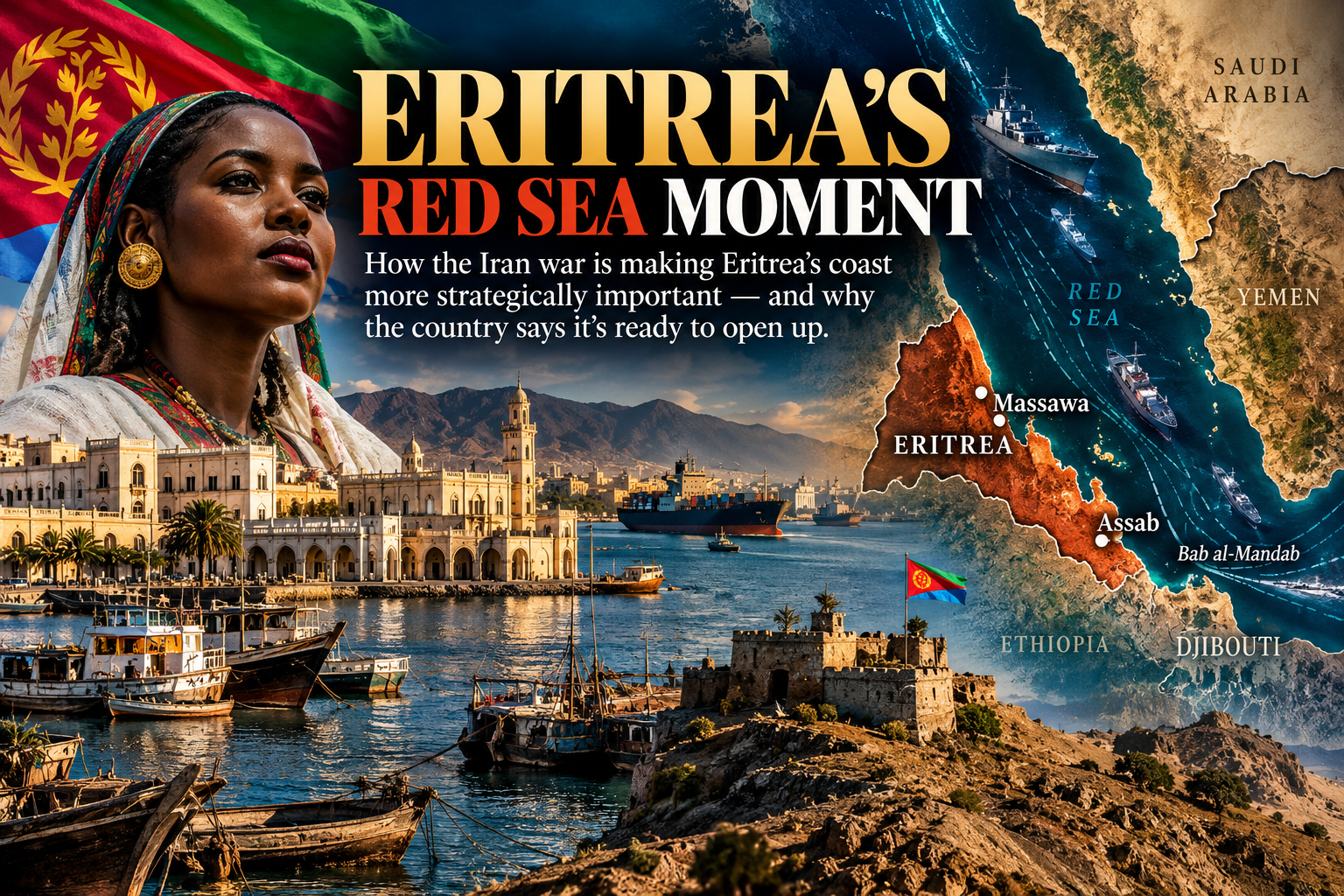
Eritrea’s position is difficult to ignore. The country has roughly 1,000 kilometers of Red Sea coastline, including access to the ports of Massawa and Assab. Its waters lie close to the Bab al-Mandab, the strategic maritime passage connecting the Red Sea with the Gulf of Aden and the wider Indian Ocean.
A country emerging from isolation
For decades, Eritrea has maintained a highly controlled political and economic system. Foreign journalists have had limited access, while international observers have criticized the government over political freedoms and its system of prolonged national service.
Reuters’ latest reporting offers a rare look inside the country, including the experiences of Eritreans whose lives were shaped by the long independence struggle against Ethiopia.
The country’s modern identity remains deeply connected to that war. Eritrea gained independence in 1993 after a decades-long armed struggle, and the government that emerged from that conflict has maintained a strong emphasis on national sovereignty and self-reliance.
That history helps explain why Asmara has traditionally been cautious about foreign influence.
Now, however, Eritrean officials are signaling that the country may be ready for a different relationship with the outside world.
The Red Sea has become more valuable
The strategic equation changed dramatically as the war involving Iran disrupted established patterns of energy transportation and maritime trade.
The Strait of Hormuz, another crucial global shipping chokepoint, has faced severe disruption during the conflict. At the same time, threats to commercial shipping around Yemen have increased the importance of alternative routes and safer maritime corridors.
That has placed the Red Sea under an even brighter geopolitical spotlight.
Reuters reports that Eritrean waters have emerged as potentially important to maritime trade because of their location along one of the world’s major shipping routes.
For Eritrea, geography has suddenly become a major strategic asset.
The country sits directly across the Red Sea from the Arabian Peninsula, with Saudi Arabia and Yemen on the opposite side of the waterway. Its location gives it proximity to some of the most important maritime and military routes connecting Europe, the Middle East, Africa and Asia.
Assab and Massawa

Eritrea’s two principal Red Sea ports, Massawa and Assab, are therefore attracting renewed attention.
Massawa has historically served as an important commercial port and gateway to Eritrea’s interior. Assab, farther south, is positioned closer to the Bab al-Mandab and has previously attracted military interest from foreign powers.
The significance of these ports extends beyond Eritrea’s borders.
Control, access or cooperation along this coastline could influence shipping, logistics, energy security and military operations throughout the Red Sea region.
That makes Eritrea increasingly difficult for regional and global powers to ignore.
Ethiopia remains the central complication
Eritrea’s opening to the world is occurring at the same time that relations with neighboring Ethiopia have deteriorated sharply.
The two countries fought a devastating border war from 1998 to 2000 before eventually reaching a historic rapprochement in 2018. But that peace has deteriorated in recent years, particularly over Ethiopia’s desire for reliable access to the Red Sea.
Ethiopia is landlocked and has repeatedly emphasized the importance of maritime access for its economy and national security.
For Eritrea, however, sovereignty over its ports and coastline is non-negotiable.
The dispute has become increasingly dangerous because it intersects with the renewed fighting in northern Ethiopia. Reuters reported earlier this month that Ethiopia and Eritrea severed diplomatic relations after Addis Ababa closed its embassy in Asmara and expelled Eritrean diplomats.
The renewed conflict in Ethiopia has also drawn Sudan, Egypt and Gulf states into a complicated network of competing interests.
A new balance of power around the Horn
The Horn of Africa is becoming one of the world’s most contested geopolitical regions.
Saudi Arabia, the United Arab Emirates, Egypt, Turkey, Iran, Israel, the United States, China and European powers all have varying strategic interests in the Red Sea and surrounding countries.
The competition is about much more than military positioning.
It involves ports, shipping corridors, energy supplies, telecommunications, mineral resources, agriculture, logistics and access to emerging African markets.
Eritrea’s coastline gives the country a potentially powerful bargaining position.
Earlier this year, the United States was reported to be preparing to lift sanctions against Eritrea, with analysts connecting the decision to the country’s strategic position along the Red Sea. Reuters reported that Washington viewed improved relations with Asmara as potentially important amid growing regional tensions.
That development suggests that Eritrea’s international isolation may be entering a new phase.
Opening up — but on Eritrea’s terms
The question is whether Eritrea’s strategic importance will translate into broader economic and political opening.
The government says it is ready to engage more with the world. But opening the country will require navigating difficult questions about national service, political freedoms, investment, infrastructure and relations with neighboring states.
Eritrea’s leadership has historically been suspicious of external pressure. Any new engagement is therefore likely to be carefully controlled and designed around national sovereignty.
The country’s leaders may see the current geopolitical environment as an opportunity: Eritrea can offer something the major powers increasingly need — strategic geography.
Africa’s Red Sea opportunity
For Africa, Eritrea’s changing position represents something larger than a story about one country.
The Red Sea is an African maritime frontier.
From Eritrea and Djibouti to Sudan, Egypt and Somalia, African states sit alongside one of the world’s most important trade corridors. Yet foreign military bases, overseas investments and competing geopolitical interests have often dominated discussions about the region.
The growing importance of Eritrea could create opportunities for African governments to negotiate greater economic value from their geographic position.
Ports can become logistics hubs. Shipping corridors can support industrial development. Maritime security can generate new partnerships. And investment in infrastructure can connect African producers to markets stretching from the Mediterranean to Asia.
But the risks are equally significant.
If the Red Sea becomes another arena for confrontation between global powers, African coastal states could find themselves caught between competing military and economic blocs.
Eritrea’s moment
The Iran war has not created Eritrea’s strategic importance. Geography gave Eritrea that importance long ago.
What has changed is the world’s attention.
A country once viewed primarily through the lens of isolation, authoritarianism and its troubled relationship with Ethiopia is now being examined as a potentially important actor in the future of Red Sea security.
The question facing Asmara is whether it can transform that strategic advantage into sustainable economic development without surrendering the sovereignty and independence that have defined the Eritrean state since its birth.
For the rest of Africa, the Eritrean story is a reminder that geography can become geopolitical power almost overnight.
As global shipping routes shift and the competition for influence around the Red Sea intensifies, Eritrea’s coastline may become one of the continent’s most strategically valuable assets.
Source: Reuters, reporting from Asmara, October 5, 2026.
Leave a Reply