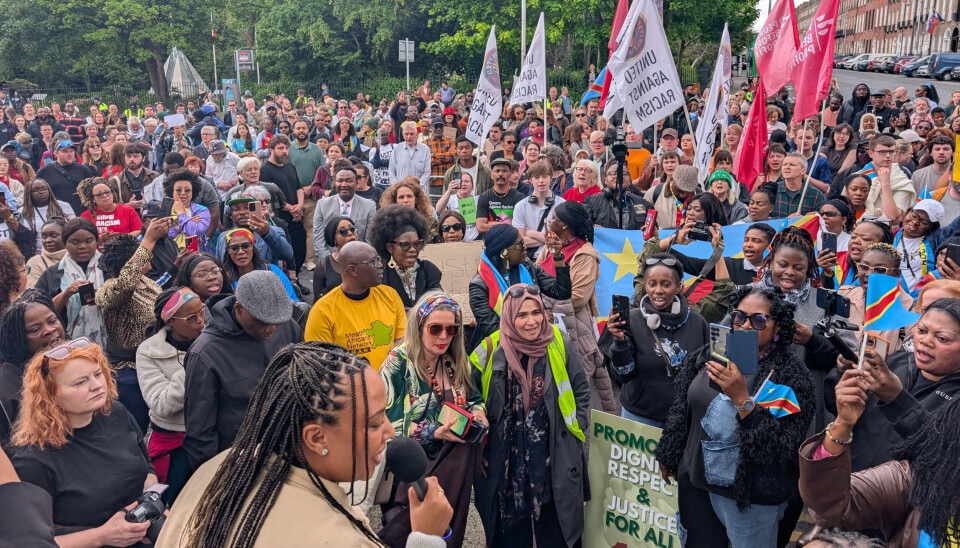
The streets surrounding Ireland’s parliament in Dublin filled with anger, grief, and demands for accountability on Thursday, May 21, after the death of Congolese-born Yves Sakila during a restraint incident outside a department store ignited protests across the country. Demonstrators carried signs calling for justice, anti-racism reforms, and an independent investigation into the circumstances surrounding Sakila’s death, which has quickly become a national flashpoint in conversations about race, policing, and immigrant rights in Ireland.
The protest follows the circulation of a widely shared video showing Sakila pinned to the ground by several men for several minutes outside a Dublin retail location. Witnesses and activists say the footage has deeply disturbed many across Ireland and the wider African diaspora, with critics arguing that the incident reflects broader issues of systemic discrimination and excessive use of force against Black communities and migrants in Europe.
Yves Sakila, originally from the Democratic Republic of Congo, reportedly died after the confrontation last week. While authorities have launched an investigation into the incident, demonstrators say the response has not gone far enough. Protesters gathered outside the Irish parliament demanding transparency, accountability, and immediate answers regarding who was involved in the restraint and whether proper procedures were followed.
For many African immigrants living in Ireland, Sakila’s death has reopened long-standing frustrations surrounding racial profiling, unequal treatment, and what activists describe as a lack of institutional protection for minority communities. Advocacy groups and community leaders at the protest stressed that this was not simply an isolated tragedy but part of a larger European conversation around race relations, policing culture, and the treatment of African migrants.
The demonstrations in Dublin drew a broad coalition of activists, students, migrant organizations, and human rights groups. Chants of “Justice for Yves” echoed through the streets as speakers called on the Irish government to confront racism more directly. Several speakers emphasized that Black residents in Ireland often experience discrimination in housing, employment, nightlife, and public spaces while also facing disproportionate scrutiny from security personnel and law enforcement.
The case has also resonated internationally, particularly among Pan-African communities monitoring the experiences of Africans abroad. Across social media, users from Ghana, Nigeria, Liberia, South Africa, the United States, and the Congo have shared solidarity messages, comparing the incident to other high-profile restraint deaths involving Black individuals in Europe and North America.
The tragedy arrives at a moment when Ireland itself is undergoing major demographic and cultural changes. Immigration has reshaped many Irish cities over the past two decades, bringing larger African, Middle Eastern, and Eastern European communities into a country once considered relatively homogenous. While many immigrants have successfully integrated into Irish society, racial tensions and anti-immigrant sentiment have increasingly surfaced in political debates, online discourse, and public demonstrations.
Some activists at Thursday’s protest warned that the rise of nationalist rhetoric and anti-immigration campaigns across parts of Europe has contributed to a climate where minority communities feel increasingly vulnerable. Others argued that the death of Yves Sakila should force Ireland to examine whether its institutions are adequately prepared to protect an increasingly diverse population.
Civil rights advocates are now calling for multiple reforms, including mandatory anti-racism training, independent oversight mechanisms for restraint incidents, clearer rules governing the use of force by security personnel, and expanded legal protections for migrants and ethnic minorities. Organizers also called for support services for African families navigating trauma and discrimination in the diaspora.
The protest remained largely peaceful, though emotions ran high as mourners held candles, flowers, and Congolese flags in honor of Sakila’s memory. Many participants described the demonstration not only as a demand for justice but also as a statement of visibility — a reminder that African communities in Ireland are demanding to be heard, respected, and protected.
As investigations continue, the death of Yves Sakila may become a defining moment in Ireland’s evolving conversation around race, immigration, and national identity. For many protesters, the issue now extends beyond one tragic incident. It has become a broader struggle over whose lives are valued, whose voices are protected, and what kind of multicultural future Ireland intends to build.
Leave a Reply