
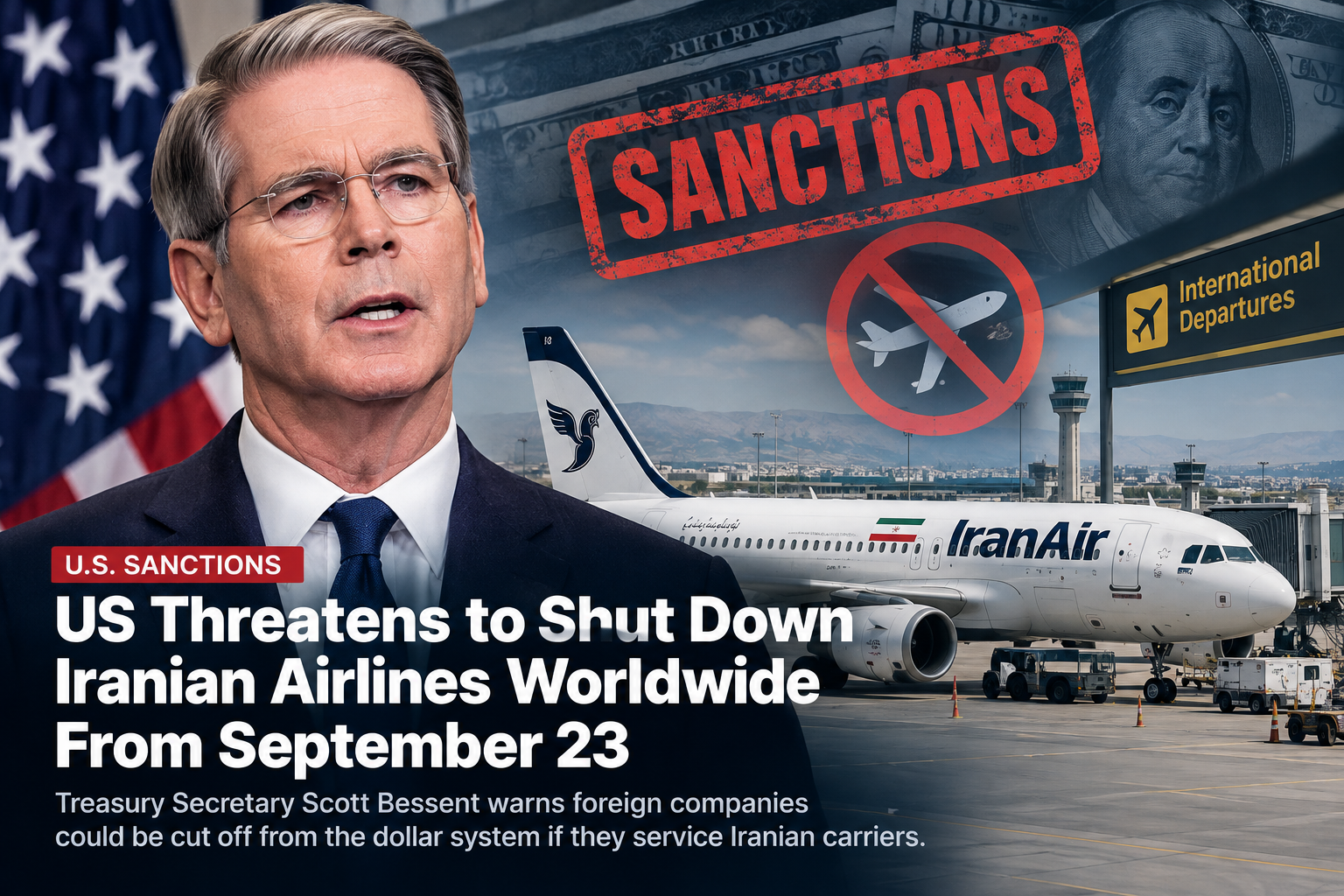
WASHINGTON — U.S. Treasury Secretary Scott Bessent has warned that Iranian airlines could effectively be cut off from international aviation services from September 23, as Washington intensifies its economic pressure campaign against Tehran.
Speaking to CNBC on Monday, September 21, Bessent said the United States intended to prevent Iranian carriers from operating normally around the world by targeting the foreign companies and aviation facilities that provide essential services to them.
“On September 23, all the Iranian airlines will be shut down around the world,” Bessent said, according to reports of the interview. (Anadolu Ajansı)
The warning represents an expansion of the U.S. sanctions strategy beyond Iranian airlines themselves. Under the approach outlined by Bessent, foreign airports, fuel suppliers, ground-service companies and ticketing operators that continue supporting Iranian carriers could face consequences involving access to the U.S. dollar financial system.
Threat of Losing Access to the Dollar System
Bessent said companies servicing Iranian aircraft would face a choice between continuing to provide services to Iranian airlines and maintaining access to the dollar-based international financial system.
“If they land, you cannot provide them with fuel, you cannot provide them with landing services, you cannot sell them tickets, or you will be knocked out of the dollar system,” he said. (The Straits Times)
The warning is significant because international airlines depend on a network of foreign service providers to operate flights outside their home countries. Aircraft require fuel, airport handling, landing facilities, maintenance and other ground services, while airlines also depend on ticketing and distribution networks to sell seats.
The U.S. strategy therefore seeks to make it difficult for Iranian carriers to maintain international operations by discouraging third-party companies from doing business with them.
Iranian Aviation Already Under Pressure
Iran’s aviation industry has faced extensive restrictions for years as a result of U.S. and other international sanctions. Those measures have complicated the country’s ability to acquire aircraft, spare parts and maintenance services.
The latest measures could place additional pressure on carriers including Iran Air, Mahan Air and Qeshm Air, which maintain international operations to varying degrees. The National reported that the proposed restrictions could leave Iran increasingly dependent on foreign airlines for international air connections. (The National)
Recent reporting also indicates that the pressure is already affecting Iranian aviation. The Financial Times reported that Mahan Air had suspended international flights to destinations including Istanbul, Ankara and Muscat amid intensified U.S. sanctions targeting Iran’s aviation sector and the companies supporting it. (Financial Times)
Iranian Aviation: International Footprint
September 2026 international scheduled aviation data. China, Türkiye, Iraq and the UAE account for 92.2% of Iran’s international capacity.
Source: OAG September 2026 data, as reported by Aviation Week. The country figures represent international scheduled aviation capacity rather than an aircraft-by-aircraft fleet count.
Secondary Sanctions Could Affect Foreign Businesses
The proposed action is particularly significant because it would target not only Iranian entities but also foreign businesses that provide services to them.
Secondary sanctions are designed to discourage third-country companies from conducting specified transactions with sanctioned entities by threatening them with restrictions on access to U.S. markets or financial infrastructure.
Bessent’s comments indicate that Washington is prepared to use the importance of the dollar system as leverage against companies that continue to support Iranian commercial aviation.
The Treasury secretary has also said that Washington has been engaging with Chinese financial authorities over compliance with the U.S. sanctions campaign. Reuters reported that Bessent described Chinese officials as being engaged in discussions over the measures. (The Economic Times)
Potential Impact on International Travel
If foreign airports and service providers broadly comply with the U.S. demands, Iranian airlines could face significant difficulties maintaining flights outside Iran.
A carrier unable to obtain fuel, landing services or other essential airport support could be forced to cancel or suspend routes even if its aircraft remain technically capable of flying.
The restrictions could also affect passengers who rely on Iranian airlines for international travel, potentially reducing the number of direct connections between Iran and destinations in the Middle East, Asia and elsewhere.
However, the precise extent of the impact will depend on how individual countries, airports, aviation companies and financial institutions respond to the U.S. measures. Analysts quoted by The National noted that enforcement and the willingness of companies around the world to comply would be important factors in determining the outcome. (The National)
Part of a Wider U.S. Pressure Campaign
The aviation measures form part of a broader U.S. campaign aimed at restricting Iran’s access to international financial and commercial networks.
Earlier this month, Washington imposed additional sanctions targeting Iranian airlines and companies accused of supporting Iran’s aviation sector. The latest threat would extend the pressure by attempting to disrupt the international infrastructure that allows Iranian carriers to operate abroad. (Ahram Online)
For Iran, the measures could further constrain an aviation industry that has already spent years operating under sanctions and facing limited access to international aircraft, components and services.
For foreign aviation companies, meanwhile, the threat creates a potentially difficult commercial calculation: continue servicing Iranian carriers and risk U.S. sanctions, or withdraw those services and potentially contribute to the further isolation of Iran’s aviation sector.
As the September 23 deadline approaches, attention is now turning to how airports, fuel providers, ticketing companies and airlines in different countries respond to Washington’s warning.
The immediate question is not simply whether Iranian airlines can physically fly, but whether they will be able to obtain the international services and financial support required to sustain those flights.
Leave a Reply