
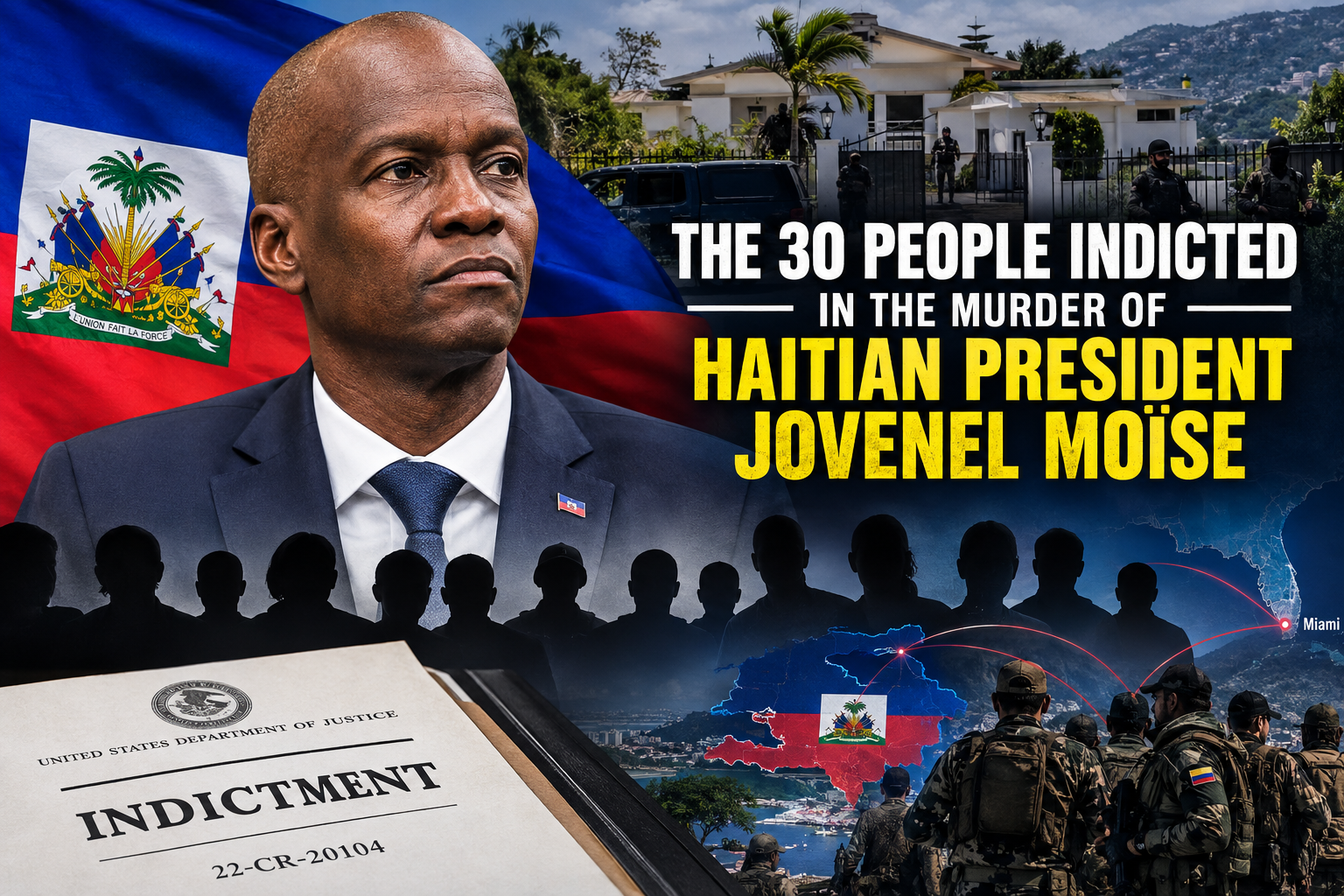
By September 2026, the investigation into the assassination of Haitian President Jovenel Moïse has expanded into a major U.S. federal case involving 30 defendants. The allegations describe a multinational conspiracy involving Haitian political and security figures, Colombian former soldiers, alleged financiers, and people accused of using U.S. COVID-relief funds to help finance the operation.
The assassination of Haitian President Jovenel Moïse on July 7, 2021, shocked Haiti and reverberated throughout the Caribbean and the wider international community. More than five years later, the case remains extraordinarily complicated. Investigators in Haiti have pursued dozens of suspects, while American prosecutors have developed a parallel federal case in South Florida.
The latest development came on September 21, 2026, when the U.S. Department of Justice announced that a federal grand jury in the Southern District of Florida had indicted 30 people in connection with different aspects of the alleged conspiracy. Eighteen defendants were transported from Haiti to Miami to face federal charges, while other defendants are accused of financial crimes connected to the alleged operation.
It is important to distinguish this 30-person U.S. indictment from the separate Haitian judicial investigation. In Haiti, an investigating judge indicted 51 people in 2024, including former First Lady Martine Moïse, former Prime Minister Claude Joseph and former police chief Léon Charles.
The following account concerns the 30 defendants in the newly unsealed U.S. federal case.
The assassination of Jovenel Moïse
Jovenel Moïse, a businessman who entered politics and became president of Haiti in 2017, was killed at his private residence in the hills above Port-au-Prince during the early hours of July 7, 2021.
According to Haitian investigators and subsequent U.S. court proceedings, an armed group entered the presidential compound. Moïse was shot and killed, while his wife, Martine Moïse, was seriously wounded.
The attack immediately raised questions about how a heavily protected head of state could be killed inside his own home.
The Haitian investigation later examined allegations that some members of the presidential security apparatus had failed to protect the president. It also investigated claims that people inside and outside Haiti had been involved in a much broader conspiracy.
The U.S. investigation has focused particularly on an alleged plan involving people in Haiti, the United States and Colombia.

What the new U.S. indictment alleges
According to the U.S. Department of Justice, the 30 defendants were indicted for different roles in what prosecutors describe as a coordinated conspiracy.
The government says at least 22 of the defendants were involved in the alleged conspiracy to kill or kidnap Moïse, while four others face charges relating specifically to an alleged Paycheck Protection Program (PPP) and Economic Injury Disaster Loan (EIDL) fraud and money-laundering scheme. One defendant, Byron Sherrod Rainer, appears in both categories.
The indictment alleges that conspirators:
- helped finance the operation;
- recruited personnel;
- provided logistical assistance;
- traveled between the United States and Haiti;
- arranged weapons and other resources;
- communicated through encrypted channels; and
- allegedly used fraudulently obtained U.S. COVID-relief money in connection with the operation.
The alleged conspiracy therefore goes beyond the men who physically entered Moïse’s residence. Prosecutors are attempting to establish a network encompassing planning, recruitment, financing and logistical support.
That distinction is important because being indicted does not mean that a person has been convicted or that every allegation against that person has been proven. The Justice Department itself emphasizes that an indictment is an allegation and that defendants are presumed innocent unless proven guilty beyond a reasonable doubt.
The 23 defendants accused in the alleged assassination conspiracy
The Justice Department lists 23 people under the portion of the indictment concerning the alleged conspiracy to kill or kidnap President Moïse.
1. Christian Emmanuel Sanon
Sanon, also known by several aliases including Kumbe, Pumba, Bubba and “Mr. President,” is one of the best-known defendants in the case.
He is a Haitian-American pastor and businessman. Earlier U.S. allegations portrayed him as an important figure in the plan and as someone who envisioned a political role for himself in Haiti.
Sanon was previously among the defendants prosecuted in the United States in connection with the Moïse case.
2. Byron Sherrod Rainer
Rainer, who used aliases including B. Ellis Rains, Byron Rain and Byron Ellis, is accused of participating in the alleged conspiracy.
His case is particularly significant because he is also charged in the alleged PPP-EIDL fraud and money-laundering component of the investigation.
3. Joseph Felix Badio
Joseph Felix Badio, known as “Cousin,” has long been one of the most prominent Haitian suspects in the Moïse investigation.
Badio was formerly associated with Haiti’s Ministry of Justice and had worked with an anti-corruption unit. He became a central figure in the investigation into the assassination.
U.S. prosecutors now include him among those charged in the alleged conspiracy to kill or kidnap Moïse.
4. Vitel’Homme Innocent
Vitel’Homme Innocent is a Haitian armed-group leader who has been wanted by authorities in connection with serious crimes in Haiti.
The new U.S. indictment places him among those accused of offenses arising from the alleged conspiracy against Moïse.
5. Carlos Giovanni Guerrero Torres
Guerrero Torres, also known as “Don Francisco,” is one of several Colombian nationals named in the indictment.
His inclusion reflects the international character of the operation described by U.S. prosecutors.
6. Victor Albeiro Pineda Cardona
Pineda Cardona, known as “Pipe,” is another Colombian defendant accused in the alleged assassination conspiracy.
7. Juan Carlos Yepes Clavijo
Yepes Clavijo, known as “Woker,” is listed among the defendants accused of offenses arising from the alleged plot.
8. Naiser Franco Castaneda
Castaneda, also known as “Esneider,” is another Colombian defendant named by federal prosecutors.
9. Angel Mario Yarce Sierra
Yarce Sierra is accused of participating in the alleged conspiracy.
10. Jheyner Alberto Carmona Flores
Carmona Flores, known as “Joseph,” is one of the Colombian nationals named in the case.
His family has previously disputed allegations against him. In reporting on the Haitian proceedings, his wife, Milena Carmona, said he was innocent.
11. Edwin Enrique Blanquicet Rodriguez
Blanquicet Rodriguez, known as “Daniel,” is named as a defendant in the alleged assassination conspiracy.
12. Manuel Antonio Grosso Guarin
Grosso Guarin, known as “Mauricio,” is another Colombian defendant.
13. Jhon Jairo Ramirez Gomez
Ramirez Gomez, known as “Danny,” is accused in the conspiracy described in the indictment.
14. Francisco Eladio Uribe Ochoa
Uribe Ochoa, known as “Cristian,” is another Colombian defendant named in the case.
15. Alejandro Giraldo Zapata
Giraldo Zapata, known as “Alexander,” is accused of participating in the alleged operation.
16. Neil Caceres Duran
Caceres Duran, known as “Anderson,” is included among the defendants facing charges arising from the alleged conspiracy.
17. Jhon Jader Andela
Andela is named by federal prosecutors as a defendant in the alleged assassination conspiracy.
18. Enalber Vargas Gomez
Vargas Gomez, known as “Victor,” is another defendant identified in the federal case.
19. John Jairo Suarez Alegria
Suarez Alegria, known as “Angel,” is accused of offenses arising from the alleged conspiracy.
20. Gersain Mendivelso Jaimes
Mendivelso Jaimes is named among the defendants accused of participating in the alleged operation.
21. Alex Miyer Peña
Peña, known as “Holman,” is another Colombian defendant in the case.
22. Samir Handal
Handal is among the defendants charged in connection with the alleged conspiracy against Moïse.
23. Ashkard Pierre
Pierre is the final defendant listed by the Justice Department under the assassination-conspiracy portion of the indictment.
The four defendants connected to the alleged COVID-relief fraud
The case also contains a financial dimension.
The Justice Department says four defendants face charges arising from an alleged PPP-EIDL fraud and money-laundering scheme. These programs were established to provide financial assistance to businesses affected by the COVID-19 pandemic.
The four are:
- Byron Sherrod Rainer
- Jameela Ammara Simmons
- Marcel Williamson
- Travis Barrett Nave
Rainer is therefore listed in both the alleged assassination conspiracy and the financial-crime component of the indictment.
The Justice Department alleges that money obtained through the COVID-relief programs was connected to financing the assassination plot.
That allegation gives the case an unusual financial dimension: prosecutors are not merely attempting to reconstruct what happened in Haiti but are also examining how money allegedly moved through U.S. financial institutions and relief programs.
Why are there 30 defendants if only 27 names appear in the DOJ’s two lists?
There is an apparent numerical issue in the Justice Department’s September 21 announcement.
The department describes the case as involving 30 defendants, but its public release lists 23 defendants in the alleged assassination-conspiracy category and four defendants in the PPP-EIDL category, with Rainer appearing in both. That produces 26 unique names, not 30.
The same release says that at least 22 newly named defendants directly participated in the multinational conspiracy.
Because the indictment itself is the controlling legal document, rather than the summary press release, the complete charging documents should be consulted for the precise count and individual charges. The Justice Department provides the indictment through its case announcement and identifies the federal case as 22-cr-20104.
This discrepancy is worth noting rather than silently assuming that every number in a press summary is internally consistent.
The Colombian connection
One of the most striking features of the Moïse case is the involvement of former Colombian military personnel.
The assassination investigation in Haiti identified numerous Colombians who had traveled to Haiti. Many had previous military experience.
The men became widely described as mercenaries, although the precise role and knowledge of individual participants has been disputed.
In 2025, the Associated Press reported that approximately 20 suspects remained imprisoned in Haiti, most of them Colombian former soldiers. Some told investigators that they believed they were participating in another type of mission and disputed responsibility for the assassination.
The U.S. case consequently involves questions that go beyond simply identifying the gunmen: Who recruited the Colombians? Who paid them? What were they told they were going to do? Who supplied weapons and transportation? And when did an alleged plan to remove or kidnap Moïse become a plan to kill him?
Those questions have been central to the prosecution.

From alleged kidnapping to assassination
Earlier U.S. prosecutions in the case alleged that the original plan involved kidnapping Moïse rather than killing him.
According to prosecutors, however, the operation changed.
A number of defendants previously pleaded guilty to charges connected to a conspiracy involving the kidnapping of Moïse, with the alleged objective of installing a new government.
In May 2026, a federal jury in Miami convicted four defendants—Arcangel Pretel Ortiz, Antonio Intriago, Walter Veintemilla and James Solages—of offenses connected to the conspiracy. The convictions included charges involving material support, conspiracy to kill and kidnap a person outside the United States, conspiracy to commit offenses against the United States and expedition against a friendly nation.
These convictions are significant because they demonstrate that the U.S. investigation has already progressed beyond allegations in several instances.
At the same time, they should not automatically be treated as proof against every person named in the much larger indictment. Each defendant’s individual conduct and criminal liability must be established separately.
The Haitian investigation: a much larger circle
The U.S. indictment is only one part of the story.
In January 2024, Haitian investigating judge Walther Wesser Voltaire issued a judicial order naming 51 people in connection with the assassination investigation.
That list included several prominent Haitian political and security figures.
Among them were:
- Martine Moïse, the president’s widow;
- Claude Joseph, a former prime minister;
- Léon Charles, who was director-general of Haiti’s National Police;
- Christian Emmanuel Sanon;
- Joseph Felix Badio;
- Dimitri Hérard, a former presidential security official;
- former senator John Joël Joseph; and
- numerous Colombian nationals and Haitian police officers.
The Haitian judge’s document alleged a variety of offenses, including assassination, attempted assassination, armed robbery, illegal weapons possession, conspiracy against state security, criminal association and complicity.
These Haitian charges are not the same thing as the U.S. federal indictment.
That distinction is essential when discussing the case because different defendants have been accused under different legal systems, with different evidence and different allegations.
The controversy surrounding Martine Moïse and Claude Joseph
The Haitian investigation generated an especially controversial development when investigators accused former First Lady Martine Moïse and former Prime Minister Claude Joseph of involvement.
According to the Haitian judge’s report, investigators alleged that the two had participated in a conspiracy connected to the president’s death and that Martine Moïse wanted to succeed her husband.
Both have denied wrongdoing.
Joseph accused the political leadership that followed Moïse of using the justice system against political opponents, while Martine Moïse described the accusations against her as political persecution. Reuters reported that a spokesperson for then-Prime Minister Ariel Henry’s office rejected the idea that the judge’s actions were politically directed and said the judge was independent.
The allegations against the former first lady therefore remain a particularly contested part of the Haitian investigation and should not be presented as established facts.
Why has the case taken so long?
One reason the Moïse assassination has remained unresolved is the severe deterioration of Haiti’s security and judicial institutions.
The investigation has been transferred between judges. Some judges resigned after receiving threats. Lawyers and judicial officials have faced serious security risks.
In 2024, gangs seized control of areas surrounding major government institutions and prisons. A prison break resulted in the escape of numerous inmates, including suspects connected to the Moïse investigation.
By June 2025, the Associated Press reported that none of the suspects imprisoned in Haiti had yet faced trial in the assassination case. The investigation had been repeatedly disrupted by violence, threats and the collapse of normal judicial operations.
This has created an extraordinary situation in which the United States has been able to advance its own prosecutions while Haiti, the country where the assassination occurred, has struggled to bring its detained suspects before a functioning criminal court.
The 2026 transfer to Miami
The most dramatic recent development occurred in September 2026.
The U.S. government transported 18 defendants from Haiti to Miami to face federal charges.
The operation involved the FBI’s Hostage Rescue Team, FBI Miami agents and Homeland Security Investigations personnel. The defendants were transported aboard a U.S. military aircraft amid security concerns surrounding the Port-au-Prince airport.
The Justice Department described the move as a major new phase in its investigation.
The transfer is important because it places numerous suspects previously held in Haiti under the jurisdiction of the U.S. federal court system.
The case is being prosecuted in the Southern District of Florida, where prosecutors have been investigating the American side of the alleged conspiracy for years.
Why South Florida?
South Florida has emerged as a major center of the investigation because several alleged conspirators had connections to the region.
The U.S. prosecution has examined activities that allegedly took place in Florida before the assassination, including financing, recruitment, communications and business dealings.
The financial allegations also have a direct U.S. connection because prosecutors say COVID-relief programs were exploited as part of the alleged financing mechanism.
The case therefore illustrates how an assassination carried out in Haiti can become a U.S. federal criminal matter when significant elements of the alleged conspiracy occur within the United States.
What happens next?
The defendants now face the American federal criminal process.
Some may contest the charges. Others could negotiate plea agreements. Still others could proceed to trial.
For defendants accused of participating directly in the alleged assassination conspiracy, prosecutors will have to establish the elements of the particular federal offenses charged against them.
For those accused of financial crimes, the government will have to prove the alleged fraud, financial transactions and connection to the broader scheme required by the applicable statutes.
The Justice Department says certain defendants could face a maximum sentence of life imprisonment if convicted, although an actual sentence would depend on the charges of conviction, federal sentencing guidelines and other statutory factors.
A case that crosses borders and institutions
The Moïse assassination is unusual because almost every part of the investigation crosses a national boundary.
The victim was Haiti’s president.
The alleged political conspiracy unfolded primarily in Haiti.
Many of the alleged combatants were Colombian.
Some alleged organizers and financiers had connections to the United States.
The financial investigation involves U.S. government COVID-relief programs.
And the current federal prosecution is taking place in Miami.
The case therefore involves Haitian police and courts, Colombian nationals and authorities, U.S. federal investigators and prosecutors, and international law-enforcement cooperation.
The unanswered questions
Despite years of investigation, some of the most important questions surrounding the assassination remain contested or unresolved.
Who ultimately ordered Moïse’s killing?
The investigations have identified numerous alleged participants, but establishing the complete chain of command is considerably more difficult than identifying people who allegedly supplied weapons, money or transportation.
What was the original objective?
Earlier U.S. prosecutions centered on an alleged plan to kidnap Moïse. Prosecutors later alleged that the plan changed into an assassination.
Who financed the operation?
The new U.S. indictment adds an important financial dimension, alleging that COVID-relief funds were fraudulently obtained and used in connection with the plot.
What did individual participants know?
This may be particularly important for the Colombian defendants. An individual’s presence in Haiti or association with other suspects does not, by itself, establish that the person knew of or participated in an assassination conspiracy.
Why was presidential security unable to prevent the attack?
The Haitian investigation has examined the actions of security officers before and during the attack, including allegations of failures, bribery and abandonment of posts. These allegations remain part of the broader investigation.
Will Haiti eventually conduct trials?
That remains a major question. The country’s judicial system has been severely disrupted by violence, and the inability to conduct trials for detained suspects has been one of the most persistent problems in the investigation.
The significance of the 30-defendant U.S. case
The September 2026 indictment represents a substantial expansion of the American prosecution.
The case is no longer limited to a small group of men accused of physically carrying out an attack. U.S. prosecutors are pursuing allegations involving recruitment, financing, logistics, weapons, communications and financial fraud.
At the same time, the case should not be understood as a single uniform allegation against 30 people. The defendants face different accusations, and some are charged principally with financial crimes rather than the alleged assassination conspiracy.
The distinction between allegation, indictment, conviction and established fact is particularly important here.
Several people connected to the wider Moïse investigation have already been convicted in the United States. Others have pleaded guilty. But many of the people newly named in the 2026 indictment have yet to have their cases adjudicated.
Conclusion
Five years after Jovenel Moïse was killed inside his home, the search for accountability has entered a new stage.
The latest U.S. case describes a multinational network allegedly involving Haitian figures, Colombian former soldiers, people based in the United States and individuals accused of manipulating American COVID-relief programs.
The September 2026 transfer of 18 defendants from Haiti to Miami brings many of the suspects into a federal court system capable of conducting trials despite the continuing instability inside Haiti. The Justice Department says its investigation remains active and that it is continuing to pursue people alleged to have financed, organized, facilitated or supported the operation.
But the story is far from settled.
The U.S. prosecution and the Haitian investigation have produced overlapping—and sometimes conflicting—accounts of what happened, who was responsible and what the ultimate objective of the conspiracy was. Haiti’s separate judicial process has implicated a much larger group of people, including prominent political figures, while the U.S. case is concentrating on alleged criminal conduct that prosecutors say crossed into American territory.
Ultimately, the courts will have to determine what each defendant actually did, what each person knew, and whether prosecutors can prove the charges beyond a reasonable doubt.
Until then, the indictment is a roadmap of the allegations—not a final verdict on the people named in it.
Sources: U.S. Department of Justice, Southern District of Florida; U.S. Department of Justice Office of Public Affairs; Associated Press; Reuters.
Leave a Reply