
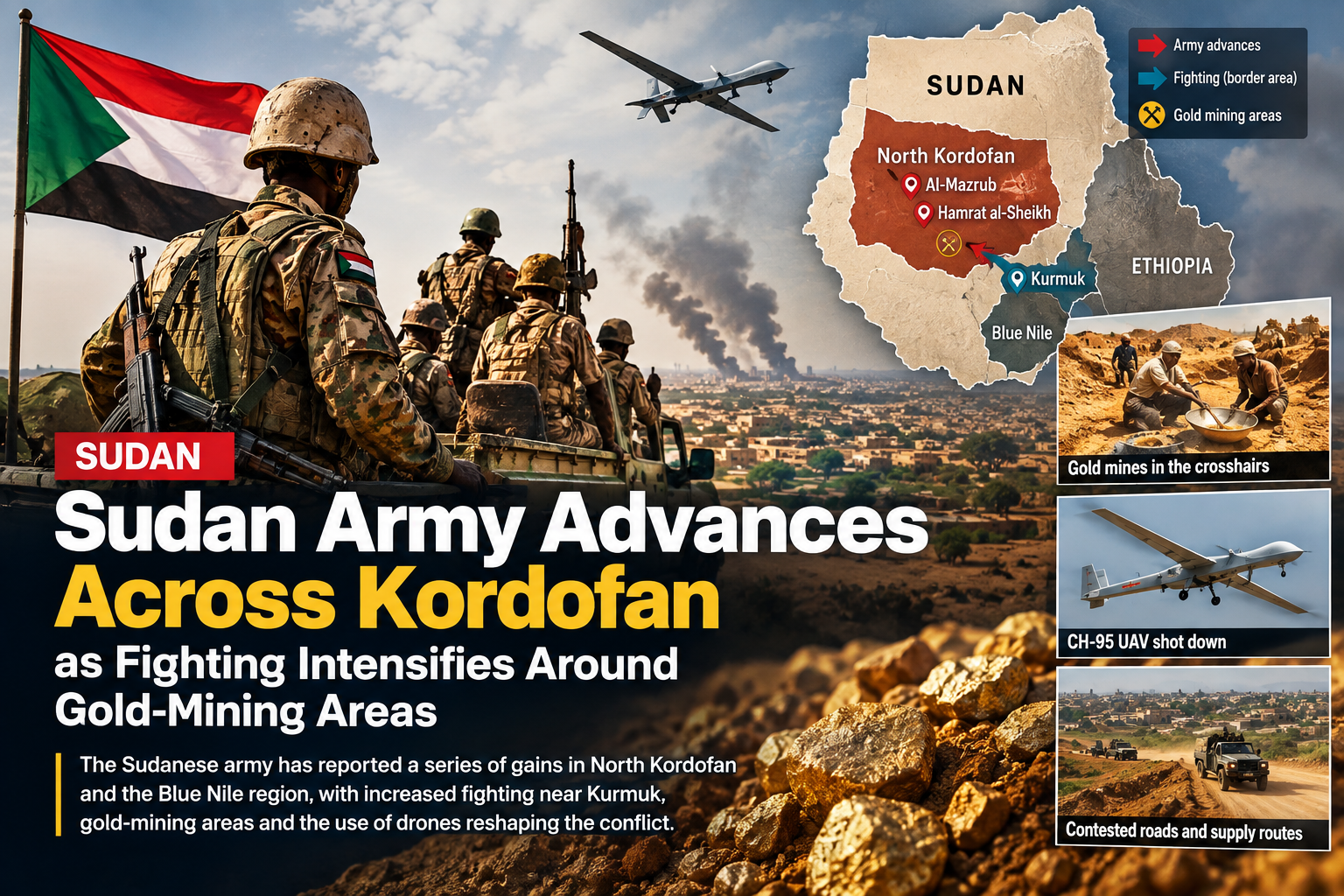
KHARTOUM — Sudan’s war is entering another intense phase as government forces push against the Rapid Support Forces (RSF) across North Kordofan and the Blue Nile region, with recent battlefield developments bringing several strategically important communities and gold-producing areas into focus.
During September, the Sudanese Armed Forces (SAF), supported by allied forces, announced a series of territorial gains in North Kordofan. The army said it had recaptured 11 areas in the state, including Kajmar, Sharshar, Al-Baniyah Al-Kurayniyah, Al-Qulay’at, Awlad Hazmah, Magwildat, Rayshan, Al-Qaa, Ghabat Al-Laqad, Al-Kukaiti and areas surrounding Al-Mazrub. (Sudan Tribune)
The advances have taken place as the army attempts to push RSF forces away from key routes linking central Sudan with the Kordofan and Darfur regions.
Fighting Spreads Along the Ethiopian Border
One of the important fronts remains in southeastern Blue Nile State near Sudan’s border with Ethiopia.
Fighting around the Kurmuk locality has involved the RSF and its ally, the Sudan People’s Liberation Movement-North (SPLM-N). Sudanese authorities have accused forces operating from or through Ethiopian territory of supporting attacks, although individual battlefield claims and the precise extent of cross-border involvement have not always been independently verified.
In mid-September, Sudanese authorities reported that the army had repelled an RSF attack near Jebel Kadam in Kurmuk. (Radio Tamazuj)
By September 21, local authorities reported further army advances northeast of Kurmuk in the areas of Balbung, Midel and Khor al-Hassan. Officials said government and allied forces captured vehicles and an ammunition depot during the operation. (Anadolu Ajansı)
The fighting in Blue Nile demonstrates the increasingly broad geography of Sudan’s conflict, with military activity stretching from the Ethiopian border through Kordofan and toward Darfur.
North Kordofan Becomes a Major Battlefield
The more substantial recent movement has occurred in North Kordofan.
The Sudanese army began a major offensive in the western part of the state after previously capturing Hamrat al-Wiz earlier in September. That operation helped strengthen government control over a supply corridor connecting the region with areas closer to Khartoum. (Sudan Tribune)
The army subsequently announced the capture of 11 additional locations, while military and local sources reported pressure on RSF positions around Sodari, Al-Mazrub, Umm Badr and Hamrat al-Sheikh.
The developments have also produced a significant humanitarian consequence. Thousands of civilians reportedly fled Hamrat al-Sheikh as government and allied forces advanced toward RSF positions, according to local sources and rights monitors cited by Sudan Tribune. (Sudan Tribune)
The RSF has reportedly withdrawn westward from some positions, although the fighting remains fluid and control of territory can change quickly.

Gold Mines Become Part of the Military Struggle
Gold is particularly important in the Kordofan conflict because mining areas provide economic resources in a country where the war has severely disrupted formal economic activity.
The RSF has maintained control over substantial gold-producing territory, particularly in parts of Darfur and Kordofan. Recent fighting has consequently placed mining areas and gold markets directly in the path of military operations.
In September, an RSF-controlled gold-mining area near Al-Nuhud in West Kordofan was the scene of a deadly mine collapse. At least 67 deaths were initially reported by the Sudan Doctors Network, while later local reports put the toll at more than 80. (Sudan Tribune)
The disaster highlighted the wider importance of the gold economy in the conflict. Sudan’s artisanal mining sector employs millions of people and has become an important source of income in areas where state institutions have been weakened by the war.
Meanwhile, local sources reported that RSF fighters attacked and looted a gold market in Umm Badr in North Kordofan as fighting intensified. A local civil-society group said five people were killed and 27 wounded in the attack. The RSF had not immediately commented on those allegations. (Anadolu Ajansı)
Drone Warfare Adds a New Dimension
The ground offensive has been accompanied by increasingly intensive drone operations.
Both the SAF and RSF have incorporated sophisticated unmanned aircraft into their operations, allowing them to conduct reconnaissance and strikes well beyond conventional front lines.
Reports indicate that the RSF has operated Chinese-made CH-95/FH-95 unmanned aircraft. In July, the Sudanese army said it had intercepted and destroyed a CH-95. Open-source reporting has subsequently documented additional claims of Sudanese-operated Bayraktar Akıncı drones engaging CH-95 aircraft associated with the RSF. (Military Africa)
However, attribution of individual drone losses remains difficult. Some reports rely on military statements or battlefield footage, and the operator of a particular aircraft is not always independently confirmed. (Business and Human Rights Centre)
The use of foreign-produced drones illustrates the increasingly international character of Sudan’s war, with both sides relying on imported military technology.
A Strategic Contest Over Supply Routes
The fighting in North Kordofan is important beyond the individual towns being contested.
The region forms a geographical bridge between central Sudan, the western states and Darfur. Control of roads, settlements and supply corridors can therefore affect the ability of both sides to move personnel, ammunition, fuel and other supplies.
The army’s advances around Hamrat al-Wiz and subsequently toward Al-Mazrub and Hamrat al-Sheikh suggest an effort to consolidate positions west of El Obeid and put pressure on remaining RSF strongholds in the region. (Sudan Tribune)
At the same time, the RSF has demonstrated that it can continue operating through mobile forces, drone attacks and raids against economically important locations.
The Challenge of Holding Captured Territory
For the Sudanese military, capturing territory is only one stage of the campaign. Maintaining control of newly occupied areas presents a separate challenge.
The army must secure roads and towns, protect supply lines and prevent RSF forces from returning through attacks on isolated positions. The displacement of civilians from areas around Hamrat al-Sheikh also demonstrates the human cost associated with the territorial struggle. (Sudan Tribune)
The fighting around gold markets adds another layer to the conflict because control of mining communities can affect access to an important source of revenue for armed groups and local populations.
Sudan’s war, which began in April 2023, has already produced a vast humanitarian crisis, with millions displaced and fighting spreading across multiple regions.
For now, the September battlefield developments indicate significant pressure on RSF positions in parts of North Kordofan, while the Blue Nile front remains active around Kurmuk. Whether the Sudanese army can consolidate its recent territorial gains—and whether the RSF can reorganize and mount counterattacks—will determine how the campaign develops in the weeks ahead.
The struggle over territory is therefore also a struggle over roads, population centers, mining areas and the economic resources that sustain the war.
Video reports provide additional visual context. Battlefield claims made by the parties to Sudan’s conflict can be difficult to independently verify.
Leave a Reply