
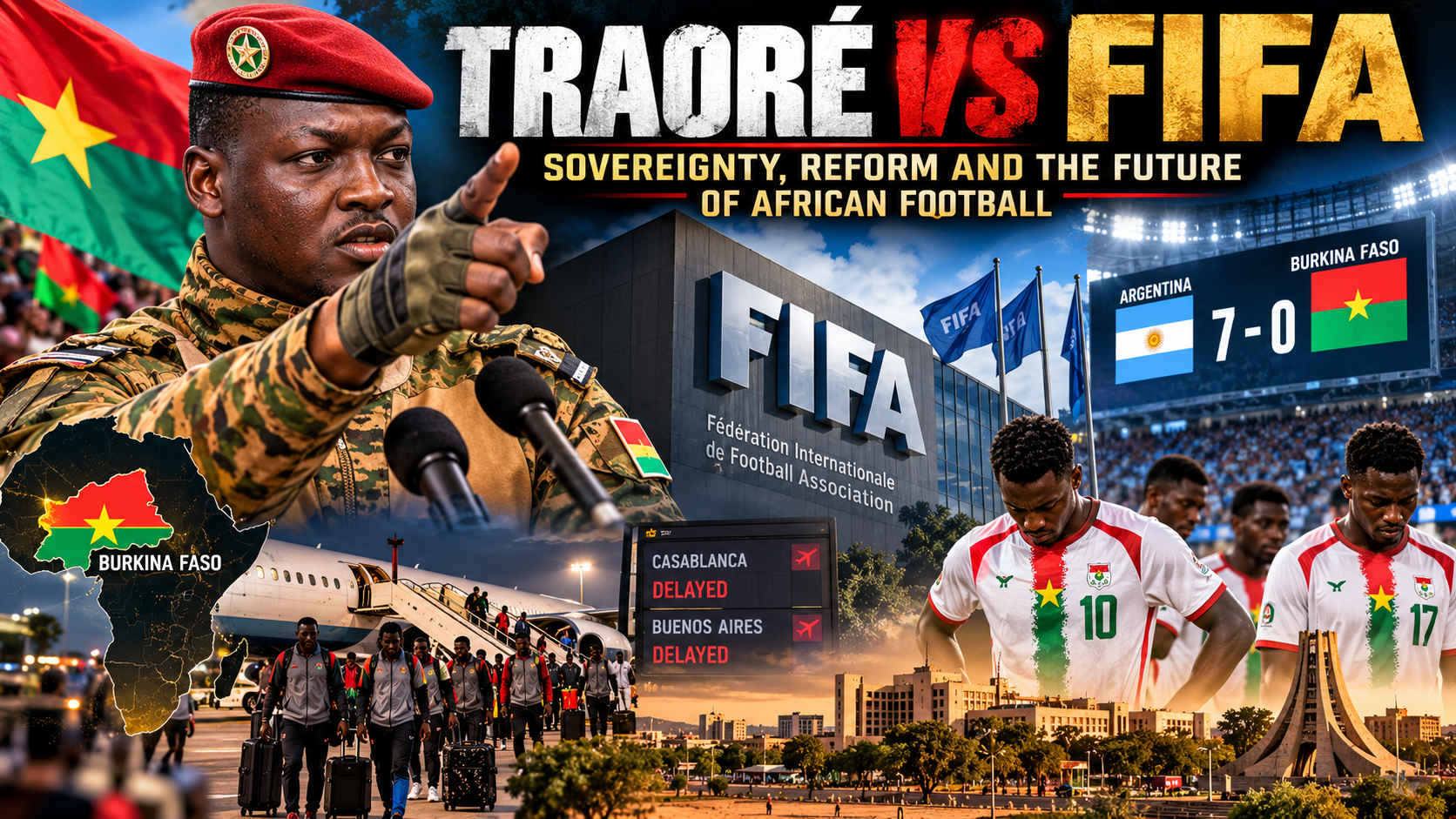
After a chaotic journey to Buenos Aires and a 7–0 defeat to Argentina, Captain Ibrahim Traoré says Burkina Faso must take control of the problems inside its national football system—even if reform brings the country into conflict with FIFA.
The 7–0 defeat of Burkina Faso by Argentina was supposed to be a football story.
Instead, it has become a debate about sovereignty, state responsibility, institutional accountability and who ultimately controls the infrastructure of African national sport.
For Burkina Faso, the scoreline was only part of the story.
The national team arrived in Buenos Aires after a chaotic journey that left the delegation stranded in Casablanca, Morocco, while questions mounted over whether the match would even take place. A largely young squad was ultimately assembled to fulfill the fixture, arriving only hours before kickoff with little time to recover from the journey.
Argentina then overwhelmed Burkina Faso 7–0.
But when the players returned home, the political conversation was no longer simply about a football defeat.
Captain Ibrahim Traoré praised the players for making the journey and fulfilling the national commitment. At the same time, he described the country’s football administration as deeply troubled and indicated that the government was prepared to intervene to correct the system. (UOL)
That statement has placed Burkina Faso on a potential collision course with FIFA.
A Football Match That Exposed a Bigger Problem
The journey to Buenos Aires became controversial after the Burkinabe delegation experienced major transportation problems.
Reports said the original travel arrangements broke down, leaving members of the delegation in Casablanca. The federation was then forced to reorganize the trip, while players faced an extremely compressed schedule before the Argentina match. (UOL)
The consequences were significant.
Burkina Faso ultimately fielded a squad dominated by younger players, including members of the country’s Under-23 setup. According to reporting surrounding the match, several players had been called up under emergency circumstances and endured an exhausting journey with almost no opportunity for proper rest. (Todo Noticias)
Argentina, meanwhile, played in front of a huge home crowd at Buenos Aires’ Monumental Stadium.
The result was 7–0.
But the Burkinabe players were subsequently praised at home for making the trip and ensuring that their country fulfilled its international commitment.
That distinction is important.
The controversy is not simply about losing a football match.
It is about whether an African national team should be placed in a position where administrative failures make competitive preparation almost impossible.
Traoré: “Our Football Is Sick”
Following the controversy, Traoré publicly questioned the condition of football administration in Burkina Faso.
He argued that the country needed to address its structural problems before simply continuing to invest money into the existing system.
The president has indicated that the state wants to improve infrastructure, cover expenses more effectively and provide better conditions for athletes. Reports also say he discussed the matter directly with the president of the Burkina Faso Football Federation. (African Football)
The argument is straightforward:
If the state is expected to finance sporting infrastructure, support national teams and invest public resources into athletes, should it also have the ability to demand accountability when the system fails?
That question extends far beyond Burkina Faso.
Across Africa, governments frequently provide stadiums, training facilities, transportation support, youth programs and other forms of public investment while national federations retain considerable institutional independence.
The Burkina Faso controversy therefore raises a larger question about where public responsibility ends and sporting autonomy begins.
The FIFA Problem
This is where the dispute becomes complicated.
FIFA requires its member football associations to operate independently and without improper interference from governments or other external actors.
FIFA’s statutes provide mechanisms for sanctions when a member association fails to meet those obligations. Depending on the circumstances, sanctions can include suspension from international football. (Todo Noticias)
That means Burkina Faso could potentially face serious consequences if government intervention moves beyond political oversight and becomes direct control of the football federation.
But there is an important distinction:
Traoré’s statements do not mean Burkina Faso has already been suspended by FIFA.
The potential conflict would arise if the government actually intervenes in the federation’s independent administration in a manner FIFA considers incompatible with its statutes. (Morocco World News)
The issue is therefore still developing.
The Sovereignty Question
For Traoré’s government, however, the debate appears to be larger than football.
Burkina Faso has increasingly emphasized national sovereignty and the state’s responsibility to build institutions capable of serving its population.
That political philosophy now appears to be reaching into sport.
The underlying argument is powerful: national football is not merely entertainment. It is part of national infrastructure, national identity and youth development.
When thousands of young people dream of representing their country, the institutions responsible for developing them become matters of national importance.
From that perspective, a dysfunctional football administration cannot simply be dismissed as an internal sporting matter if the consequences fall on athletes, taxpayers and the country’s international reputation.
But FIFA’s position is built around a different principle: football associations must be protected from political interference so that governments cannot manipulate national teams and sporting institutions for political purposes.
Both arguments have legitimate concerns.
The difficult question is where the boundary should be drawn.
Why the 7–0 Defeat Matters

The 7–0 scoreline will inevitably dominate headlines.
But focusing exclusively on the result misses the deeper story.
Burkina Faso was not simply defeated on a football field. The match exposed weaknesses in preparation, administration and logistics that became impossible to hide once the team arrived in Argentina under extraordinary circumstances.
The young players nevertheless accepted the responsibility of representing their country.
For Traoré, their willingness to travel despite the circumstances appears to have reinforced the argument that the athletes themselves should not bear the consequences of administrative failures.
The president’s response has therefore been to frame the episode as an institutional problem rather than simply a sporting embarrassment.
Africa’s Football Institutions Under the Microscope
Burkina Faso is not alone in facing difficult questions about the relationship between governments and football federations.
African football has enormous economic and political significance.
National teams are symbols of national identity. Stadiums are public infrastructure. Youth academies are pathways to professional careers. International tournaments generate tourism, broadcasting revenue and diplomatic visibility.
Yet the administration of football is often divided between government ministries, national associations, private sponsors, clubs, regional bodies and international organizations.
That structure can produce enormous tension when something goes wrong.
Who pays?
Who is responsible?
Who investigates?
Who has the authority to replace officials?
And who ultimately answers to the public?
The Burkina Faso controversy places those questions directly on the table.
Could Burkina Faso Really Face a FIFA Suspension?
Potentially—but not automatically.
The crucial issue is what the government actually does.
If authorities simply demand reforms, increase investment, improve infrastructure or investigate administrative failures, that is different from directly taking control of the football federation.
FIFA’s rules are particularly concerned with the independence of member associations. (Todo Noticias)
Consequently, the coming days could be more important than the Argentina match itself.
If Burkina Faso restructures its sporting institutions while maintaining a legally independent football federation, the confrontation could remain manageable.
If the government directly assumes control over federation operations, appointments or decision-making, FIFA could respond.
As of the latest reporting, no such suspension has been imposed.
The Bigger African Debate
There is another way to understand the controversy.
African countries have spent decades being told to build strong institutions, develop domestic capacity and become less dependent on external systems.
But when those countries attempt to reorganize institutions according to their own political priorities, they can encounter international rules that limit the state’s room to maneuver.
Sport is one of the clearest examples.
FIFA is a global institution with its own rules.
Burkina Faso is a sovereign state with its own government.
The football federation sits between the two.
The question now is whether Burkina Faso can reform its football system without violating the international rules governing its participation in global football.
The Players Should Not Become the Casualties
Whatever happens between Ouagadougou and FIFA, the most important people in this story remain the players.
They were the ones who traveled.
They were the ones who endured the logistical problems.
They were the ones who walked onto the field after an exhausting journey.
And they were the ones who absorbed the consequences on the scoreboard.
The next phase of reform should therefore focus not simply on political control, but on professional management: reliable travel arrangements, proper preparation, medical and technical support, youth development, transparent finances and modern sporting infrastructure.
Burkina Faso has produced generations of talented footballers.
The challenge is creating an institutional system capable of supporting them.
A Fight Bigger Than Football
The confrontation now emerging between Burkina Faso’s government and the international football establishment may ultimately be remembered as a dispute over more than one football federation.
It is a test of competing ideas.
One says international sport requires independent federations protected from political interference.
The other asks whether a government that invests public resources into national sport can remain completely powerless when that system fails its athletes.
Traoré has made his position clear: Burkina Faso intends to address what it considers a broken football system, even if doing so creates international consequences. Recent reporting indicates that the government has not yet been suspended, but the possibility of FIFA sanctions has become a central part of the debate. (African Football)
The next move will determine whether this becomes a negotiated reform of Burkinabe football—or a direct institutional confrontation with FIFA.
Either way, the 7–0 defeat in Buenos Aires has already produced a much bigger story than the final score.
Burkina Faso is now asking who should have the final word over the institutions that represent the nation on the world stage.
And that is a question that African football cannot afford to ignore.
Leave a Reply