
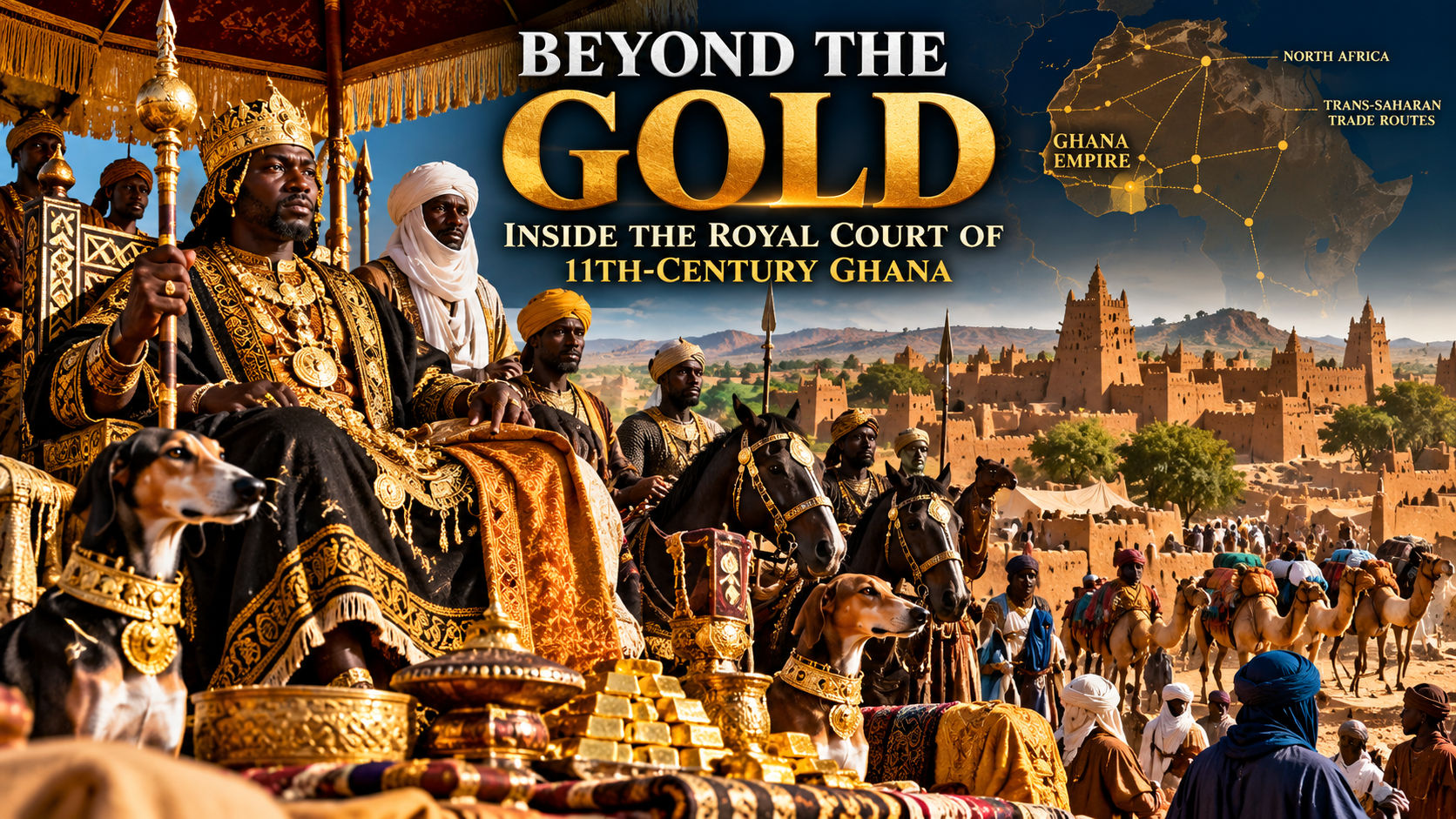
For centuries, the medieval Ghana Empire has often been reduced to a single word: gold. But the surviving historical record reveals something far more complex — a sophisticated political system, a powerful royal court, thriving trans-Saharan trade and a society navigating different religious traditions.
When people speak about the medieval Ghana Empire, the first image that often comes to mind is gold.
Gold was undeniably central to the region’s wealth and its commercial connections across the Sahara. But focusing only on gold risks missing the larger story.
More than a thousand years ago, a powerful state emerged in the western Sahel, controlling important trade routes linking the gold-producing regions farther south with North African markets.
At the centre of that system stood a king whose authority extended far beyond the control of precious metal.
A King Surrounded by Power
One of the most important written accounts of medieval Ghana comes from the 11th-century North African geographer al-Bakri.
Al-Bakri described a royal court filled with symbols of wealth and authority.
The king was surrounded by elaborately equipped horses, weapons, royal officials and subordinate rulers. Muslim advisers were also present at the court, reflecting the growing importance of Islam and long-distance commerce in the region.
Even the royal dogs were described as wearing precious collars.
These details have helped historians reconstruct an image of a highly organized and ceremonially powerful court.
But one detail is particularly revealing.
The king was not simply portrayed as a distant figure of wealth and ceremony. Al-Bakri’s account also describes the ruler as hearing grievances against his officials.
That suggests an important dimension of kingship: government and accountability.
The royal court was not merely a display of wealth. It was also a centre where disputes could be brought before the ruler and where political authority was exercised.
Gold Was Only One Part of the System
The Ghana Empire’s wealth was closely connected to its position within the trans-Saharan trading system.
Gold moved north.
Salt, textiles, metals and other commodities moved south.
Merchants crossed the Sahara, connecting West Africa with North Africa and, indirectly, the wider Mediterranean and Islamic worlds.
The state benefited from its ability to regulate and participate in this commerce.
But trade does not operate by itself.
It requires security, political authority, taxation, commercial centres, roads and institutions capable of maintaining order.
The gold that made Ghana famous was therefore part of a much larger political and economic machine.
A Court Between Religious Worlds
Another fascinating feature of medieval Ghana was the coexistence of different religious traditions.
Islam had established a presence among merchants and communities connected to trans-Saharan commerce. Muslim scholars and advisers could interact with the royal court.
Yet the kingdom’s rulers did not simply abandon older religious traditions.
Instead, the evidence points toward a political environment in which different belief systems existed alongside one another.
That religious coexistence is important because it challenges simplistic ideas about the spread of Islam in early West Africa.
Conversion, commerce and political authority did not necessarily move together at the same speed.
The Mystery of the Royal Capital
And here the story becomes much more complicated.
Where exactly was the political centre described by al-Bakri?
For generations, historians and archaeologists have debated the location and nature of the capital of medieval Ghana.
The archaeological site of Koumbi Saleh, in present-day Mauritania, has traditionally been associated with the Ghana Empire and remains one of the most important archaeological sites connected to the kingdom.
But archaeology has not produced a simple answer.
The surviving ruins, settlement patterns and material evidence raise questions about how the urban centre was organized and how closely the archaeological remains correspond to the royal court described by written sources.
This is where history becomes an investigation rather than a finished story.
The Problem With al-Bakri
There is another crucial limitation.
Al-Bakri never personally visited the Ghanaian royal court.

His account was based on information gathered from people familiar with the region and with the trans-Saharan world.
That does not make his account useless.
Far from it.
His writings remain one of the most valuable surviving descriptions of medieval West Africa.
But historians must distinguish between what al-Bakri directly observed and what he reported from other sources.
That distinction matters.
Descriptions of royal ceremony, wealth and political organization may preserve genuine information, but they must be evaluated alongside archaeology, later historical traditions and other evidence.
When Archaeology Challenges the Written Record
This is one of the most fascinating aspects of studying medieval Africa.
Written sources can tell us about rulers, merchants, religious communities and political institutions.
Archaeology can reveal buildings, ceramics, settlement patterns, trade goods and everyday life.
Sometimes the evidence fits together neatly.
Sometimes it does not.
And when it does not, historians should not simply choose the source they prefer.
The disagreement itself becomes evidence.
It forces us to ask what the ancient observer knew, what the archaeological record can demonstrate and what remains uncertain.
Beyond the King
Perhaps the most important question is what happened beyond the royal court.
Al-Bakri’s description naturally focuses attention on the king and the elite surrounding him.
But an empire is not built by rulers alone.
Farmers produced food.
Miners extracted gold.
Craft workers produced goods.
Merchants moved commodities across enormous distances.
Communities maintained roads and settlements.
Soldiers protected territory and trade routes.
And ordinary people lived within the political and economic system that made the royal court possible.
The story of medieval Ghana is therefore not simply a story about a wealthy king sitting among gold.
It is a story about a society.
A Different Way to Understand Medieval Ghana
The Ghana Empire should not be remembered merely as an ancient source of gold for distant markets.
It was a major West African power positioned at the intersection of African economies, trans-Saharan commerce and the expanding Islamic world.
Its rulers exercised political authority.
Its merchants participated in international trade.
Its court brought together different communities and religious traditions.
And its history survives through a complicated combination of written testimony, archaeology and oral traditions.
The unanswered questions are just as important as the established facts.
Where exactly was the royal centre?
How was the kingdom administered?
How did ordinary people experience the state’s power?
How much of al-Bakri’s description reflects direct knowledge, and how much came through intermediaries?
These questions remain part of the ongoing historical investigation.
The Bigger Story
The medieval Ghana Empire was never simply about gold.
It was about power, government, trade, belief, diplomacy and evidence.
And beneath the wealth of the royal court were the farmers, miners, traders, artisans, soldiers and families whose lives made that civilization possible.
More than a thousand years later, their world is still being reconstructed — piece by piece — from ruins beneath the Sahel, commodities buried in the earth and words written by an observer who never actually saw the king.
That is what makes the history of medieval Ghana so compelling.
It is not a finished story.
It is an investigation.
Panafrican.email — Africa’s history, intelligence and stories from an African perspective.
Leave a Reply