






There is a temptation to treat online romance scams as morality plays with obvious heroes and villains. Victims are portrayed as naïve. Scammers become caricatures—faceless criminals hiding behind glowing laptop screens somewhere in West Africa. Carlos Barragán’s The Yahoo Boys resists that easy narrative. Instead, it asks a far more interesting question: What happens when economic opportunity, digital technology, and human longing collide?
Rather than merely documenting cybercrime, Barragán investigates the social ecosystem that gave rise to Nigeria’s so-called “Yahoo Boys.” His reporting reveals individuals shaped by unemployment, inequality, global media, family expectations, and a rapidly changing digital economy. None of this excuses fraud. It does, however, explain why so many young people came to see internet deception as one of the few available paths toward economic mobility.
The Power of Context
One of the book’s greatest strengths is its insistence that context matters. We often imagine crime as the product of individual character, but Barragán repeatedly demonstrates that environments shape decisions. Communities create norms. Technology lowers barriers. Global inequalities create incentives that would be difficult to understand from a distance.
The result is a work that feels less like true crime and more like investigative sociology. Readers expecting only stories of elaborate scams may instead find themselves reflecting on youth unemployment, migration, digital capitalism, and the strange intimacy created by social media platforms.
Technology doesn’t simply connect people—it also creates entirely new ways for trust to be built, manipulated, and monetized.
— @panafricanemail
The Human Side of Digital Deception
Perhaps the book’s most valuable contribution is that it restores humanity to everyone involved. Victims are not foolish; they are often lonely, hopeful, grieving, or searching for connection. Likewise, the young Nigerians profiled are neither monsters nor folk heroes. They are complex people making choices within systems that reward appearance, performance, and financial success.
That complexity makes the book occasionally uncomfortable. It asks readers to hold two truths simultaneously: romance scams inflict genuine emotional and financial harm, and many perpetrators emerge from circumstances that deserve careful examination rather than simplistic condemnation.
Why This Story Matters Beyond Nigeria
It would be easy to file this away as a uniquely Nigerian story. That would be a mistake. Barragán’s reporting illustrates something much broader about the internet age. Digital platforms erase geographic distance while magnifying economic inequality. They allow people to reinvent themselves, manufacture identities, and participate in global markets that barely existed a generation ago.
In that sense, “Yahoo Boys” are not merely products of one country. They are products of globalization itself—a digital economy where attention, emotion, and trust have become valuable commodities.
Reporting with Curiosity Rather Than Judgment
Barragán succeeds because he approaches his subjects with curiosity rather than certainty. He spends time listening before explaining. That patience allows contradictions to emerge naturally. Readers encounter ambition alongside desperation, entrepreneurship alongside criminality, and community alongside exploitation.
This approach ultimately produces a richer understanding than sensational headlines ever could. The book reminds us that behind every online scam is not only a victim and a perpetrator but also a complicated web of history, economics, culture, and technology.
Final Verdict
The Yahoo Boys is not simply a book about romance scams. It is a thoughtful exploration of how digital life reshapes opportunity, identity, and morality in an interconnected world. Carlos Barragán challenges readers to move beyond stereotypes without abandoning accountability, producing a work that is as intellectually engaging as it is socially relevant.
For readers interested in Africa’s digital transformation, cybersecurity, internet culture, or the human consequences of globalization, this book deserves a place on the reading list. It replaces easy answers with better questions—a hallmark of memorable nonfiction.
Rating
★★★★☆ (4.5/5)
An insightful, empathetic, and rigorously reported examination of one of the internet’s most misunderstood phenomena.
Watch: Carlos Barragán Discusses The Yahoo Boys

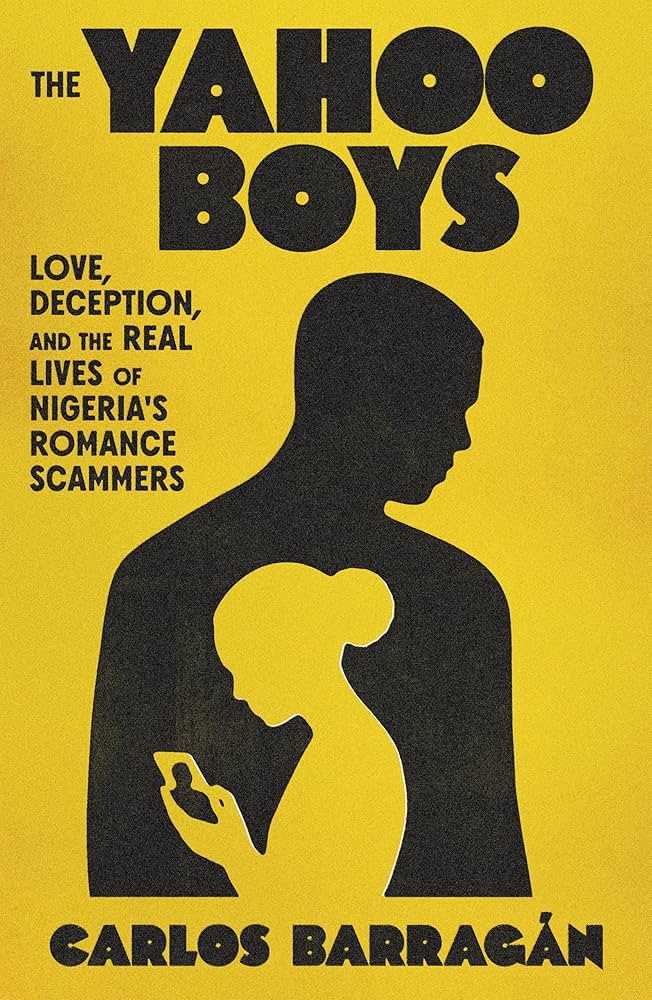
The Yahoo Boys: Love, Deception, and the Real Lives of Nigeria’s Romance Scammers
The Yahoo Boys is a nuanced and deeply reported work that moves beyond sensational headlines to examine the human, economic, and technological forces behind Nigeria’s romance scam industry. Carlos Barragán neither excuses fraud nor reduces its perpetrators to stereotypes, instead offering a balanced exploration of ambition, inequality, and the digital age. For readers interested in Africa, cybersecurity, globalization, or investigative journalism, this is an insightful and thought-provoking read that replaces easy answers with meaningful questions.
The Good
- Modern and fresh yet sleek design
- Improved battery life
- Performance of M3 Chipset
- Designed for a larger screen
The Bad
- Lackluster Audio and tiny speaker
- Still ridiculously large
- Can't render the brightest colors
- Missing dedicated ports
-
Book Cover Design8.5
-
Readabily8
-
Details7
-
Digestible8
-
Bachelors Degree10


