
INTELLIGENCE ASSESSMENT: Moderate
REGION: Global / Mining Technology
CATEGORY: Mining & Mineral Resources / Technology
TOPIC: Gold Processing and Gravity Separation
STATUS: Technology demonstration / commercial mining-equipment content
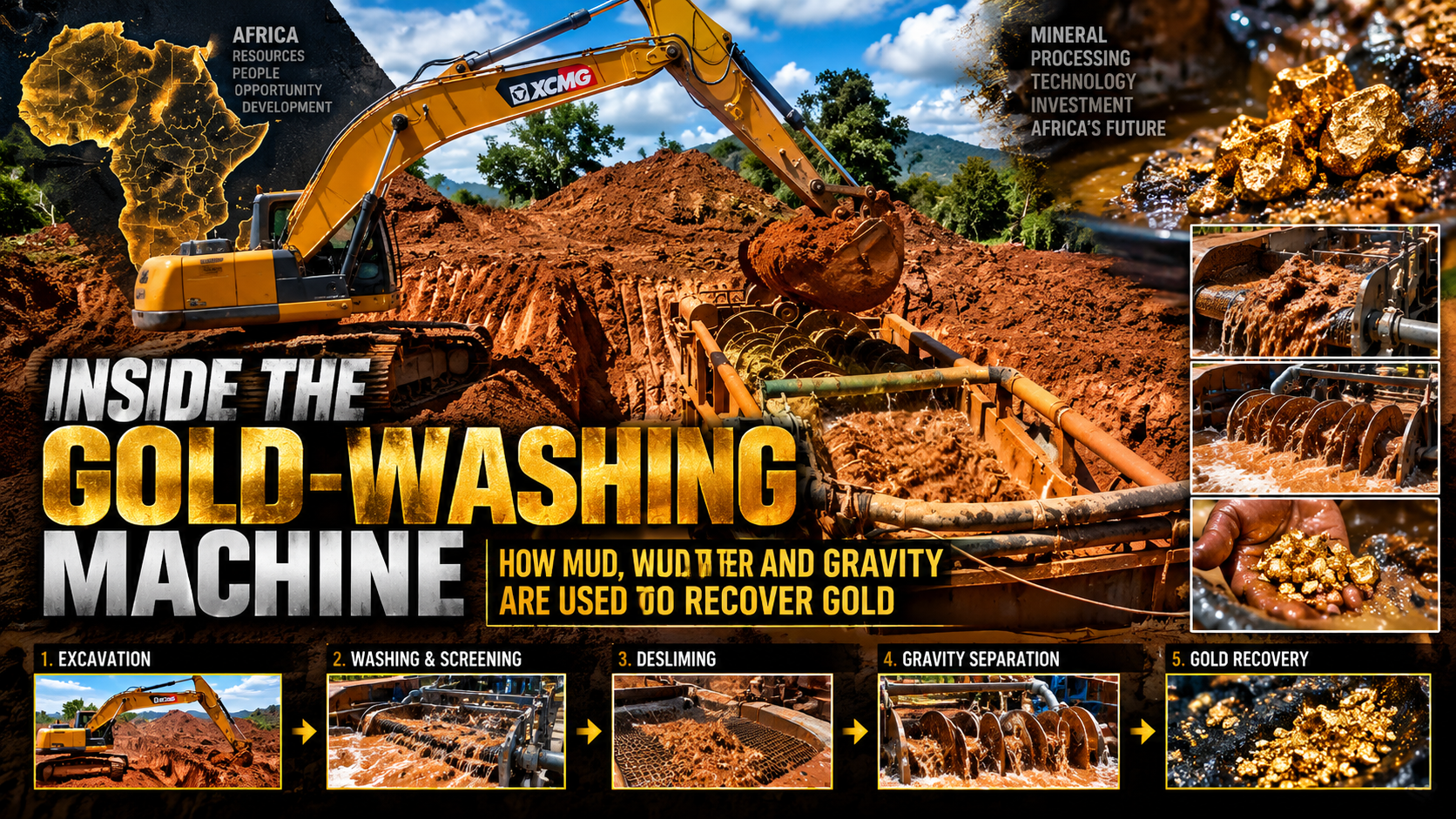
A striking video circulating on TikTok offers a close look at the increasingly industrial character of gold recovery: an excavator tears into a massive bank of reddish earth while a mechanical washing and separation system processes a stream of muddy water and mineral-bearing material.
The video was posted by the account JianlongGoldMiningMachinery, with a caption describing a gold-washing and sorting process involving a spiral washing machine. The post says the material contains a high level of mud and describes stirring and desliming as part of the effort to clean the ore and expose gold-bearing material.
The machinery visible in the footage illustrates an important reality of modern gold mining: recovering gold is not simply a matter of digging up soil. The valuable metal must be separated from clay, sand, gravel and other minerals before a commercially useful concentrate can be produced.
Commercial suppliers such as Ganzhou Jianlong Machinery Equipment Co., Ltd. market a range of equipment for gold washing, ore washing and mineral beneficiation, including spiral washers, log washers, gold separation equipment and larger washing plants. (Alibaba)
From Earth to Gold
The first stage visible in the video is excavation.
A large hydraulic excavator removes material from the ground and feeds the processing operation. At this stage, the material is not “gold” in any meaningful commercial sense. It is a mixture of soil, clay, gravel, sand, rock fragments and potentially gold-bearing minerals.
The challenge for the processor is to reduce that mixture to a smaller stream containing the valuable heavy minerals.
This is where washing, screening, desliming and gravity separation become important.
The reddish material shown in the video is particularly significant because high-clay or high-mud material can make mineral processing more difficult. Sticky clay can bind particles together and interfere with screening and gravity separation.
The solution is to introduce water and mechanical agitation.
Why Water Matters
Gold has a much higher density than ordinary soil and many of the lighter materials surrounding it.
That physical difference is the foundation of many traditional and industrial gold-recovery systems.
When water is introduced into mineral-bearing material, the operator can use differences in particle size, density and settling behavior to separate fractions of the feed.
The process can broadly involve:
Excavation → Washing → Screening → Desliming → Concentration → Final Recovery
Each stage has a different purpose.
The washing stage attempts to break apart clay and remove unwanted material.
Screening separates particles according to size.
Desliming removes extremely fine material that can interfere with subsequent separation.
Concentration then attempts to produce a smaller stream containing a higher proportion of heavy minerals.
The Spiral Washing Principle
The TikTok caption specifically references a spiral washing machine.
Spiral equipment uses a flowing slurry and the geometry of a spiral channel to help classify and separate mineral particles.
As material and water move through the system, particles behave differently according to their physical characteristics. Heavy minerals tend to behave differently from lighter particles, allowing the operator to produce separate streams.
Spiral equipment is widely marketed for mineral-washing and beneficiation applications. Commercial listings show spiral washers and spiral concentrators being offered for applications involving gold and other minerals. (Accio)
However, a spiral washer should not be confused with a machine that simply “finds gold.”
It is a separation tool.
The actual recovery performance depends on the characteristics of the feed material, including gold particle size, mineral association, clay content, water conditions, feed rate and equipment configuration.
What Happens to the Mud?
One of the most interesting features of the footage is the amount of muddy water moving through the system.
This is not necessarily waste at the beginning of the process.
Mud and clay can contain particles that need to be liberated from the surrounding material before concentration can occur.
Mechanical agitation and washing can break up these masses.
But the resulting slurry creates another challenge: water management.
A serious gold-processing operation must manage the water and sediment produced by the washing circuit.
Poorly controlled discharge can carry suspended sediment into rivers and streams, potentially affecting water quality and aquatic ecosystems.
That means the engineering problem is larger than simply recovering gold.
A modern operation has to consider:
- Water recycling
- Sediment containment
- Tailings management
- Erosion control
- Chemical use
- Fuel consumption
- Land disturbance
- Rehabilitation of excavated areas
The Gold Is Not Necessarily Visible
Another misconception created by viral mining videos is the expectation that gold should immediately be visible.
In many deposits, the concentration of gold in the original material is extremely low.
Thousands of kilograms of material may have to be processed before a relatively small amount of gold is recovered.
The objective of a washing plant is therefore to concentrate the valuable fraction.
The material coming out of the first washing stage may still require additional processing.
Depending on the deposit and plant design, downstream equipment can include sluices, jigs, centrifugal concentrators, shaking tables or other gravity-separation equipment.
Commercial equipment listings show that gold-processing systems can combine multiple technologies rather than relying on a single machine. (Alibaba)
Why Excavators and Wash Plants Are Changing Small-Scale Mining
The combination visible in the video represents a major technological leap from traditional hand panning.
A person with a pan processes a very small amount of material.
An excavator can move enormous quantities of earth.
A mechanized washing system can then process that material continuously.
This dramatically increases throughput.
It also changes the economic equation.
Instead of asking whether an individual can find enough gold manually, operators can ask whether the deposit contains enough recoverable gold to justify the cost of excavation, fuel, labor, water, equipment maintenance and processing.
That is the beginning of industrial mineral economics.
The African Gold Question
For Africa, this technology has enormous implications.
The continent contains some of the world’s major gold-producing regions, while millions of people also participate in artisanal and small-scale mining.
The introduction of increasingly sophisticated washing and concentration machinery can potentially increase recovery from mineral-bearing material.
But technology alone does not guarantee responsible mining.
A highly productive machine can also accelerate environmental damage if deployed without appropriate controls.
The same excavator capable of moving hundreds of tonnes of material can rapidly transform a riverbank, forest edge or agricultural landscape.
The central question therefore becomes:
Who controls the technology, where is it deployed, and under what regulatory framework?
From Gold Recovery to Resource Intelligence
The video also illustrates why mineral intelligence is becoming increasingly important.
A country may possess substantial geological potential, but geological potential is not the same as commercially recoverable reserves.
To understand a gold opportunity, analysts need to consider geology, historical production, exploration activity, infrastructure, water availability, permitting, security, processing technology, energy costs and the economics of recovery.
The machinery is only one part of that equation.
A deposit with abundant gold but poor access may be less economically attractive than a smaller deposit with established infrastructure and processing facilities.
Likewise, a deposit with high clay content may require substantially different processing equipment from a clean alluvial deposit.
The Hidden Technology Behind the Gold
The spectacular part of the video is the excavator.
But the real technological story is happening inside the processing circuit.
Gold recovery depends on controlling a sequence of physical processes:
Liberation.
Breaking apart the material so valuable particles can be separated from surrounding material.
Classification.
Sorting material by size and physical behavior.
Desliming.
Removing very fine particles that can interfere with downstream separation.
Concentration.
Increasing the proportion of valuable heavy minerals in a smaller stream.
Recovery.
Extracting the gold-bearing concentrate from the remaining material.
Each stage can dramatically affect the final recovery rate.
A Warning About Viral Mining Videos
The TikTok video should also be viewed carefully.
The footage demonstrates machinery operating in a gold-washing environment, but it does not by itself prove:
- the location of the mine;
- the amount of gold being recovered;
- the grade of the deposit;
- the profitability of the operation;
- the ownership of the mining site;
- the legality of the operation;
- or the recovery rate claimed by the equipment manufacturer.
The account publishing the video appears to be associated with mining machinery marketing, and commercial listings confirm that Ganzhou Jianlong Machinery Equipment Co., Ltd. supplies mining and mineral-processing equipment. (Alibaba)
Therefore, the footage is best understood as a technology demonstration, unless independent evidence establishes the operational details.
The Bigger Picture
Gold mining is entering an era in which excavation, mineral processing, data analysis and resource intelligence increasingly overlap.
The machine shown in this video represents one part of that transformation.
The excavator extracts the earth.
Water liberates and transports the material.
Screens and washers classify it.
Gravity-based systems concentrate heavier minerals.
And downstream recovery equipment attempts to turn that concentrate into a commercially valuable product.
The most important lesson is that finding gold and recovering gold are two different problems.
A geological deposit can contain gold without being economically exploitable.
A mining operation can extract gold without being environmentally sustainable.
And sophisticated equipment can increase production without necessarily increasing profitability.
The future of responsible African mineral development will therefore depend not only on discovering resources, but on understanding the complete chain from geology to processing, economics, infrastructure, environmental management and governance.
The muddy stream flowing through the machine may look simple on the surface.
Behind it lies an entire industrial system.
INTELLIGENCE SUMMARY
What the video shows: Mechanized excavation and gold-washing/mineral-processing equipment.
Technology identified: Excavator feeding a wet mineral-processing circuit, with washing/separation equipment and spiral-style processing referenced in the video’s caption.
Primary purpose: Washing and concentrating mineral-bearing material.
Gold recovery principle: Exploiting physical differences such as density and particle size.
Key challenge: High clay/mud content can complicate mineral processing.
Strategic significance: Mechanized processing can dramatically increase throughput compared with manual gold panning, while also increasing environmental and regulatory risks.
Verification status: The machinery and supplier category can be corroborated through commercial mining-equipment listings; the specific location, gold grade and production claims shown or implied by the TikTok video have not been independently established. (Alibaba)
Leave a Reply