
INTELLIGENCE ASSESSMENT: Moderate
REGION: West Africa
COUNTRY: Liberia
CATEGORY: Security / Human Rights / Military Affairs
STATUS: Confirmed by contemporaneous Liberian reporting
LOCATION: Paynesville, Montserrado County
DATE: October 21, 2026
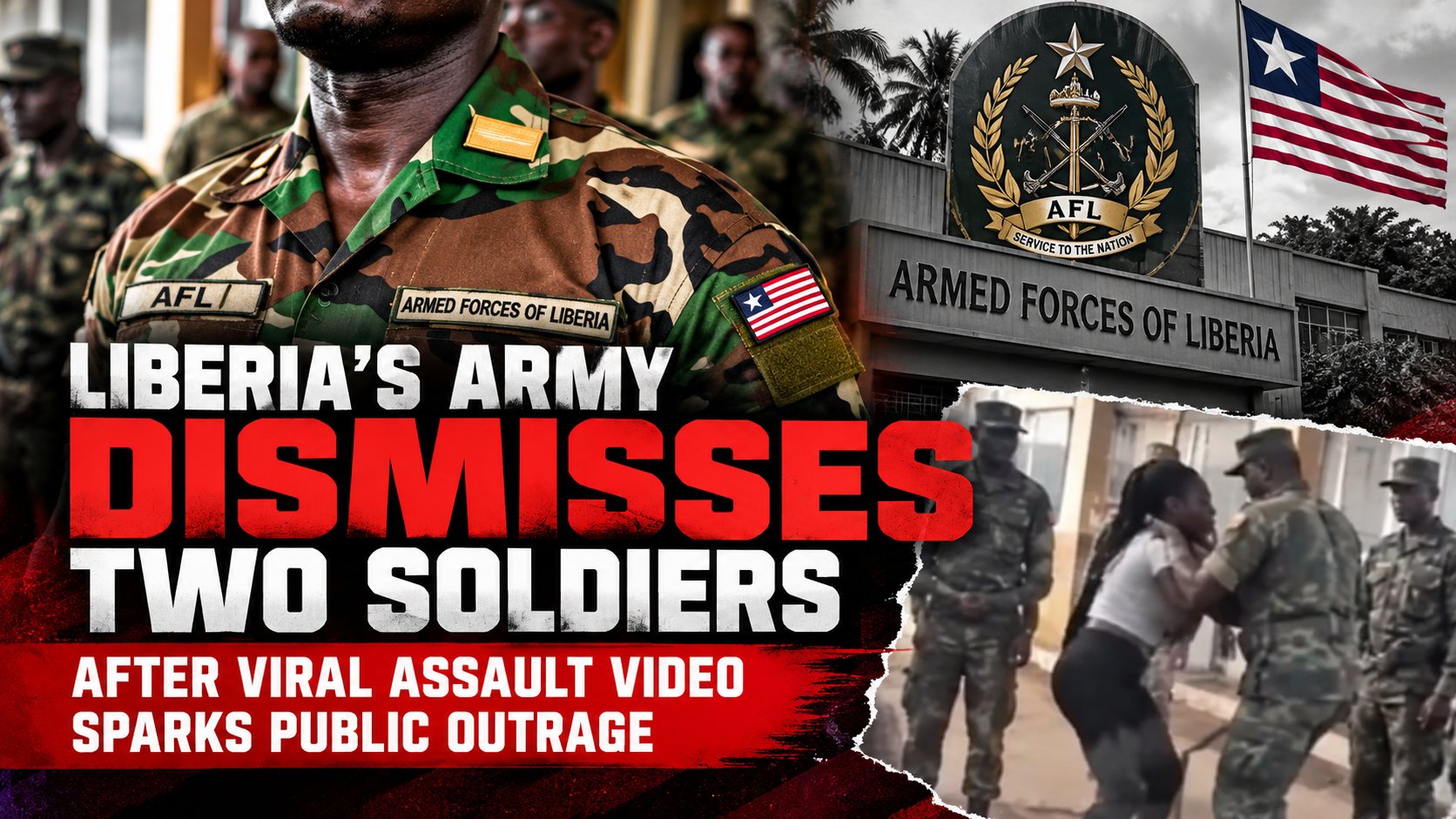
MONROVIA — Liberia’s Armed Forces has dismissed two soldiers following the circulation of a viral video appearing to show an assault involving military personnel and a young woman.
The Armed Forces of Liberia (AFL) dishonorably discharged the two soldiers on Wednesday, October 21, after the video spread widely across social-media platforms and generated public condemnation.
The soldiers were identified in contemporaneous Liberian reporting as Sgt. Robert P. Menyon and Sgt. Abu S.B. Sheriff, members of the AFL’s 23rd Infantry Brigade. (THE LIBERIAN INVESTIGATOR)
The reported incident occurred in the Thinkers Village community of Paynesville. While the circumstances surrounding the confrontation remain subject to scrutiny, the circulation of the footage placed the conduct of the soldiers under intense public attention. (THE LIBERIAN INVESTIGATOR)
Military moves against its own personnel
The dismissals were announced during a ceremony at the Edward Beyan Kesselly Military Barracks.
According to the Liberian Investigator, AFL Chief of Staff Maj. Gen. Davidson Forleh condemned the conduct attributed to the soldiers and characterized it as incompatible with the responsibilities of military personnel.
The military said its response was based on information gathered through its internal security and investigative processes rather than simply responding to social-media pressure. Military police were reportedly dispatched following information about the incident. (THE LIBERIAN INVESTIGATOR)
The decision represents a significant institutional response because the alleged conduct involved personnel operating under the authority and symbolism of the national military uniform.
For a post-conflict state such as Liberia, the credibility of security institutions carries particular weight. The country’s armed forces have spent years rebuilding public confidence and professionalizing their relationship with civilians following the era of civil war.
The legal basis for the dismissal
The administrative action reportedly relied on Chapter 7, Section 7J of Liberia’s New National Defense Act of 2008.
The dismissal order, identified as Order No. 6 and dated October 21, directed that the two soldiers be discharged for the good of the service with immediate effect. The order also instructed the AFL provost marshal to recover government property held by the dismissed personnel. (THE LIBERIAN INVESTIGATOR)
The order reportedly included measures concerning the soldiers’ families and their accommodation at the military barracks.
The use of an established military disciplinary framework is significant because it places the response within the AFL’s institutional chain of command rather than treating the incident solely as a social-media controversy.
The victim asks for leniency
One of the most notable elements of the case is the reported reaction of the woman involved.
The victim, identified by the Liberian Investigator as Blessings Kpalleh, reportedly expressed mixed feelings about the dismissals. While she wanted the soldiers to face consequences for their actions, she said she had forgiven them and did not intend for them to lose their military careers. (THE LIBERIAN INVESTIGATOR)
Her position introduces another dimension into the debate surrounding the incident.
Public accountability and the wishes of an alleged victim do not always lead to the same outcome. A military disciplinary process may consider the broader implications of personnel conduct, particularly when the alleged behavior occurs while soldiers are representing the state.
The AFL therefore faces a larger institutional question: how should it balance individual punishment, rehabilitation, victim concerns and the preservation of professional standards within the armed forces?
Why the case matters beyond one viral video
The incident is larger than the video itself.
Liberia’s security institutions operate in a society where public trust in state authority remains an important part of democratic consolidation. When members of the security forces are accused of abusing civilians, the issue can quickly become a test of whether institutional reforms are producing meaningful changes in behavior.
The rapid spread of the footage demonstrates another reality of modern security governance: incidents involving uniformed personnel can become national controversies within hours.
A cellphone recording can now reach thousands of Liberians before a formal military investigation has even begun.
That creates pressure on security institutions to respond quickly while still maintaining due process, evidence standards and procedural fairness.
The social-media effect
The case also illustrates the growing role of social media as an informal accountability mechanism.
The video circulated widely before the AFL’s disciplinary action became public. The resulting attention placed the alleged conduct in front of a much larger audience than would have been possible through traditional complaint mechanisms alone.
That can have positive consequences when footage brings credible evidence of misconduct to public attention.
But it also creates risks.
Short videos can lack context, chronology or surrounding evidence. Viral distribution can transform an allegation into an assumed fact before investigators establish exactly what happened.
For that reason, the distinction between what the video appears to show, what witnesses report, and what investigators formally establish remains essential.
In this case, the AFL’s reported disciplinary decision provides an institutional response, but continued transparency about the underlying investigation would be important for public confidence.
A test for Liberia’s military professionalism

The dismissal of the two soldiers sends a broader message about the standards expected from members of the AFL.
Military personnel carry state authority. Their conduct therefore has consequences beyond their individual actions.
When a soldier is accused of mistreating a civilian, the public may judge not only the individual involved but also the institution that trained, equipped and authorized that soldier.
That makes accountability an important component of military professionalism.
The AFL’s challenge now extends beyond the dismissal itself. The institution must demonstrate that disciplinary standards are consistently applied, that civilian complaints can be investigated credibly, and that military personnel understand the limits of their authority.
What happens next
The immediate disciplinary action closes one phase of the incident, but questions remain concerning the underlying events and any additional civilian or legal proceedings.
The public will also be watching whether the AFL provides further information about its investigation and whether the incident produces additional measures concerning discipline, civilian protection or military conduct.
For Liberia, the case has become another test of how the country’s security institutions respond when their own personnel become the subject of public scrutiny.
The central issue is therefore not simply whether two soldiers were dismissed.
It is whether Liberia can continue building security institutions in which discipline, accountability and respect for civilian rights are treated as fundamental components of military professionalism rather than exceptions imposed only after a video goes viral.
Intelligence Assessment
Assessment: MODERATE CONFIDENCE
The reported dismissal of the two AFL personnel is corroborated by contemporaneous Liberian reporting published October 21, 2026. The underlying circumstances of the confrontation should nevertheless be distinguished from the verified fact of the military’s disciplinary response. (THE LIBERIAN INVESTIGATOR)
Key indicators to watch:
- Any further AFL statement concerning the investigation
- Possible civilian or judicial proceedings
- Additional identification of witnesses or evidence
- Public reaction from civil-society organizations
- Whether the AFL introduces additional disciplinary or training measures
- Whether similar allegations involving security personnel emerge
Bottom line: The AFL’s dismissal of two soldiers following a viral alleged assault marks a significant public accountability moment for Liberia’s military. The longer-term significance will depend on whether the case produces sustained institutional reforms and greater public confidence in civilian-military accountability.
Leave a Reply