
INTELLIGENCE ASSESSMENT
EVENT: Restoration of the death penalty
REGION: West Africa / Sahel
COUNTRY: Burkina Faso
CATEGORY: Security / Counterterrorism / Governance / Justice
STATUS: Confirmed
INTELLIGENCE LEVEL: High
CONFIDENCE: High
SOURCE: Burkina Faso Government / Africanews / Associated Press
LOCATION: Ouagadougou, Burkina Faso
Burkina Faso Brings Back Capital Punishment
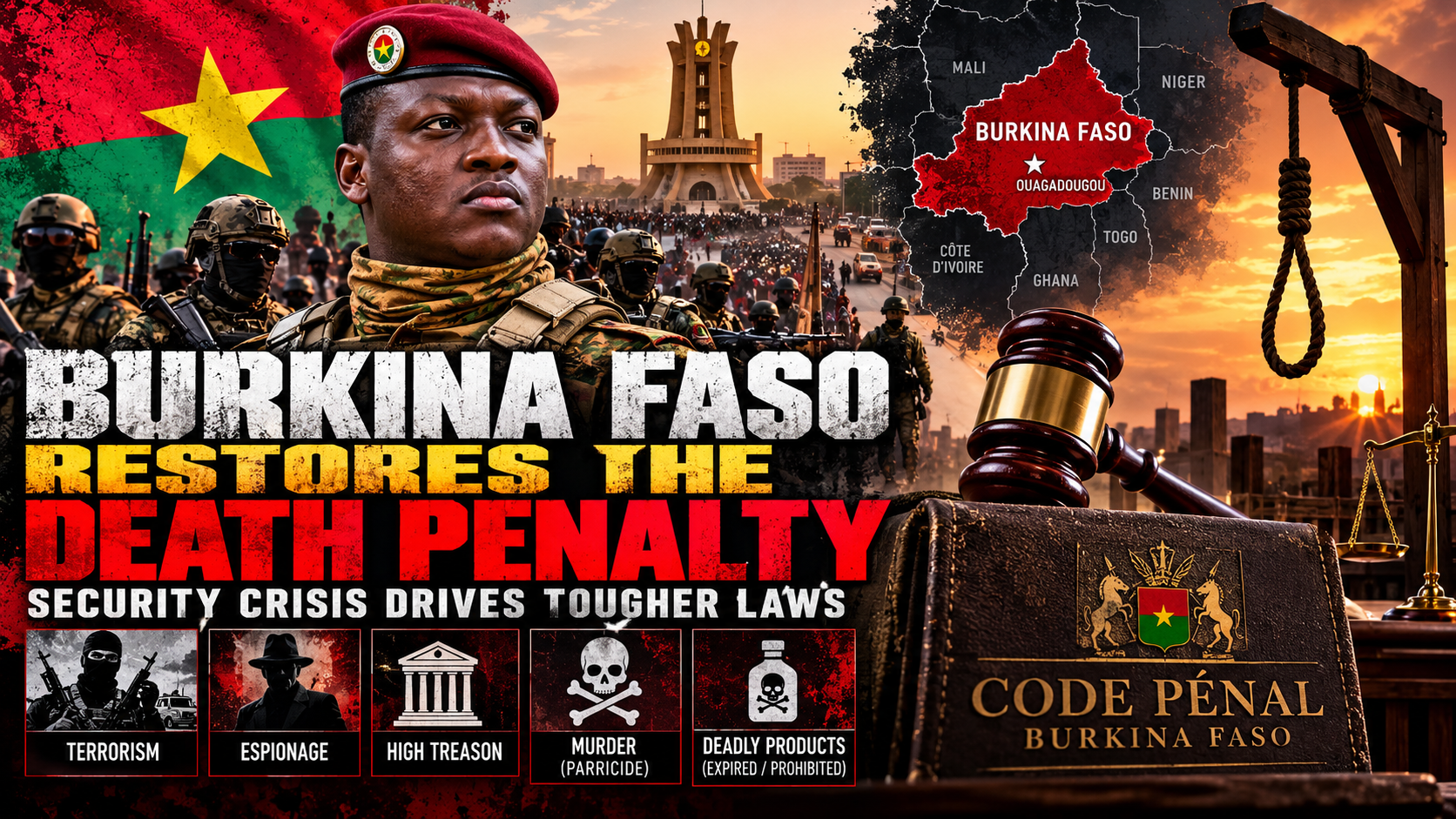
Burkina Faso has restored the death penalty nearly eight years after abolishing it, marking one of the most significant changes to the country’s criminal justice system since the military government came to power.
The country’s transitional legislature approved the revised penal code on October 20, 2026, reversing the 2018 abolition of capital punishment. The measure was approved unanimously, according to reports from Burkina Faso’s Justice Ministry and other sources. (Africanews)
The new framework makes capital punishment available for crimes including terrorism, espionage, high treason, parricide, and certain cases involving prohibited or expired products that result in death. (actualite.bf)
The restoration does not represent an isolated criminal-justice change. It is part of a broader transformation of Burkina Faso under the military government of Captain Ibrahim Traoré, whose administration has placed national security, sovereignty and the fight against armed extremist groups at the center of state policy.
What Led to the Policy?
The principal driver is Burkina Faso’s prolonged security crisis.
For more than a decade, the country has faced attacks by armed groups associated with al-Qaeda and the Islamic State operating across the Sahel. The conflict has devastated communities, displaced civilians and severely challenged the state’s ability to control territory.
The military government argues that existing criminal penalties were insufficient to address terrorism and related crimes.
Burkina Faso’s Justice Minister Edasso Rodrigue Bayala previously said the government believed the law needed to change because extremist groups could exploit the existing legal framework when recruiting fighters. In explaining the new legislation, the government has argued that people participating in terrorism should face the most severe possible punishment. (actualite.bf)
The government’s argument therefore connects capital punishment directly to counterterrorism and deterrence.
From Abolition to Restoration
Burkina Faso abolished the death penalty under its 2018 penal code. The country’s last known execution took place in 1988. (Amnesty International)
The reversal began publicly emerging in 2024, when government officials acknowledged that the death penalty was being considered again.
In November 2024, Justice Minister Bayala said the issue was being discussed and would be implemented as part of a new criminal code reflecting President Traoré’s political direction. Human Rights Watch subsequently reported that terrorism-related offenses were among the crimes being considered for capital punishment. (Human Rights Watch)
The government formally advanced the policy in December 2025, when the Council of Ministers adopted a draft penal code restoring the death penalty for offenses including terrorism, espionage and high treason. (Government of Burkina Faso)
The transitional legislature’s October 2026 approval completed the legislative step needed to restore capital punishment under the revised criminal code. (Africanews)
The Traoré Doctrine

The policy reflects a wider ideological and political shift under Ibrahim Traoré’s government.
Since the 2022 military takeover, Burkina Faso’s leadership has emphasized national sovereignty, military resistance to jihadist groups and reduced dependence on traditional Western partners.
The government has increasingly framed national security as an existential struggle rather than a conventional law-enforcement problem.
Within that framework, the death penalty becomes more than a criminal sentence. It represents a declaration that terrorism, espionage and acts considered threats to the state will be treated as attacks on national survival.
This helps explain why the measure has been politically significant beyond the criminal code itself.
A Broader Security State
The restoration of capital punishment comes amid a broader tightening of Burkina Faso’s political and security environment.
Human Rights Watch has warned that the military government has restricted civic space since taking power, while journalists, political opponents and civil-society organizations have faced increasing pressure. (Human Rights Watch)
That context has created concern among human-rights organizations that expanded criminal penalties could eventually be used beyond their stated counterterrorism purpose.
Amnesty International has strongly opposed the restoration, arguing that capital punishment is irreversible and does not have a demonstrated unique deterrent effect. (Amnesty International)
The African Commission on Human and Peoples’ Rights has likewise called the restoration a serious setback for protection of the right to life and urged Burkina Faso to preserve abolition. (African Commission)
The Strategic Question
The central question for Burkina Faso is whether harsher punishment can actually reduce terrorism.
The government believes stronger penalties can increase deterrence and reinforce state authority.
Critics argue that the roots of the insurgency are more complex, involving governance, poverty, local grievances, recruitment networks, territorial control and the weakness of state institutions.
Capital punishment may therefore become an important symbol of the government’s security doctrine without necessarily resolving the underlying causes of the conflict.
Intelligence Assessment
Assessment: HIGH INTEREST
Burkina Faso’s restoration of the death penalty represents a significant departure from the country’s post-2018 legal framework and demonstrates how the Sahel’s security crisis is reshaping criminal justice.
The policy appears to have three strategic objectives:
1. Deterrence: Increase the perceived cost of terrorism, espionage and treason.
2. State authority: Demonstrate that the government is prepared to use its strongest legal powers against threats to national security.
3. Political messaging: Reinforce the Traoré government’s broader narrative of sovereignty, national defense and resistance to insecurity.
The critical test will be whether the new law produces measurable improvements in security or primarily functions as a political and deterrence instrument.
Burkina Faso’s decision also signals a wider debate emerging across the Sahel: how far governments should go in expanding state power when conventional security institutions have failed to contain armed insurgencies.
For Panafrican.email, the development should be monitored alongside Burkina Faso’s battlefield situation, terrorism-related prosecutions, treatment of political dissent and any future death sentences or executions.
Panafrican.email Intelligence Desk
Leave a Reply