
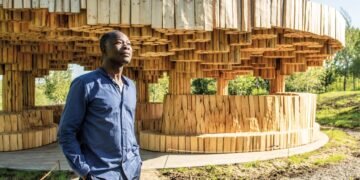
OUAGADOUGOU, Burkina Faso — Burkina Faso is advancing a major cultural and architectural vision in Ouagadougou, where internationally acclaimed Burkinabè architect Francis Kéré is contributing to the development of a landmark complex designed to preserve national memory while creating new spaces for culture, education and public gathering.
At the centre of the project is the Thomas Sankara Memorial, a major development dedicated to the memory of former Burkinabè leader and Pan-African icon Thomas Sankara. The complex is designed not simply as a memorial, but as a living public space where history, architecture, education and culture can meet.
Kéré, who became the first African recipient of the Pritzker Architecture Prize in 2022, has brought an architectural approach rooted in Burkina Faso’s climate, materials and traditions to the project. His design incorporates locally appropriate materials and passive cooling principles, demonstrating how contemporary African architecture can respond to both modern needs and indigenous environmental knowledge. (The Guardian)
An Amphitheatre for Culture and Public Life
One of the most significant elements of the memorial complex is an amphitheatre intended to provide a gathering place for the public.
The amphitheatre forms part of a broader 14-hectare development that includes memorial spaces, restaurants, public areas and a prominent tower. Rather than creating a monument that exists only as a historical marker, the project is envisioned as a place where people can gather, learn, perform and engage with Burkina Faso’s history. (The Guardian)
This approach reflects a wider movement across Burkina Faso to strengthen cultural institutions and give the arts a more prominent role in national development. In 2024, the Burkinabè government announced reforms aimed at revitalizing the country’s national artistic ensembles, including the National Ballet, National Orchestra and National Instrumental Ensemble, while establishing a National Theatre and a national philharmonic ensemble. (Signature)
Architecture Rooted in Burkina Faso
Kéré’s work has become internationally recognized for combining modern architectural techniques with local knowledge.
His approach frequently makes use of materials and construction methods suited to African environments, while emphasizing natural ventilation, shade and community participation. At the Sankara Memorial, the architecture is intended to create spaces that remain functional within Ouagadougou’s demanding climate while maintaining a strong connection to Burkina Faso’s cultural identity. (The Guardian)
The project therefore represents more than the construction of another public building. It reflects an attempt to establish an African architectural language in which historical memory and contemporary design can coexist.
A New Generation of African Cultural Spaces
Burkina Faso already has a history of using public architecture to promote cultural expression. During the revolutionary period associated with Thomas Sankara, cultural initiatives and public participation were given considerable importance. The country’s Théâtre populaire Désiré Bonogo, for example, was established during the Sankara era and was conceived as a space for cultural expression and popular engagement. (Vox Sahel)
The development of new cultural infrastructure comes at a time when Burkina Faso is seeking to reinforce national identity and cultural sovereignty.
For many African countries, cultural infrastructure has increasingly become part of a larger conversation about sovereignty. Museums, theatres, memorials, amphitheatres and cultural centres can provide spaces for communities to preserve their histories while giving younger generations opportunities to create new forms of African expression.
Remembering Sankara Through Architecture
Thomas Sankara remains one of Africa’s most influential political figures, particularly among young Pan-Africanists. His emphasis on self-reliance, national dignity, social transformation and African sovereignty has continued to influence political and cultural conversations long after his assassination in 1987.
The memorial seeks to translate that historical legacy into a physical environment.
Its amphitheatre can consequently be viewed not simply as a structure for performances, but as a potential forum for public dialogue, music, theatre, education and cultural celebrations.
As Burkina Faso continues to invest in its cultural institutions, projects such as the Thomas Sankara Memorial demonstrate how architecture can become a vehicle for national memory and African identity.
The work of Francis Kéré also carries a broader message: Africa does not have to choose between modern architecture and traditional knowledge. The two can be combined to create buildings that are contemporary, environmentally responsive and unmistakably African.
In Ouagadougou, the emerging cultural landscape is therefore becoming part of a larger Pan-African story — one in which architecture is being used not merely to construct buildings, but to preserve memory, strengthen identity and create spaces for future generations.
Leave a Reply