
INTELLIGENCE ASSESSMENT
EVENT: Private security operation in Haiti
REGION: Caribbean / Latin America
COUNTRY: Haiti
CATEGORY: Security / Geopolitics
STATUS: Reported
ASSESSMENT: High Interest
SOURCE: CNN
LOCATION: Port-au-Prince, Haiti
The Battle for Haiti’s Capital
Haiti’s continuing security crisis has created an environment in which armed gangs control or influence large portions of Port-au-Prince, severely limiting the ability of state institutions to maintain order.
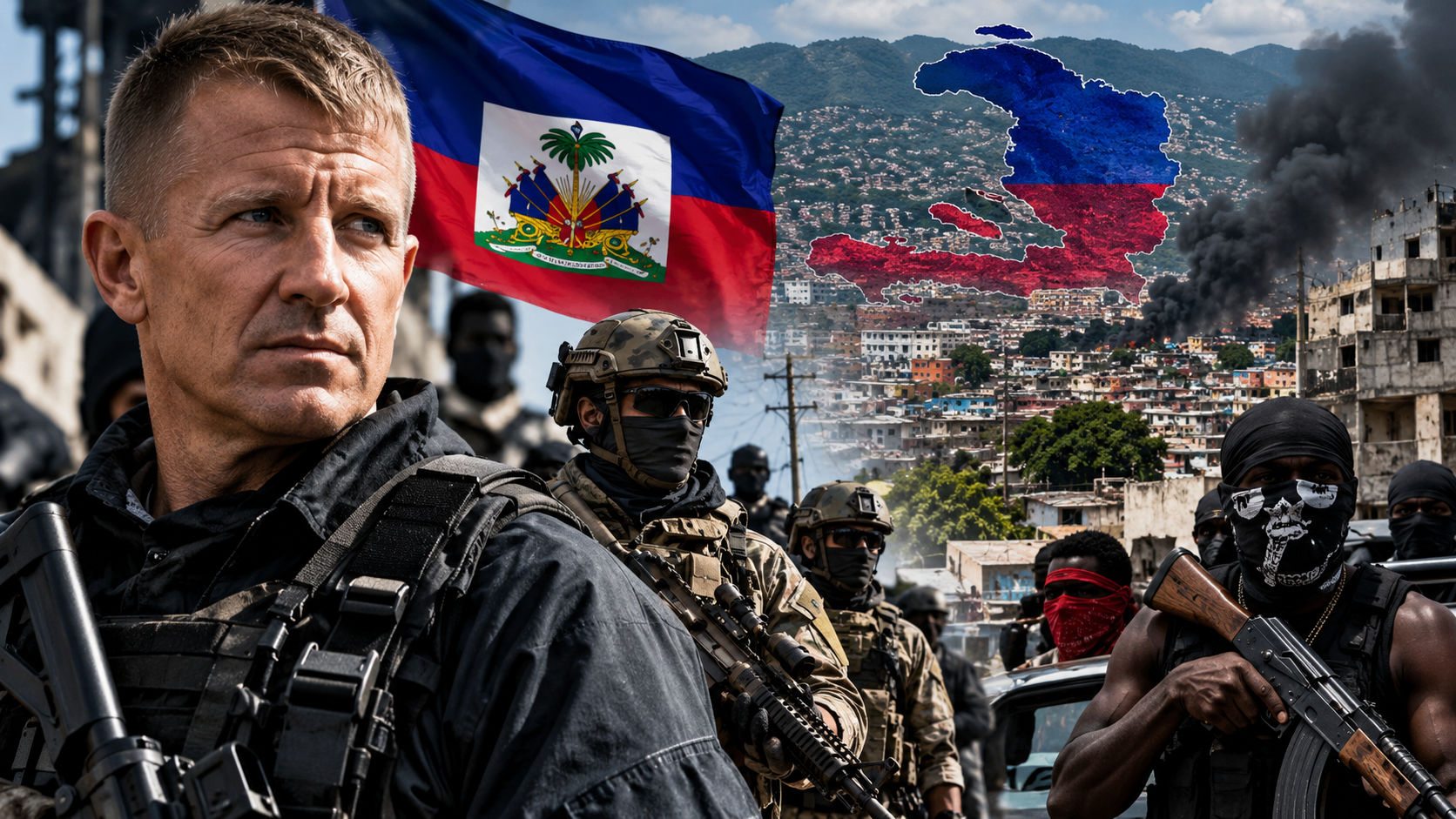
Against this backdrop, private security entrepreneur Erik Prince has launched an operation aimed at supporting efforts to confront Haiti’s powerful armed groups.
CNN correspondent Nick Paton Walsh gained exclusive access to Prince’s operation, providing a rare look inside an increasingly controversial model of security intervention: the use of private forces to perform functions traditionally associated with governments and national security institutions.
The operation comes as Haiti struggles to restore control over territory, protect critical infrastructure and establish conditions for political stability.
A Different Approach to Haiti’s Security Crisis
Haiti has experienced repeated international interventions and security initiatives over the years, yet armed groups have continued to expand their influence.
Prince’s approach represents a fundamentally different model.
Rather than relying exclusively on conventional international peacekeeping or state security institutions, the operation introduces private-sector security capabilities into an environment where the Haitian state remains severely constrained.
The central question is whether private security forces can accomplish what previous international efforts have failed to achieve—or whether the model introduces additional risks into an already fragile political environment.
Gangs and the Collapse of State Control
Port-au-Prince has become the epicenter of Haiti’s security crisis.
Armed groups have gained control over strategic neighborhoods and transportation routes, while violence and insecurity have disrupted commerce, public services and humanitarian access.
The weakening of state authority has created a security vacuum that competing actors are attempting to fill.
For Haiti, the issue is therefore larger than defeating individual gangs. The broader challenge is rebuilding legitimate state authority capable of maintaining security after foreign or private forces withdraw.
The Private Security Question
Erik Prince is a controversial figure in the international security industry and is best known for founding the private military company Blackwater.
His involvement in Haiti places private security contractors directly into one of the Caribbean’s most complex geopolitical crises.
Supporters of private security operations argue that private organizations can deploy personnel, equipment and specialized capabilities more rapidly than traditional government institutions.
Critics, however, raise questions about accountability, legal authority, civilian protection and the long-term consequences of outsourcing security functions.
The Haitian operation therefore represents a potentially important test of how private security companies may operate in countries where government institutions are unable to provide basic security.

Strategic Implications
The Haiti operation should be viewed within the larger context of instability across the Caribbean and the Western Hemisphere.
Haiti occupies a strategically important position near major maritime routes and is closely connected to regional migration, trade and security concerns.
A successful stabilization effort could potentially restore access to critical infrastructure and create space for political institutions to rebuild.
A failure, however, could reinforce the perception that Haiti’s security crisis cannot be resolved through conventional international intervention—or through privatized security operations alone.
Intelligence Assessment
The emergence of a private security operation under Erik Prince represents a significant development in Haiti’s ongoing struggle for territorial control.
The immediate objective is security.
The larger question is who ultimately controls the instruments of force in Haiti—and under whose authority.
If private forces achieve measurable gains against armed groups, the operation could become a model for future interventions in fragile states.
If the operation fails to produce sustainable security, Haiti could face another cycle of intervention without resolving the underlying political, economic and institutional weaknesses that allow armed groups to thrive.
For Haiti, the decisive measure will not simply be whether private forces can win tactical engagements.
It will be whether Haiti’s government can eventually reclaim sustainable control of its territory and institutions.
Panafrican.email Intelligence Desk
Leave a Reply