
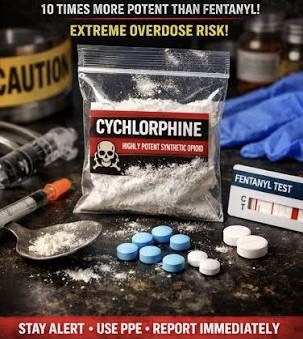
ATLANTA, Georgia — A powerful synthetic opioid known as cychlorphine is raising alarms among law-enforcement and public-health officials as the substance continues to appear in the illicit U.S. drug supply.
The drug, formally known as N-propionitrile chlorphine, has been described by authorities and toxicology experts as being up to 10 times more potent than fentanyl. Officials warn that its presence in counterfeit pills and other illicit substances creates an especially dangerous situation because people who consume a contaminated product may have no idea that cychlorphine is present. (https://www.atlantanewsfirst.com)
Atlanta Officials Sound the Alarm
The warning comes as authorities across the Southeast monitor the spread of the emerging opioid.
Atlanta’s Drug Enforcement Administration field office has warned about cychlorphine after the substance was detected in multiple states. While officials said there had not yet been a confirmed cychlorphine case in Georgia at the time of their April warning, they were closely watching developments in neighboring states.
DEA officials described the emergence of another extremely potent synthetic opioid as a major public-safety concern. (https://www.atlantanewsfirst.com)
The concern is not limited to Atlanta. Cychlorphine has already been identified in states across the country, with toxicology laboratories reporting cases involving the substance in multiple regions of the United States. The White House Office of National Drug Control Policy previously warned that cychlorphine had been associated with at least 55 deaths and had the potential to spread nationwide. (Organization of American States)
Hidden Inside Counterfeit Pills
One of the most dangerous characteristics of cychlorphine is that consumers may not know they are taking it.
Investigators have found the substance mixed with other illicit drugs, including fentanyl and stimulants. It has also been detected in counterfeit pills designed to resemble legitimate prescription medications. (CFSRE)
Authorities have warned that counterfeit tablets can look nearly identical to legitimate medications while containing entirely different—and potentially lethal—ingredients.
That means the appearance of a pill provides no reliable indication of what is actually inside it.
A Growing National Threat
The emergence of cychlorphine is part of a broader evolution in the illicit synthetic-opioid market, where new compounds can appear rapidly and complicate efforts by law enforcement, medical professionals and toxicology laboratories to identify them.
The Center for Forensic Science Research and Education reported that cychlorphine was identified in 25 blood specimens from fatal overdoses, with the majority of those samples submitted in late 2025 and early 2026. The specimens originated from eight U.S. states and three Canadian provinces. In 11 of those cases, cychlorphine was the only opioid identified. (CFSRE)
Officials have also reported the substance alongside fentanyl, oxycodone, methamphetamine, cocaine and other novel psychoactive substances.
Why Cychlorphine Is Particularly Dangerous
Cychlorphine’s extreme potency creates a narrow margin between a potentially intoxicating amount and a life-threatening exposure.
According to federal drug-threat information, an overdose involving cychlorphine may require multiple doses of naloxone, the opioid-overdose reversal medication commonly known by the brand name Narcan. (Organization of American States)
Another concern is that standard fentanyl test strips may not reliably identify cychlorphine. A recent medical toxicology review notes that the compound’s molecular structure differs substantially from fentanyl and that it is not expected to be detected by fentanyl or nitazene test strips. (ACMT)
This makes accidental exposure particularly concerning.
The Counterfeit-Pill Problem
For years, authorities have warned Americans about counterfeit pills made to resemble medications such as oxycodone, hydrocodone or other prescription drugs.
Cychlorphine adds another layer of uncertainty.
Recent reports from North Louisiana, for example, found the substance appearing in street pills that visually resembled commonly prescribed opioid medications. Investigators emphasized that a person cannot determine the chemical contents of such a pill simply by looking at it. (https://www.ksla.com)
For someone who believes they are taking a familiar medication, the presence of an extremely potent synthetic opioid can turn an ordinary-looking tablet into a potentially fatal dose.
Officials: Don’t Gamble With an Unknown Pill
The message from authorities is straightforward: people should not assume that an illicit pill is safe because it looks familiar or because someone they know has taken the same pill without apparent consequences.
DEA officials have urged the public to obtain prescription medications only through legitimate medical providers and licensed pharmacies.
In Atlanta, DEA Special Agent in Charge Jae Chung warned that obtaining pills outside the legitimate medical and pharmacy system can amount to an extraordinarily dangerous gamble. (https://www.atlantanewsfirst.com)
What to Do in an Opioid Emergency
If someone is suspected of experiencing an opioid overdose, emergency medical assistance should be sought immediately.
Warning signs can include extreme sleepiness or unconsciousness, slow or stopped breathing, inability to respond, choking or gurgling sounds, and other signs of severe respiratory depression.
Naloxone should be administered when available, and additional doses may be necessary with highly potent opioids. Medical professionals emphasize that naloxone does not replace emergency medical care.
The public should also understand that a person experiencing an overdose may have taken multiple substances. Other drugs, including sedatives, can complicate an overdose and may not be reversed by naloxone. (PubMed Central (PMC))
A Warning That Extends Beyond Atlanta
Although Atlanta officials have been monitoring the potential arrival of cychlorphine, the broader evidence shows that this is no longer simply a regional concern.
The substance has been identified in multiple states and has been associated with fatal overdoses across the country. Federal officials say the drug has appeared both by itself and mixed with other substances. (Constant Contact)
As authorities continue tracking the drug, the central warning remains the same: a counterfeit pill can contain a substance that the person taking it never expected—and cychlorphine may be among the most dangerous possibilities yet identified.
For communities across the United States, the emergence of cychlorphine represents another reminder of how rapidly the illicit drug supply is changing and how difficult it can be for consumers to know what they are actually ingesting.
Pan African News — Key Facts
- Drug: Cychlorphine (N-propionitrile chlorphine)
- Drug class: Synthetic opioid
- Reported potency: Up to 10 times that of fentanyl
- Primary concern: Hidden in counterfeit pills and other illicit drugs
- Reported combinations: Fentanyl, oxycodone, methamphetamine, cocaine and other substances
- Confirmed fatal-overdose specimens: 25 reported by CFSRE, with additional cases identified by other toxicology laboratories
- Geographic spread: Multiple U.S. states and Canadian provinces
- Overdose reversal: Naloxone may be effective, but multiple doses may be required
- Public warning: Never assume an illicit or counterfeit pill is what it appears to be
Leave a Reply