
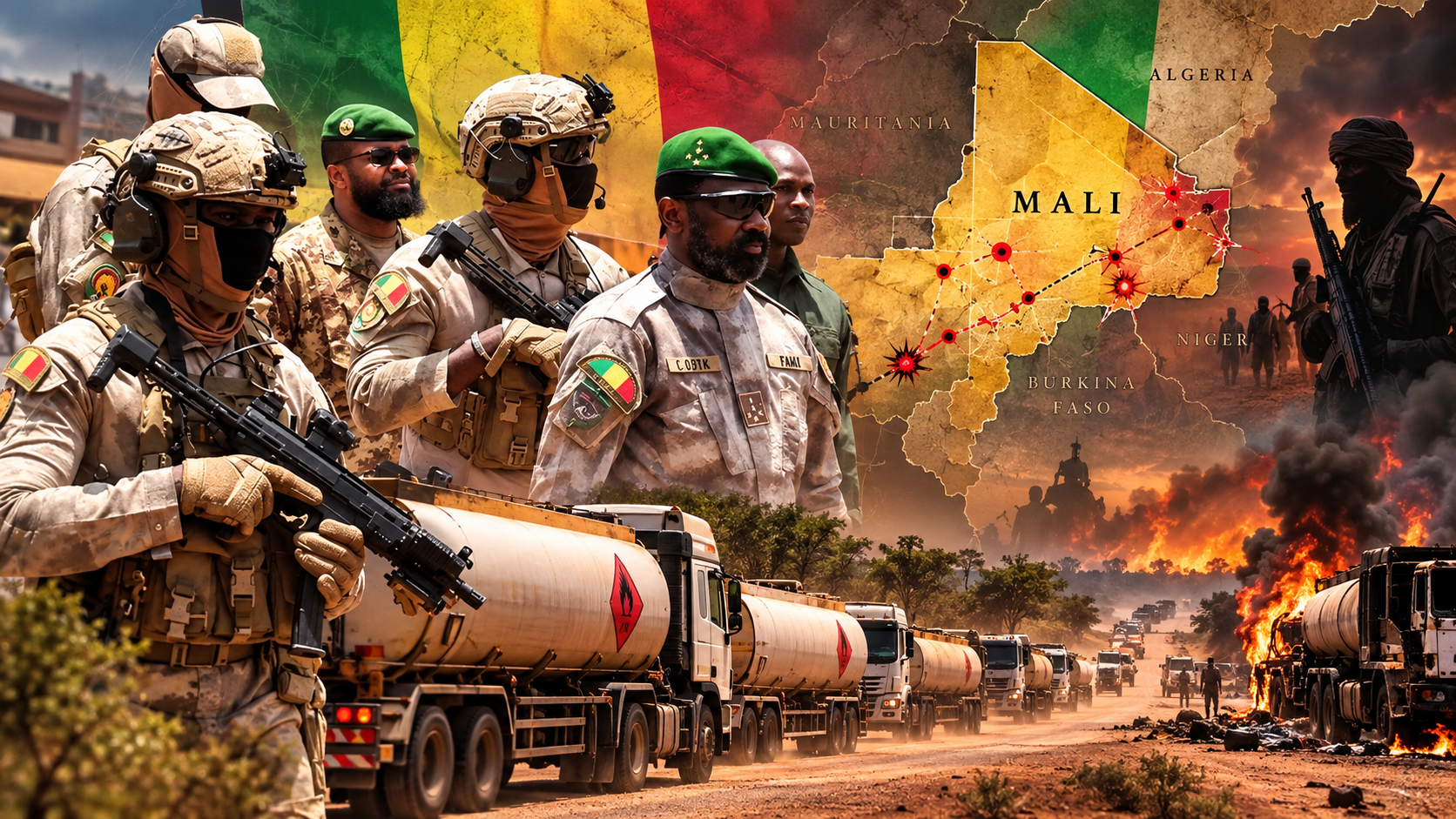
BAMAKO, Mali — September 24, 2026 — Russia’s Africa Corps has asked Mali’s government for an increase in its fuel allocation as Russian and Malian forces face renewed pressure from jihadist groups across the country.
The request comes at a particularly difficult moment for Mali. Al-Qaeda-linked Jama’at Nusrat al-Islam wal-Muslimin (JNIM) has intensified attacks on military positions and, increasingly, on the fuel routes that keep the landlocked country’s economy operating.
The Africa Corps, which operates under Russia’s Defence Ministry and replaced the Wagner Group’s formal role in Mali in 2025, has become an important component of Bamako’s security partnership with Moscow. Its request for additional fuel highlights how the conflict is increasingly becoming a logistical battle as much as a conventional military confrontation.
Fuel Has Become a Strategic Resource
Mali depends heavily on road transport to bring petroleum products into the country from neighboring coastal states. That vulnerability has allowed JNIM to target the supply network rather than concentrating exclusively on military bases.
In September, JNIM attacked fuel-tanker convoys travelling under military protection. Janes reported attacks on September 13–14 involving convoys travelling through western Mali, with numerous tankers reportedly set on fire. The attacks followed earlier assaults on fuel shipments coming from Côte d’Ivoire.
The Malian government subsequently announced that more than 900 fuel tankers entered Bamako under military escort on September 14, describing the operation as an effort to protect critical economic corridors and stabilize petroleum supplies.
The significance of those convoys extends beyond keeping vehicles moving. Fuel is required for military operations, electricity generation, commercial transportation, agriculture and the distribution of essential goods.
JNIM Expands Pressure on the State
The fuel crisis is unfolding alongside a broader deterioration in Mali’s security environment.
On September 10, JNIM attacked a Malian army camp in Dioura in central Mali. Reuters reported that more than 100 Malian soldiers were killed according to sources familiar with the incident, while AP reported that JNIM claimed substantially higher numbers that could not be independently verified. The Malian military acknowledged losses and said it subsequently launched operations against the attackers.
JNIM has also claimed attacks around Sevare and Konna, demonstrating the group’s ability to place pressure on multiple strategic locations simultaneously. Russian personnel supporting Malian forces have also reportedly suffered casualties during the recent fighting.
The result is a security environment in which Bamako must protect not only military installations but also the roads, fuel convoys and commercial infrastructure connecting the capital with neighboring countries.
Russia’s Growing Logistical Responsibility

The fuel request also illustrates the changing nature of Russia’s involvement in Mali.
Wagner forces were originally deployed to support Mali’s military government after Bamako broke increasingly with France and other Western security partners. Wagner announced its departure from Mali in June 2025, after which Russia’s Africa Corps assumed the formal role of Moscow’s military-security organization in the country.
Unlike Wagner, Africa Corps operates under direct Russian state control. That means logistical requirements—including fuel, transportation and military supply—are increasingly connected to an overt Russian state-backed deployment rather than a formally independent private military organization.
The distinction is significant because Russia’s military presence is now more directly associated with the performance and sustainability of Mali’s security partnership with Moscow.
A Battle Over the Roads
For Mali, the fuel issue has become part of a larger struggle over control of transportation corridors.
JNIM’s campaign against fuel shipments demonstrates how an armed group can put pressure on a government without occupying the capital itself. By attacking roads and commercial convoys, militants can increase transportation costs, disrupt fuel availability and force the government to divert soldiers toward convoy protection.
That creates a difficult allocation problem for Bamako: troops assigned to protect fuel shipments are troops that cannot simultaneously reinforce vulnerable military bases or conduct offensive operations.
The September convoy operation involving more than 900 tankers demonstrates the scale of the logistical challenge facing the government.
Regional Implications
The crisis also extends beyond Mali’s borders.
Mali relies on transportation corridors connected to Senegal, Côte d’Ivoire, Guinea and other neighboring countries. Ghana has also become part of the regional fuel equation. Reuters reported this month that Ghana’s state-owned BOST reduced fuel exports to Mali and Burkina Faso while prioritizing domestic supply amid international energy-market pressures.
That means insecurity inside Mali is intersecting with regional energy logistics, border security and international fuel markets.
For the Africa Corps, additional fuel would provide greater operational capacity. For the Malian government, however, increasing military allocations comes while civilian demand for fuel remains high and supply routes continue to face attacks.
The Bigger Question
The latest request from Africa Corps comes as Mali confronts a security challenge that is becoming increasingly interconnected: jihadist attacks, disrupted transportation routes, fuel shortages and the growing cost of maintaining military operations.
The September attacks demonstrate that controlling territory is only part of the conflict. Control over roads, fuel and supply chains has become equally important.
As Bamako seeks to maintain access to essential supplies, Russia’s Africa Corps is being drawn deeper into the logistical infrastructure required to sustain Mali’s counterinsurgency campaign.
For Mali, the immediate challenge is therefore not simply how to fight armed groups, but how to keep the country’s economic and military supply network functioning while those groups increasingly target the arteries that connect the capital to the outside world.

Leave a Reply