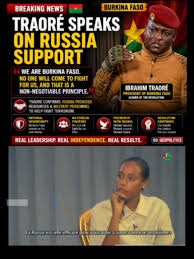
In a recent Sky News interview that has sparked widespread debate across the African continent and beyond, a journalist asserted that nearly 60% of Burkina Faso is under jihadist control. The claim, presented with confidence, reflects a broader pattern in international media coverage of African nations—one that often emphasizes instability while overlooking internal efforts at reform, resilience, and sovereignty.
What stood out in response, however, was not just the claim itself, but the growing contrast between such narratives and the posture of Burkina Faso’s transitional leadership under Captain Ibrahim Traoré.
Traoré, one of the youngest heads of state in the world, has increasingly positioned himself as a symbol of a new wave of African leadership—one that speaks not only with conviction but backs its rhetoric with visible action. From rejecting foreign military dependency to prioritizing domestic resource control and regional cooperation, his approach has resonated with a generation of Africans seeking a break from the status quo.
This moment raises a deeper question: how many African leaders today project this level of confidence, clarity, and accountability when addressing both domestic and international audiences?
Across the continent, frustration continues to grow over leadership models that appear more aligned with external interests than with the aspirations of their own populations. For many observers, the issue is no longer just about governance failures, but about ideological direction. Leadership that lacks a Pan-African vision—rooted in sovereignty, unity, and self-determination—is increasingly viewed as inadequate in the face of Africa’s complex challenges.
The reaction to the Sky News interview reflects this shift in public sentiment. Many Africans are no longer passive consumers of global narratives about their countries. Instead, they are interrogating these narratives, demanding context, and comparing them against realities on the ground. In Burkina Faso’s case, while security challenges are undeniable, there is also a parallel story of mobilization, reform, and a leadership attempting to redefine its national trajectory.
This duality—between external portrayal and internal transformation—is precisely why the call for Pan-African leadership is gaining momentum.
Pan-Africanism, in its modern sense, is not merely an ideological relic of the independence era. It is increasingly being reframed as a practical framework for governance. It demands leaders who prioritize African solutions to African problems, strengthen regional alliances, and resist exploitative external dependencies.
Traoré’s leadership, whether one agrees with all its methods or not, has become a focal point in this conversation because it challenges long-standing norms. It raises uncomfortable but necessary questions: What does true accountability look like? Who benefits from Africa’s current political and economic arrangements? And what kind of leadership is required to shift that balance?
For many young Africans, the answer is becoming clearer. They are not just looking for leaders who speak well, but for those who demonstrate tangible results—leaders who align words with action, and rhetoric with measurable change.
The broader implication is a growing demand across the continent: for leadership that is transparent, responsible, and unapologetically African in its priorities.
As this conversation continues to evolve, one thing is certain—Africa’s political future will increasingly be shaped not just by those in power, but by a population that is more informed, more connected, and more willing to question both local governance and international narratives.
The era of passive acceptance is fading. In its place is a rising expectation: that African leadership must not only respond to criticism but redefine the terms of engagement entirely.
Sources
Leave a Reply