
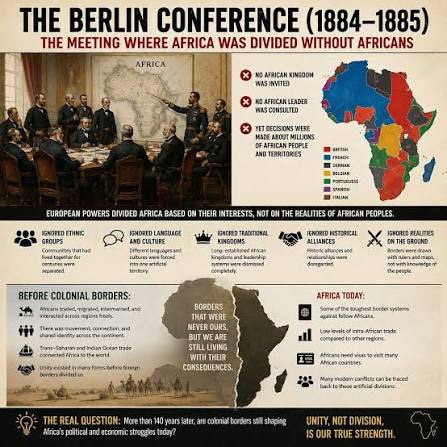
ACCRA — The political map of Africa that exists today is the product of a turbulent history of European colonial expansion, territorial competition and negotiations that took place largely without African representation. For Pan-African advocate and Zimbabwean diplomat Dr. Arikana Chihombori-Quao, the legacy of that process remains one of the continent’s most consequential challenges.
Chihombori-Quao has argued that the 1884–1885 Berlin Conference played an important role in transforming Africa’s political landscape, contributing to the fragmentation of territories and political communities that existed before European colonial rule.
The conference, convened in Berlin under German Chancellor Otto von Bismarck, brought together European powers and other states to establish rules governing European activity and territorial claims in Africa. No African government was represented as an equal participant in the negotiations.
While the conference itself did not simply draw every modern African border on a single map, its agreements helped establish the framework for the subsequent European partition and colonization of much of the continent.
A Continent Divided
Before European colonial domination, Africa was home to numerous kingdoms, empires, city-states, federations and decentralized political societies. Political authority varied enormously from one region to another, with territories and relationships changing over time through trade, migration, warfare, diplomacy and cultural exchange.
Among the major political formations were the Asante Empire, Sokoto Caliphate, Ethiopian Empire, Buganda Kingdom, Bornu Empire, Oyo Empire, Kongo Kingdom and numerous other states and societies.
The colonial process increasingly imposed European territorial boundaries over these existing political landscapes.
Chihombori-Quao’s criticism centers on the consequences of this transformation. In her view, European governments approached the continent primarily through their own strategic and economic interests, rather than through the political realities and aspirations of African societies.
The resulting borders frequently divided communities that shared languages, cultures, histories and economic networks while placing different communities within the same colonial territories.
The Berlin Conference and the “Scramble for Africa”
The Berlin Conference was held between November 1884 and February 1885. Its central purpose was not a detailed drawing of all of Africa’s borders, but rather the establishment of rules concerning European claims, trade and territorial occupation.
The principle of “effective occupation” became particularly important. European powers increasingly sought to demonstrate actual control over territories they claimed, accelerating the military and administrative occupation of African lands.
Britain, France, Germany, Belgium, Portugal, Italy and other European powers subsequently expanded their control across large portions of the continent.
Over the following decades, treaties between European governments and negotiations among colonial powers helped establish many of the boundaries that would later become the borders of independent African states.
For critics such as Chihombori-Quao, the significance of this history lies not only in the loss of sovereignty but also in the political fragmentation that followed.
Borders That Outlived Colonialism
When African countries began achieving independence in the 20th century, newly independent governments faced a difficult question: Should colonial boundaries be dismantled or preserved?
African leaders ultimately chose, in large measure, to maintain existing borders in order to avoid potentially catastrophic territorial conflicts.
The principle became associated with the Organization of African Unity and the broader commitment to respecting the territorial integrity of newly independent states.
This decision provided a degree of stability, but it also meant that many colonial-era boundaries remained in place.
Communities divided by those boundaries often became citizens of different countries, while states inherited economic systems and transportation networks designed primarily to serve colonial extraction.
Railways, roads and ports had frequently been constructed to move minerals, agricultural products and other resources from the interior toward coastal export points rather than to promote integrated continental commerce.
The Economic Dimension
Chihombori-Quao’s broader argument connects political fragmentation with Africa’s struggle for economic sovereignty.
The continent possesses enormous deposits of gold, diamonds, oil, natural gas, uranium, copper, cobalt, lithium, iron ore and other strategic resources. Yet many African economies continue to export raw materials while importing finished products.
From a Pan-African perspective, fragmented national markets can make it more difficult for African countries to negotiate collectively, develop continent-wide industries and build integrated supply chains.
The creation of the African Continental Free Trade Area (AfCFTA) represents one attempt to address this challenge by increasing trade among African countries and creating a larger continental market.
For advocates of greater African integration, the objective is not necessarily to erase national identities or existing states, but to reduce the economic barriers that prevent African economies from operating as a more integrated system.
The Question of African Unity
The debate over colonial borders therefore extends beyond historical scholarship. It remains connected to contemporary discussions about African unity, sovereignty and economic development.
Chihombori-Quao’s argument reflects a long-standing Pan-African position: that Africa’s political and economic future cannot be separated from an understanding of how colonial rule reorganized the continent.
At the same time, historians point out that Africa’s political geography was already complex before European colonization. Kingdoms expanded and contracted, populations migrated, alliances changed and political boundaries shifted. The European partition was therefore imposed upon an already diverse and evolving political landscape rather than replacing a single unified African political system.
The central historical issue is consequently not whether Africa had fixed borders before colonialism. It is how European colonial powers transformed existing political relationships and then institutionalized territorial boundaries that continued after independence.
A Legacy Still Being Debated
More than 140 years after the Berlin Conference, the map created during the colonial era remains one of the defining features of African international relations.
The borders of today’s African states determine citizenship, political authority, taxation, trade policy and access to natural resources. They also influence regional security, migration and diplomatic relations.
For Chihombori-Quao and other Pan-African thinkers, understanding this history is essential to imagining alternatives for the future.
The argument is ultimately larger than the Berlin Conference itself. It concerns whether Africa can overcome the political and economic divisions inherited from colonial rule while preserving the sovereignty and identities of its modern nations.
Africa’s contemporary borders may appear permanent on today’s maps, but the historical circumstances that produced them continue to shape debates over continental integration.
The challenge for the next generation of African leaders may therefore be less about redrawing borders and more about building bridges across them — through trade, infrastructure, political cooperation, cultural exchange and economic integration.
The map of Africa may have been shaped by colonialism, but the future of African cooperation remains a matter for Africans to determine.
Leave a Reply