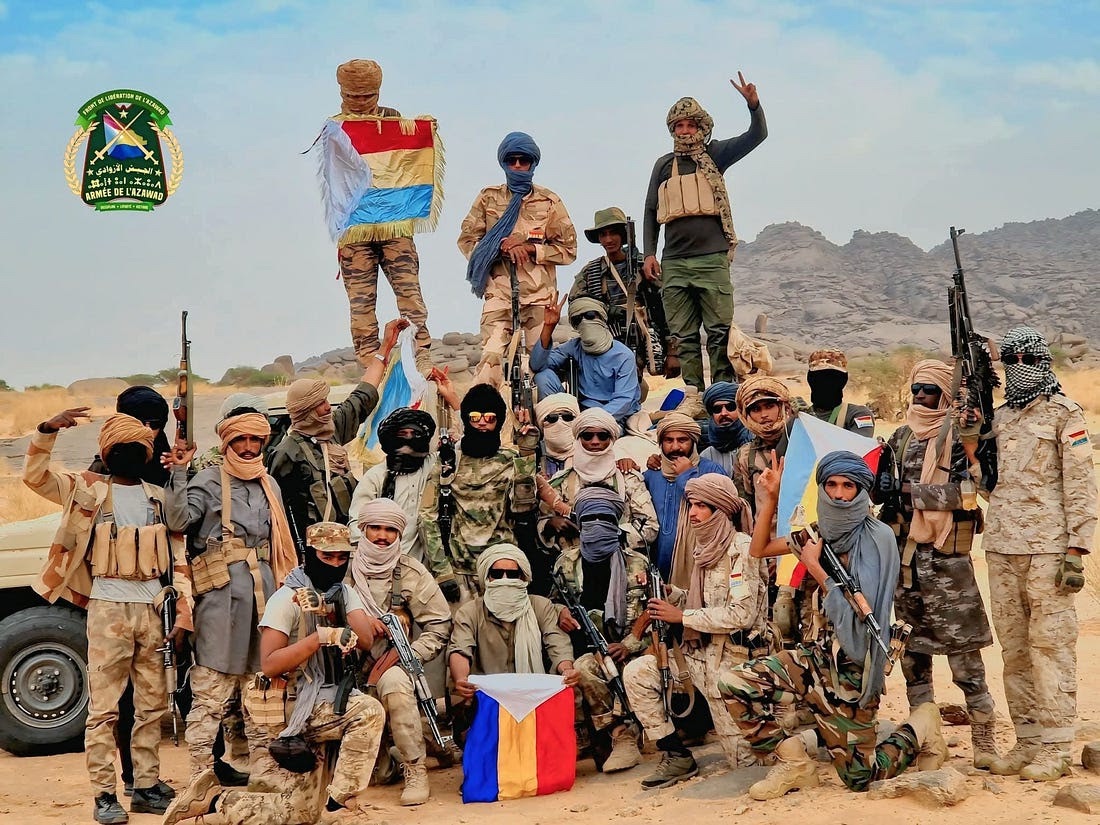
The coordinated attacks carried out across Mali on April 25 may mark one of the most significant turning points in the country’s conflict since the collapse of the 2015 Algiers Peace Agreement and arguably since the battle of Tin Zaouatine in July 2024, where Russian mercenary group Wagner suffered one of its deadliest setbacks in the Sahel. Yet beyond the military implications, the attacks exposed something that for years was denied, downplayed, or deliberately kept ambiguous: the Northern Malian separatist military group Azawad Liberation Front (FLA) and Jama’at Nusrat al-Islam wal-Muslimin (JNIM), al-Qaeda’s branch in the Sahel, are increasingly operating on the same side of the battlefield.
For years, the northern rebel factions that make up FLA attempted to maintain at least a degree of political distance from JNIM. They operated in a deliberate grey zone where tactical coexistence with jihadi actors was widely suspected, but where political separation could still be publicly maintained. While local arrangements, battlefield coordination, and non-aggression agreements were often reported, the rebels consistently attempted to preserve an image of themselves as nationalist actors with political ambitions and agenda distinct from JNIM’s ideological jihadi agenda. However, the events of April 2026 severely damaged that distinction.
The attacks, reportedly conducted across six locations in Mali, demonstrated a level of operational coordination between JNIM and the FLA that goes far beyond temporary battlefield convenience. The offensive can also be considered one of FLA’s most symbolic victories since its rebranding, culminating in the recapture of the town of Kidal, located in the northern region of Mali.
A few days after the attack, the Russian Africa Corps confirmed its withdrawal from Kidal alongside Malian troops. Shortly afterwards, the FLA declared the city “free” and announced its control over Kidal, alongside claims that more than 200 soldiers from the Forces Armées Maliennes or the Mali state military, including senior officers and non-commissioned officers, had been captured.
The FLA’s military victory may become its political defeat
However, while coordination with JNIM gave the FLA operational advantages, particularly by expanding attacks beyond its traditional northern strongholds toward central Mali and areas linked to the Malian military establishment, such as Kati, the alliance may prove politically disastrous for the movement in the long term.
The FLA’s long-standing challenge has always been legitimacy. Unlike JNIM, which openly embraces jihadi militancy, the FLA attempted to position itself as a political and military alternative for northern Mali, capable of eventually attracting some degree of international engagement around a quasi-political project rooted in autonomy, marginalization, and ethnic grievances. However, the latest cooperation with JNIM places that political project under serious strain.

By openly aligning on the battlefield with JNIM, the FLA risks increasingly being viewed internationally not as a nationalist insurgent movement with legitimate demands, but as another component within a broader al-Qaeda-aligned insurgent ecosystem in the central Sahel.
This shift comes at a particularly critical moment because there had been growing debate among analysts over whether JNIM itself could gradually evolve into a more politically pragmatic actor, drawing comparisons with Hay’at Tahrir al-Sham (HTS) in Syria.
The comparison was never baseless. Over the years, HTS gradually rebranded itself from a direct al-Qaeda affiliate into a more locally focused Islamist group, distancing itself publicly from transnational jihadi rhetoric, consolidating governance structures, and ultimately positioning itself as the dominant governing actor in Syria following the collapse of the Assad regime in Damascus.
JNIM has displayed some limited similar changes. The group has increasingly focused on local grievances, tribal mediation, dispute resolution, and forms of shadow governance. In several areas across Mali and Burkina Faso, JNIM has attempted to present itself less as a foreign ideological movement and more as a local actor in charge of resolving conflicts and governance.
However, JNIM has not yet taken the political steps necessary to transform itself into a genuinely pragmatic political actor. Unlike HTS, it has not seriously distanced itself from al-Qaeda central, nor has it attempted meaningful engagement with emerging civilian political movements inside Mali.
This is particularly important given the growing influence of Imam Mahmoud Dicko, one of Mali’s most influential religious and political figures. Dicko has increasingly positioned himself as a civilian alternative to the ruling junta, capable of mobilizing broad anti-government sentiment through religious networks and popular frustration over insecurity and economic decline. Figures surrounding his movement, including political allies and civil society actors, such as Etienne Fakaba Sissoko, have contributed to shaping an emerging opposition that criticizes both military rule and state failure.
AQAP’s message destroyed the illusion of distance
To make matters worse for both JNIM and the FLA’s political narratives, Al-Qaeda in the Arabian Peninsula (AQAP) reportedly congratulated JNIM and the “tribes” following the offensive, effectively framing the events as a victory for the broader al-Qaeda network.
Leave a Reply