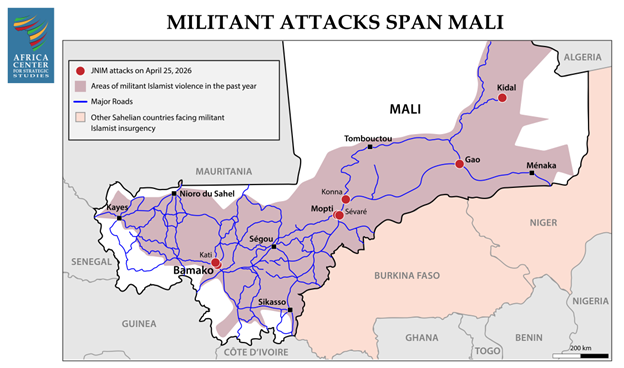
A recent wave of coordinated armed attacks across Mali, including incidents reported near the capital Bamako, has intensified concerns about the country’s deteriorating security landscape and the broader instability spreading across the Sahel region.
Despite years of international military interventions, regional security partnerships, and counterterrorism operations, armed violence continues to expand into new areas, raising urgent questions about the effectiveness of current strategies and the long-term stability of West Africa’s central Sahel corridor.
Renewed Violence Near the Capital
The latest attacks, attributed by local authorities to coordinated armed groups operating in multiple zones simultaneously, highlight a troubling trend: the increasing ability of militant networks to operate closer to major population centers.
While rural northern and central regions of Mali have long experienced instability, recent incidents near Bamako mark a significant escalation. Security analysts warn that such proximity to the capital signals both operational growth and strategic intent by armed groups seeking to undermine state authority and public confidence.
For residents, the psychological impact is as severe as the physical threat. Markets, transport routes, and daily economic activities are increasingly shaped by insecurity, checkpoints, and unpredictable disruptions.
A Crisis Spreading Across the Sahel

Mali’s situation cannot be understood in isolation. It is part of a wider regional crisis affecting the broader Sahel belt, including Burkina Faso and Niger, where armed insurgent groups have expanded their reach over the past decade.
The Sahel has become one of the world’s most complex security environments, characterized by overlapping threats including:
- Islamist insurgencies
- Ethnic militia conflicts
- Weak state presence in rural areas
- Cross-border arms trafficking
- Climate-driven resource competition
These factors reinforce one another, creating conditions in which instability becomes difficult to contain within national borders.
International and Regional Interventions Under Pressure
Over the past decade, Mali has been at the center of multiple foreign military and peacekeeping initiatives, including United Nations missions and regional counterterrorism partnerships.
However, the persistence and spread of violence suggest that military interventions alone have not resolved the underlying drivers of conflict.
Security experts increasingly argue that while tactical gains may occur in certain regions, insurgent groups have adapted by dispersing into remote terrain, reorganizing across borders, and embedding themselves within local grievances.
This evolving pattern has placed significant pressure on both national governments and regional blocs such as the Economic Community of West African States (ECOWAS), which continues to grapple with political fragmentation and differing security strategies among member states.
Governance, Trust, and State Capacity
Beyond military concerns, Mali’s crisis reflects deeper governance challenges. Limited state presence in rural areas, contested authority, and political instability have all contributed to weakening public trust in national institutions.
In many communities, local governance structures and informal systems of authority have filled the vacuum left by the state, sometimes negotiating directly with armed groups to maintain fragile stability.
This dynamic complicates counterinsurgency efforts and raises difficult questions about how long-term peace can be achieved without broader political and economic reform.
Implications for the Wider Sahel Region
The implications of Mali’s worsening security situation extend far beyond its borders. The Sahel is increasingly viewed as an interconnected conflict zone where instability in one country can rapidly spill into neighboring states.
The recent escalation underscores several regional risks:
- Expansion of armed group influence across borders
- Increased displacement of civilian populations
- Disruption of regional trade corridors
- Rising humanitarian needs
- Greater geopolitical competition among external powers
As violence spreads, regional cooperation becomes both more urgent and more difficult to sustain.
A Critical Moment for Sahel Stability
The renewed attacks in Mali serve as a reminder that the Sahel remains at a critical crossroads. While multiple initiatives continue to seek solutions—ranging from military coordination to development programs—the persistence of violence near Bamako suggests that the conflict is evolving rather than stabilizing.
Observers warn that without a more comprehensive approach addressing governance, economic opportunity, and local legitimacy, the region may continue to face cycles of escalation.
“TalkAfrica” Focus on Mali’s Deepening Crisis
This week’s TalkAfrica discussion turns its attention to Mali’s escalating security situation and its broader implications for the Sahel. The program examines whether current strategies are sufficient—or whether a fundamental shift in approach is needed to address one of Africa’s most pressing security challenges.
Leave a Reply